The Architecture of Breath: Living Rooms as Breathing Walls
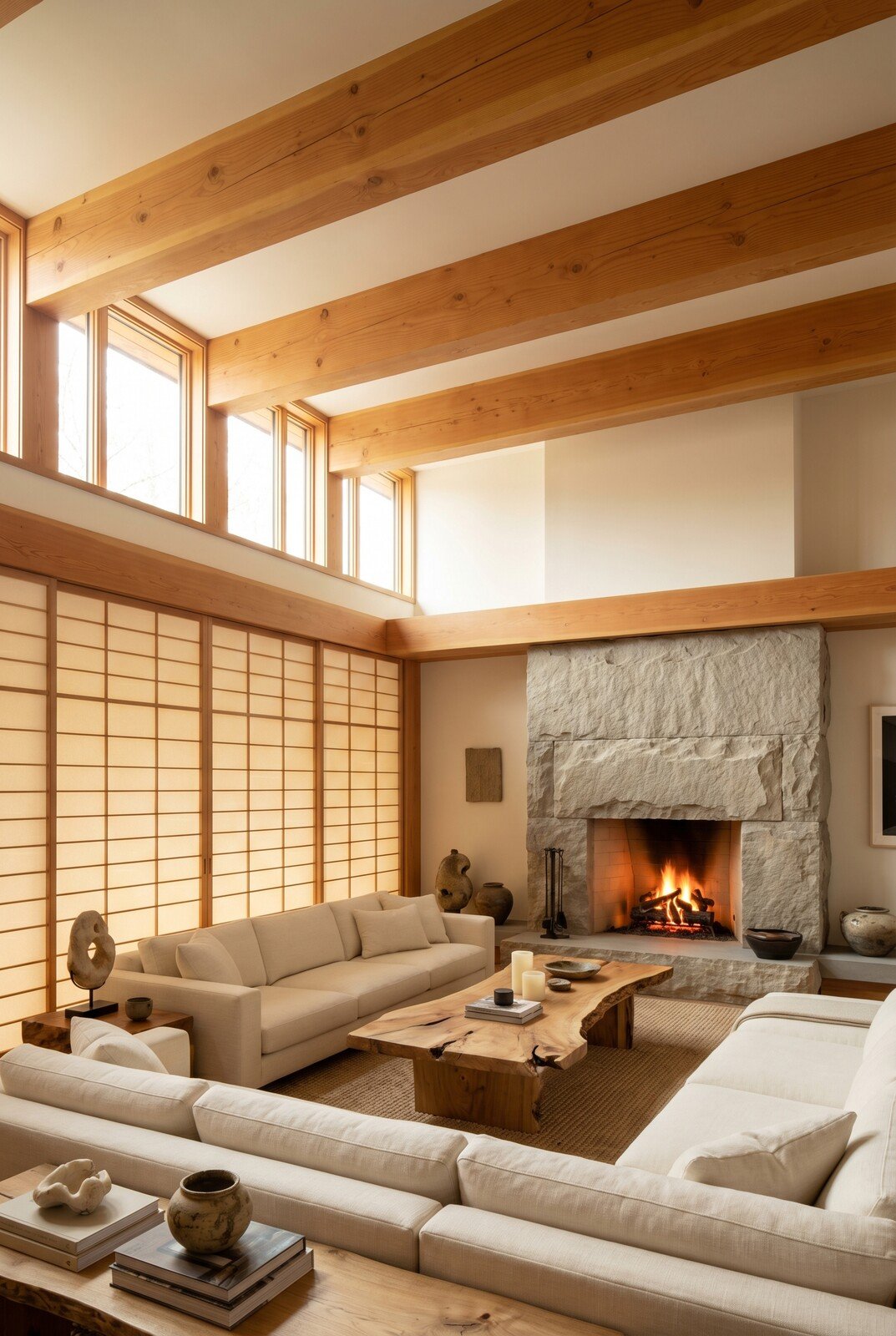
The Shōrin Villa sits above Kyoto’s eastern slopes like a whispered conversation between stone and sky. At 5,000 square feet, the great room does not announce itself—it exhales. Architect Kenji Takahara designed it as what the Japanese call the engawa: not merely a room, but a breathing edge where interior dissolves into exterior consciousness. The principle is ancient, yet the execution here required an intelligence that could understand both philosophy and mathematics simultaneously.
Eighteen feet of veined travertine rises behind the hearth, hand-selected from quarries outside Tivoli. But the stone is not static. Modish Global’s Cinematic Intelligence™ generated 192 distinct variations of backsplash illumination—what the design team calls “The Light Script.” Each variation responds to time of day, season, and the emotional geometry of the space. The travertine becomes a vertical surface of conversation: warm honey at dawn, electric silver at midday, deep amber at dusk. The stone is not backdrop; it is participant.
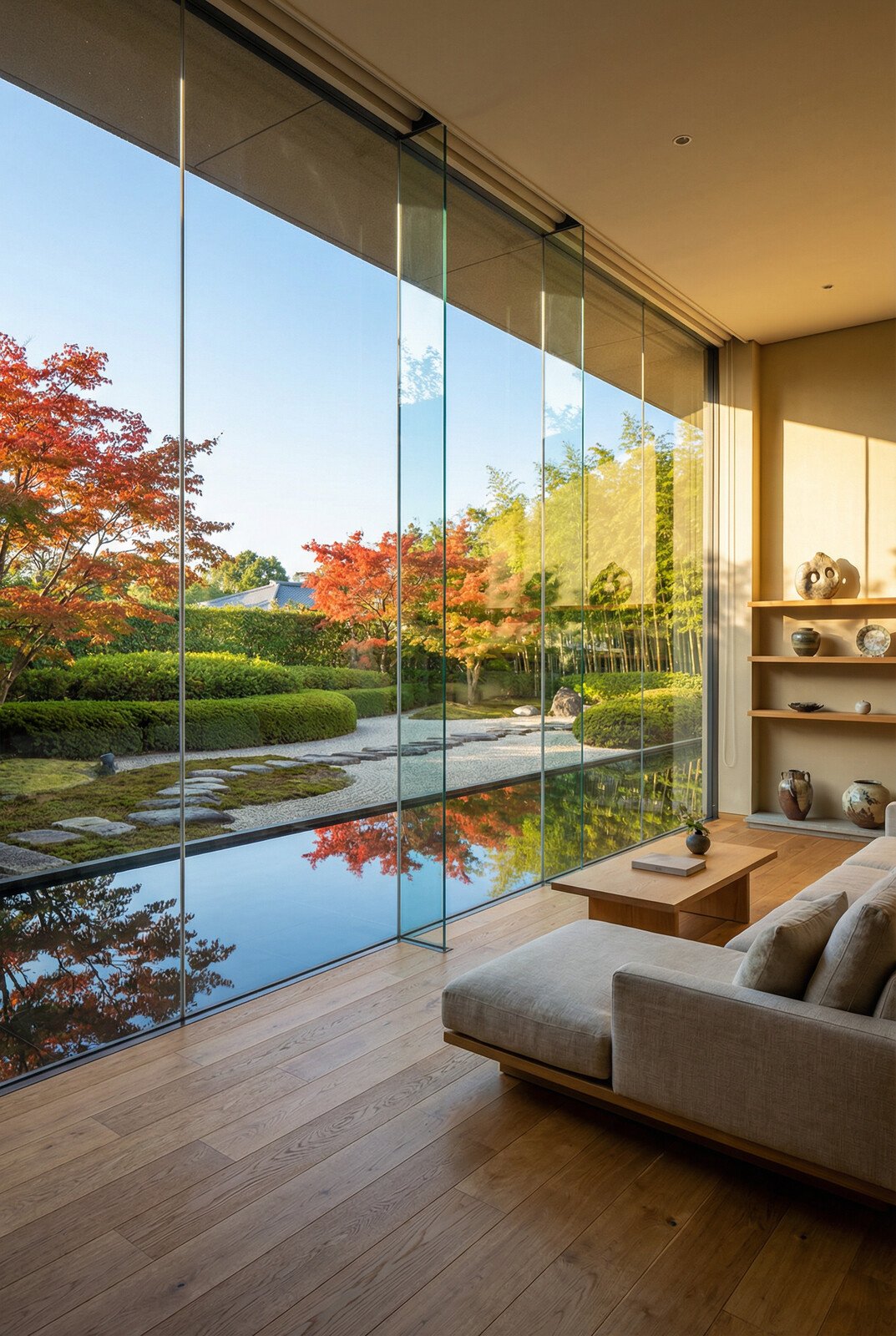
The dialogue extends outward. Beyond the room’s south-facing glass plane sits a reflecting pool with an onyx garden backsplash that rises organically from the water’s surface. The onyx was chosen for a reason that has nothing to do with luxury and everything to do with optics: the stone’s translucency allows light to penetrate and scatter, creating an architecture of refracted geometry. Where travertine speaks of warmth and human scale, onyx whispers of infinity.
The Proportional Language: Tatami Mathematics in Stone
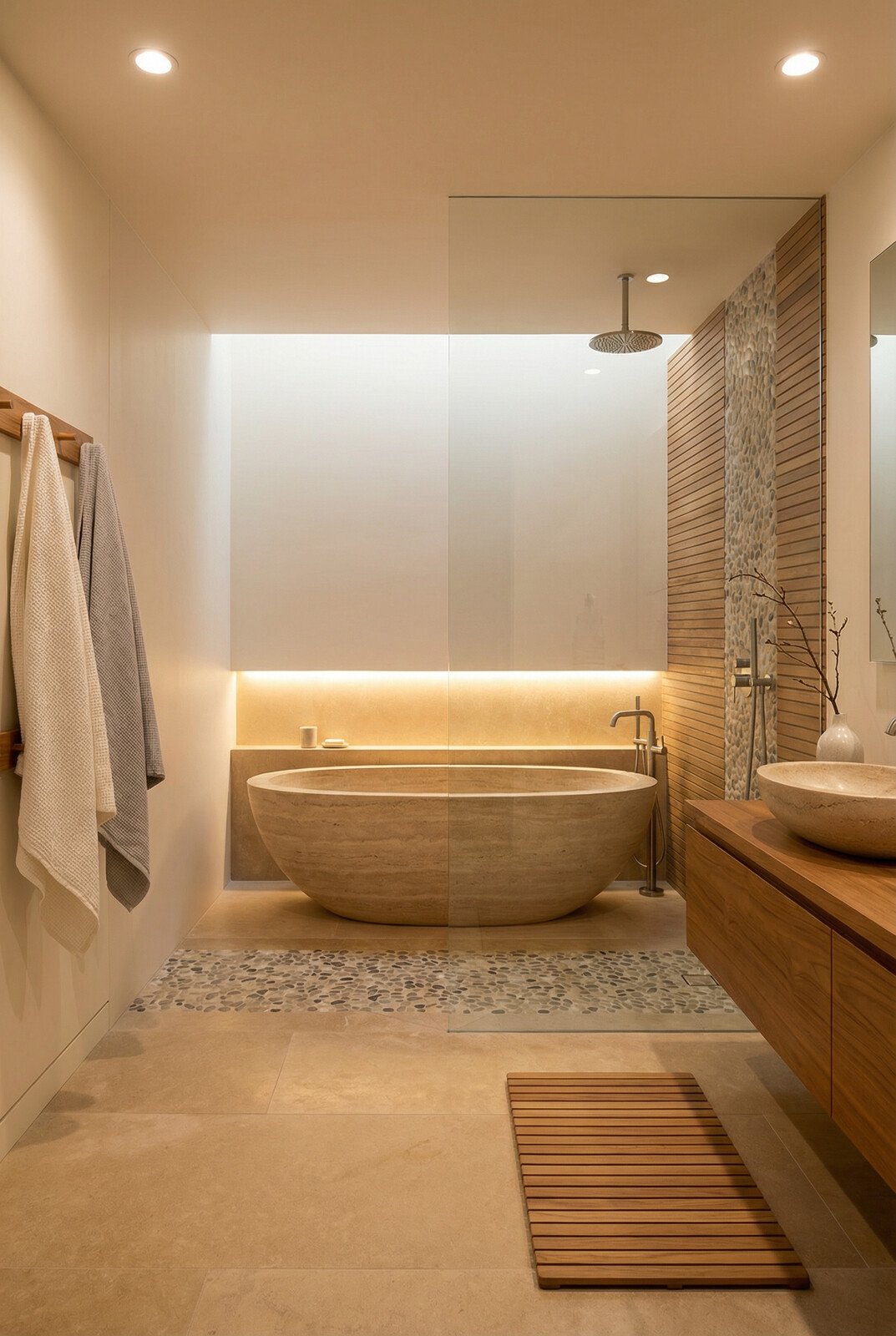
Japanese architectural tradition derives from the tatami—a rectangular mat with a 3:2 aspect ratio that has governed room proportions for centuries. Takahara and developer Akira Tsukamoto (Tsukamoto Real Estate) rebuilt the Villa’s emotional geometry around this ratio. The result is a space that feels inherently restful to the human eye, as though the room itself were breathing in rhythm with the viewer. This is not metaphor. The proportions are engineered to produce a specific emotional state—one of calm, centeredness, and an almost meditative sense of rightness.
The travertine backsplash echoes this proportion. Its veining pattern—seemingly organic, actually algorithmically analyzed through Cinematic Intelligence—distributes light and shadow in 3:2 intervals. This is not decoration. This is mathematics rendered as feeling. The veins of mineral deposit within the stone follow the same proportional logic as the room’s spatial arrangement. When light strikes the travertine at various angles throughout the day, the veining pattern creates a visual rhythm that the eye recognizes subconsciously as harmonious. The nervous system relaxes. The mind enters a state of receptivity.
A collector from London, visiting in early autumn, stood before the wall for forty minutes without speaking. Later, she commissioned a three-wall installation for her Belgravia townhouse using the same mathematical backsplash system. Her brief to Modish: “I want my home to breathe the way the Shōrin Villa does.” She understood that she was not purchasing a decorative object but a system—an entire architectural intelligence embedded within a single wall surface.
The work has spawned a new category of high-end commissions globally. Collectors from Singapore, Los Angeles, and Copenhagen have all requested backsplash variations tailored to their specific spatial geometries and light conditions. The pattern is consistent: they visit the Villa, they encounter the travertine, they sense something deeper than aesthetic pleasure. They perceive what Takahara calls “surface consciousness”—the idea that a wall, properly understood, is not a boundary but a threshold. It is the point where interior space meets the observer’s perception, where architecture enters consciousness itself.
What distinguishes the Shōrin backsplash from mere decorative surface is its responsiveness. The light does not simply illuminate the stone; the stone participates in the illumination. The veining creates shadow patterns that shift throughout the day. In winter, when the sun’s angle is low, the travertine glows amber. In summer, when light strikes the wall at different angles, the color shifts toward pale honey. A resident of the Villa described this effect as “watching the wall age and youthen through the seasons—the stone remains constant, but its appearance transforms, teaching the observer that change is the fundamental nature of all things.”
The Garden as Third Room
If the great room and its travertine hearth represent the Villa’s interior consciousness, the garden is its meditative extension. Landscape architect and artist Rei Nakamura designed the perimeter with dense bamboo screening—a living boundary that shifts from transparent to opaque depending on viewing angle and light condition. The bamboo was selected not for a single season’s appearance but for its capacity to transform across the calendar year. In spring, the new growth emerges pale and luminous. By summer, the screening reaches its deepest green. In autumn, the bamboo takes on subtle golden tones. In winter, the bare stems create a delicate tracery against snow and pale sky.
Stone lanterns punctuate the composition at intervals that follow the same 3:2 proportions governing the interior great room. This is not coincidental detail. The garden is not separate from the architecture of the interior. It is an extension of the same mathematical intelligence that governs the travertine backsplash. Walk through the garden, and you will find that the proportions your eye encounters are the same proportions your body instinctively recognizes as restful and harmonious. The entire property—interior and exterior—operates as a single unified field of proportional intelligence.
The crushed glass aggregate pool floor—a technical innovation that took two years to perfect—scatters light into the water column in ways that shift with sun angle and cloud cover. At dusk, swimmers immerse themselves in what appears to be liquid luminescence, their bodies surrounded by subtle glowing particles. The effect is not accidental theatrical spectacle; it is physics rendered as aesthetic experience. The crushed glass was sourced from recycled architectural salvage—old windows, mirrors, and light fixtures from demolished buildings across Kyoto. Each fragment carries traces of the city’s history. Nakamura’s concept was to allow the Villa’s residents to literally swim through the accumulated light of Kyoto’s past.
Every material choice in the garden echoes the interior’s dialogue of surfaces: stone speaks to water, water reflects sky, bamboo frames all three in an ever-shifting relationship. The garden is designed to be perceived from the great room’s south-facing glass plane, and also to be inhabited as an experiential space. The duality is intentional. The view of the garden from inside the Villa presents one aesthetic experience; the act of walking through the garden presents another. Both are necessary for the complete experience of what Takahara calls “the breathing architecture.”
The Philosophy of Luxury Redefined
The $110 million price tag includes not just construction but conceptual architecture of the highest order. For comparison, the average luxury residential property of equivalent square footage would cost $15-20 million. The Shōrin Villa costs five to seven times that amount because it is not primarily a room or a house. It is a lived philosophy. It is an entire architectural system designed to transform consciousness through the everyday experience of inhabiting space.
The Shōrin Villa represents a threshold moment: the point at which residential design ceases to be about rooms and becomes instead about consciousness itself. Every surface, every proportion, every variation in illumination has been considered not as luxury but as philosophy rendered in stone and light. A previous generation of wealth built estates to display status. The Shōrin Villa displays something subtler and more profound: the idea that a building can be designed to make you think differently, feel differently, and exist in a state of deeper harmony with your own sensory apparatus.
This represents a shift in how the ultra-wealthy conceive of architecture. A $500 million yacht contains within it perhaps $50 million in value; the rest is lifestyle theater. A $110 million house contains within it perhaps $20 million in raw material and construction cost; the rest is conceptual investment—in the intelligence embedded within the design, in the proportional systems, in the understanding of how light and material and geometry can transform human consciousness.
The garden closes at sunset. But the travertine backsplash continues its work through the night, holding the day’s accumulated warmth, releasing it slowly into darkness. This is what Takahara calls the “ethics of material”—the idea that every element, properly chosen and placed, enters into a covenant with those who inhabit the space. Stone is not inert. Travertine has absorbed light and heat across geological epochs. When you place your hand against the Shōrin Villa’s backsplash at midnight, you are touching warmth that the stone harvested from the Mediterranean sun months earlier. The wall is teaching you that time is not linear but cyclical, that energy persists, that nothing in architecture is truly static.
To enter the Shōrin Villa is to accept that covenant. To stand before its travertine hearth is to understand that architecture, at its highest expression, is the art of teaching stone to listen, teaching light to speak, teaching proportion to transform consciousness. This is what the $110 million investment has purchased: not rooms, but a complete architectural philosophy of how a human being can live in alignment with the fundamental principles of beauty, proportion, and truth.