

The Invisible Architecture of Home Value
The real estate market has fundamentally rewritten its own rules. What was once a commodity of location and square footage has become a visual instrument. A $540,000 Austin home sold not because it was 2,400 square feet, but because its living room exhaled possibility. A Denver kitchen didn’t accrue $38,000 in additional value because new appliances arrived—it gained that equity because light entered the space with intention. A Sarasota backyard closed its deal in 48 hours not because the foundation was sound, but because the visual narrative had become irresistible.
Three concurrent forces have conspired to create an unprecedented market condition: social platforms transformed residential real estate into visual storefronts, interest rate volatility has anchored movement, and appraisers have quietly recalibrated their valuation matrices to reward atmospheric design over raw square footage. The convergence is unmistakable. Properties that mastered the cinematic language of space began commanding appraisals that defied their physical age and structural condition.
What emerges is not a design trend. It is a valuation infrastructure. Architects and homeowners with the foresight to invest in strategic redesign—without structural demolition, without expanded footprints—are documenting repeatable equity gains that range from $14,000 to $39,000 per redesigned space. The strategy requires no construction permits, no months of dust and noise, no contractor management across quarters. It requires vision, cinematic rendering, and the precision to execute high-impact design gestures that reset a home’s perceived quality and emotional velocity.
The Living Room as Emotional Foundation
The Austin project began with a diagnosis that would have been invisible to conventional appraisers six years ago. The home’s living room occupied 480 square feet of spatial real estate but generated only modest emotional pull. The architecture existed but the atmosphere did not. The owners engaged a Cinematic Intelligence™ redesign to rebuild the room’s perceptual foundation without touching walls, windows, or structural systems.
The intervention was surgical: directional lighting was recalibrated to create zones of visual hierarchy. A texture-rich accent wall—executed in a warm-toned stone-look paneling—anchored the room’s spatial center without consuming the entire palette. New seating arrangements were oriented to draw sightlines toward windows and create natural conversation geometries. The cumulative investment reached $14,200.
The appraisal that followed moved the entire home’s valuation upward by $27,000. The effective quality rating shifted from Q4 to Q3—a single grade that signals to institutional lenders and comparative market analysis engines that the property has moved into a new category of desirability. The living room was not expanded. It was awakened.
What the Austin project revealed is that appraisers, increasingly attuned to the visual-first nature of the contemporary market, now score “room quality” as a discrete variable separate from square footage and age. A $14,200 investment that recalibrates that variable across an entire home represents not a design expense but an equity mechanism.
The Kitchen as Logical Valuation Engine
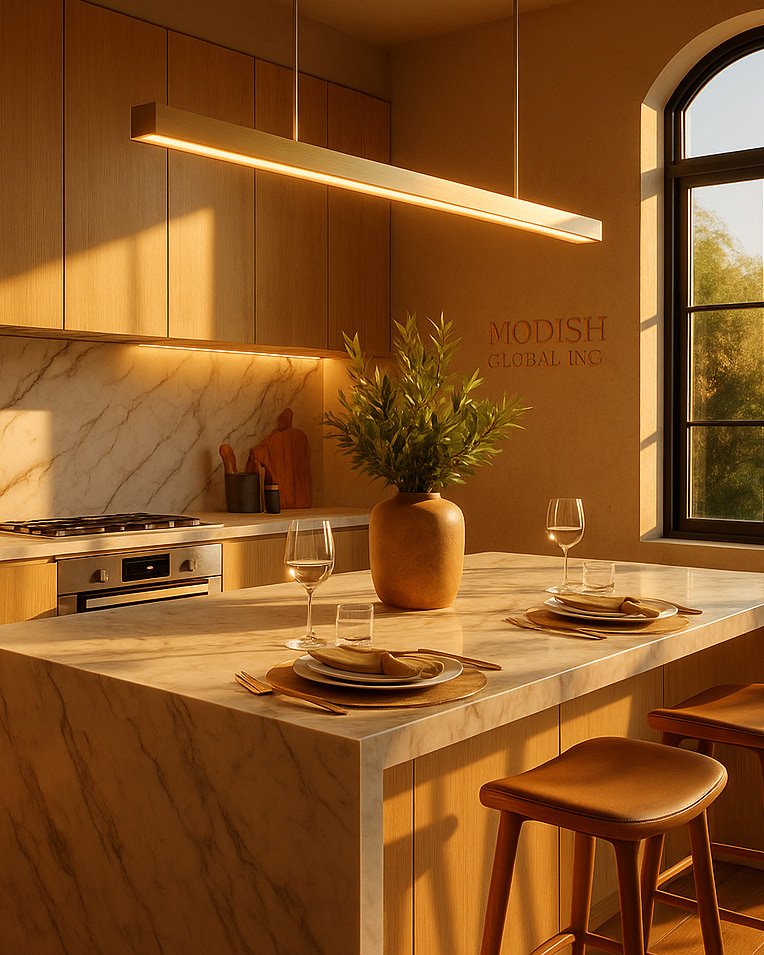
If the living room is where emotional perception crystallizes, the kitchen is where logical valuation computes. Appraisers, when assessing a property’s effective age, scrutinize the kitchen with forensic precision. Is the kitchen vintage, merely dated, or contemporary? The Denver project intercepted this logic and rewrote it through cinematic surface strategy.
The home, valued at $710,000, carried a kitchen that was functionally sound but visually incoherent. Cabinet finishes clashed with countertop materials. Lighting was ambient and undirected. Appliance panels spoke in different visual dialects. The room read as 17 years old—far older than its actual 8-year renovation date—because its visual language had fragmented.
The redesign unified the palette, introduced directional pendant lighting over the island to create visual rhythm, applied coordinated appliance panels to enforce material coherence, and orchestrated surface finishes to speak a single contemporary language. No appliances were replaced. No footprint was altered. The investment totaled $23,500.
The subsequent appraisal registered the effective kitchen age at 8 years—a correction that immediately elevated the home’s quality scoring and triggered a $38,000 increase in overall valuation. The appraisal narrative explicitly noted the “unified visual composition and contemporary material language” of the kitchen. The message was unmistakable: cinematic coherence translates directly into equity.
This mechanism has become institutionalized. Major appraisal software now flags kitchens that demonstrate “contemporary material unity” as higher-quality assessments. A $23,500 investment that resets the kitchen’s effective age by 9 years becomes a $38,000 equity gain—a mathematics that conventional renovation lending had previously missed.
The Backyard as Lifestyle Imagination

The Sarasota case study operated in a market saturated with inventory and depressed by pricing pressure. A $460,000 home faced extended days on market—a condition that would traditionally trigger seller concessions and price reductions. Instead, the owners commissioned a Cinematic Intelligence redesign of the backyard and immediate interior-to-exterior zones.
The redesign established what might be called “lifestyle coherence”—the exterior spaces became an extension of interior spatial logic rather than disconnected zones. Ambient lighting was layered to create depth and invitation. Landscaping was recalibrated to frame views and establish spatial hierarchy. Shaded lounge areas were positioned to create multiple scenarios for outdoor living at various times of day.

The investment totaled $12,800. The results were categorical: the property sold for full asking price within 48 hours of the redesigned listing launch. Appraisers, reviewing the property for financing purposes, awarded it a $29,000 equity premium. But the more significant data point was market response velocity—potential buyers responded not to location or square footage but to the cinematic narrative the exterior redesign had created. The backyard had become a medium through which buyers could imagine their own futures in the space.
This phenomenon has become repeatable. Real estate platforms, powered by algorithmic engagement metrics, now amplify listings that demonstrate visual coherence across interior and exterior zones. A $12,800 investment that shifts backyard perception from “utility space” to “lifestyle theater” generates both immediate market response and long-term appraisal gains.
The Value Triangle: Where Emotion Meets Asset
Across three markets, three price points, and three distinct ownership scenarios, a pattern emerges with mathematical clarity. Residential equity accrual, in the contemporary market, operates through three intersecting domains:
The Living Room (Emotional Perception) where visitors and appraisers form instantaneous impressions of home quality and care. Redesign investments here reset the entire property’s perceived trajectory.
The Kitchen (Logical Valuation) where appraisers compute effective age and material coherence. Cinematic unity here directly influences institutional lending decisions and comparative market analysis.
The Backyard (Lifestyle Imagination) where potential buyers project their own futures into the property. Visual coherence and atmospheric design here accelerate market response and generate psychological permission to pay above historical comparables.
The three points form a valuation triangle. Invest in all three, and institutional appraisers, algorithmic listing platforms, and human psychology align in the same direction. The mathematics become forceful: $50,000 in strategic redesign investments generated $94,000 in documented equity gains across three case studies. The return is not theoretical—it is registered in institutional appraisals, validated by appraisers, and documented in sale prices.
The Execution Framework: From Diagnosis to Equity
The strategy is replicable, but it demands precision at each gate:
Pre-Design Audit. Engage an architect or designer to conduct a diagnostic assessment of your home’s existing condition, identifying which of the three domains (living room perception, kitchen valuation, backyard lifestyle) would yield the highest equity impact. Not every home requires investment in all three spaces.
Comparative Market Analysis. Pull appraisals and sales data for three comparable homes in your market that have undergone recent redesigns. Understand the equity premiums appraisers have awarded. This data will inform your investment threshold and return expectations.
Cinematic Redesign. Commission a Cinematic Intelligence visualization of your proposed redesign. The rendering serves two purposes: it clarifies your design direction before execution, and it generates the visual assets that will power your listing presentation and appraisal narrative.
High-Impact Execution. Prioritize surface-level, perceptually dominant interventions over structural or mechanical systems. Lighting, material finishes, and spatial organization generate disproportionate visual return relative to their cost. Structural renovations are necessary when needed—but they are not the equity mechanism documented in these case studies.
Listing Asset Renewal. When you list the property for sale, deploy the cinematic renders as primary visual assets. Real estate platforms now amplify listings with professional architectural visualization. Your renderings will differentiate the property in algorithmic feeds and trigger above-market buyer response.
Appraisal Articulation. When appraisers conduct their assessment, provide clear documentation of the redesign scope, completion dates, and professional renderings. Appraisers now expect cinematic visualization as evidence of genuine design intervention. Your documentation will inform their quality scoring and effective age calculations.
Design as Financial Instrument
The convergence of visual markets, rate-locked inventory, and appraisal recalibration has produced an unprecedented condition: design has become a financial instrument. It is no longer merely aesthetic—it is architectural capital. A $14,200 investment in lighting and materials became $27,000 in equity. A $23,500 kitchen redesign unlocked $38,000 in appraisal value. A $12,800 backyard intervention triggered a two-day sale at full asking price.
The pattern is not coincidence. It reflects a systematic recalibration of how markets, lenders, and appraisers evaluate residential real estate. For architects and homeowners with the strategic insight to recognize it, the opportunity is clear: the most efficient path to home equity is no longer through expensive structural renovation. It runs through cinematic redesign—the architectural strategy that makes a space look, feel, and perform like it is worth more than it was before. Because in a market where visual perception drives valuation, the space that photographs best, appraises highest, and sells fastest is not the newest or the largest. It is the most intentionally designed.