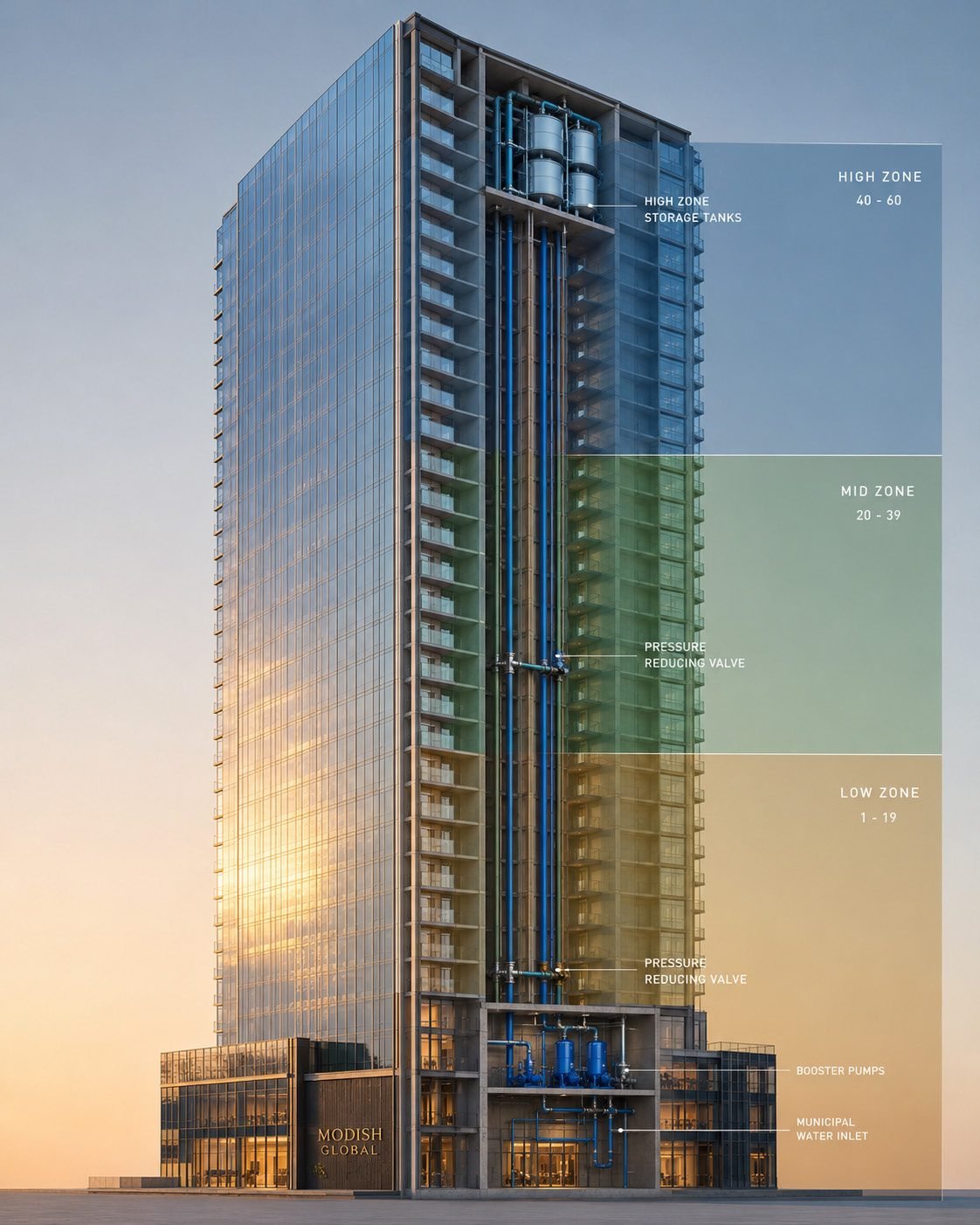
I test water for a living. More precisely, I test the water that arrives at penthouse kitchen faucets, spa showerheads, and rooftop infinity-pool filtration systems in buildings that cost more per square foot than most people earn in a month. What I have learned over two decades of high-rise plumbing diagnostics is that altitude does something to water that no marketing brochure will ever acknowledge. The water entering a supertall tower at street level is generally excellent. The water arriving at the seventy-eighth floor is something else entirely. It has been pumped, stored, reheated, recooled, pressurized, and held in transit through systems whose complexity rivals a small industrial plant, and whose maintenance receives a fraction of the attention any industrial plant would demand. The most transparent buildings on Earth conceal the most opaque infrastructure, and almost none of it is visible to the people who own the view.
The Physics of Pressure at Height
Water is heavy, and gravity does not negotiate. Water loses 0.433 pounds per square inch of pressure for every vertical foot it climbs. A building rising six hundred feet imposes roughly two hundred sixty PSI of static pressure loss on the column of water attempting to reach the top. Municipal water mains deliver somewhere between forty and eighty PSI. The arithmetic is unforgiving. The city’s pressure is exhausted before the water reaches the twentieth floor. Everything above that height must be lifted by the building itself, and lifting water three, five, eight hundred feet into the sky is not a trivial mechanical act. It is the central engineering problem of vertical living, and the way a tower solves it determines the quality of everything that eventually pours from its taps. Every pump, every valve, every storage vessel introduced to conquer that vertical column is also a place where water changes character, and the taller the building, the longer that chain of intervention becomes.
Stacked Hydraulic Worlds
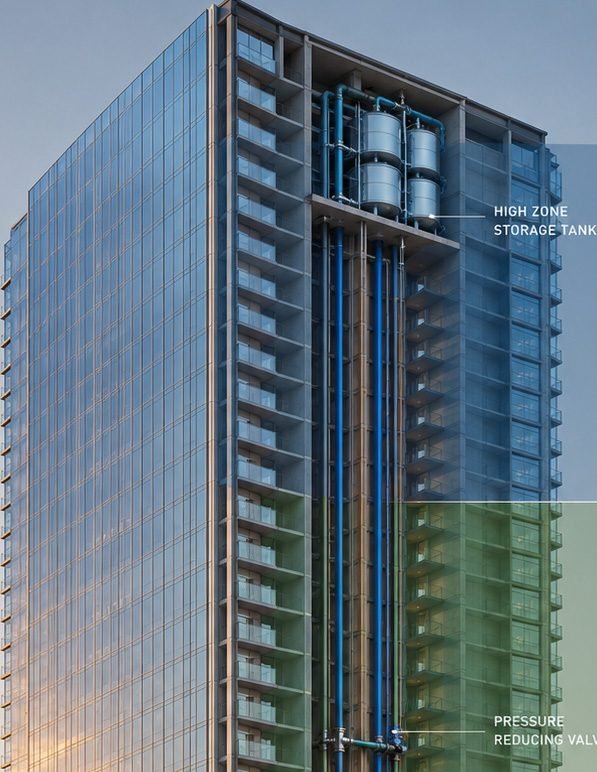
The solution is the multi-zone pressure system. Booster pump stations, pressure-reducing valves, and break tanks divide the building into zones spanning fifteen to twenty floors each. A seventy-story tower may operate four or five independent hydraulic environments stacked vertically, each with different pressures, flow velocities, water ages, and thermal profiles. These are not variations on a single system. They are separate worlds, and the water in the uppermost zone has been pumped harder, stored longer, and subjected to more pressure transitions than any zone below it. Residents on the sixty-eighth floor are not drinking the same water as residents on the twelfth. They are drinking older water, and in water systems age is precisely where pathology begins. A break tank on a high zone is a reservoir, and a reservoir is a place where water waits. The longer it waits, the more its protective chemistry decays, and the more hospitable it becomes to the organisms that municipal treatment was designed to suppress.
What Lives in the Riser
The vertical riser moves water only when demand pulls it upward. In luxury towers where occupancy is seasonal and many units are investment properties held empty for most of the year, demand is erratic. A penthouse occupied only during winter imposes zero demand on the riser segment above it all summer long. The water sits. It warms toward room temperature. Residual chlorine, the last line of chemical defense the municipal system provides, dissipates into nothing. And biofilm, the slick microbial community that coats the interior of every pipe, begins to thrive. Legionella pneumophila is not exotic. It exists at low concentrations in virtually every municipal supply, harmless at the levels and temperatures of a well-circulated system. But in a stagnant riser segment sitting at ninety-five degrees Fahrenheit, Legionella proliferates. I have sampled risers in luxury towers where concentrations exceeded four thousand two hundred colony-forming units per liter, well above the threshold recommending immediate remediation. The building’s water management plan had not been updated in three years. The residents had no idea. They were paying for altitude and receiving, without knowing it, a slow biological experiment conducted inside their own walls.
The Silent Damage
Stagnation is only half the story. The other half is violence, delivered in pulses too fast for the human eye. Pressure transients, what plumbers call water hammer, inflict cumulative mechanical damage throughout these systems. When a booster pump engages, it delivers a pressure wave traveling at roughly four thousand seven hundred feet per second. Reflected waves create spikes that exceed the system’s rated pressure by a factor of three. Ten thousand such events over five years produce microscopic fatigue fractures that become pinhole leaks, hidden behind drywall, saturating insulation and cultivating mold in wall cavities where no inspection will ever find it until the damage announces itself as a stain on a ceiling two floors below.
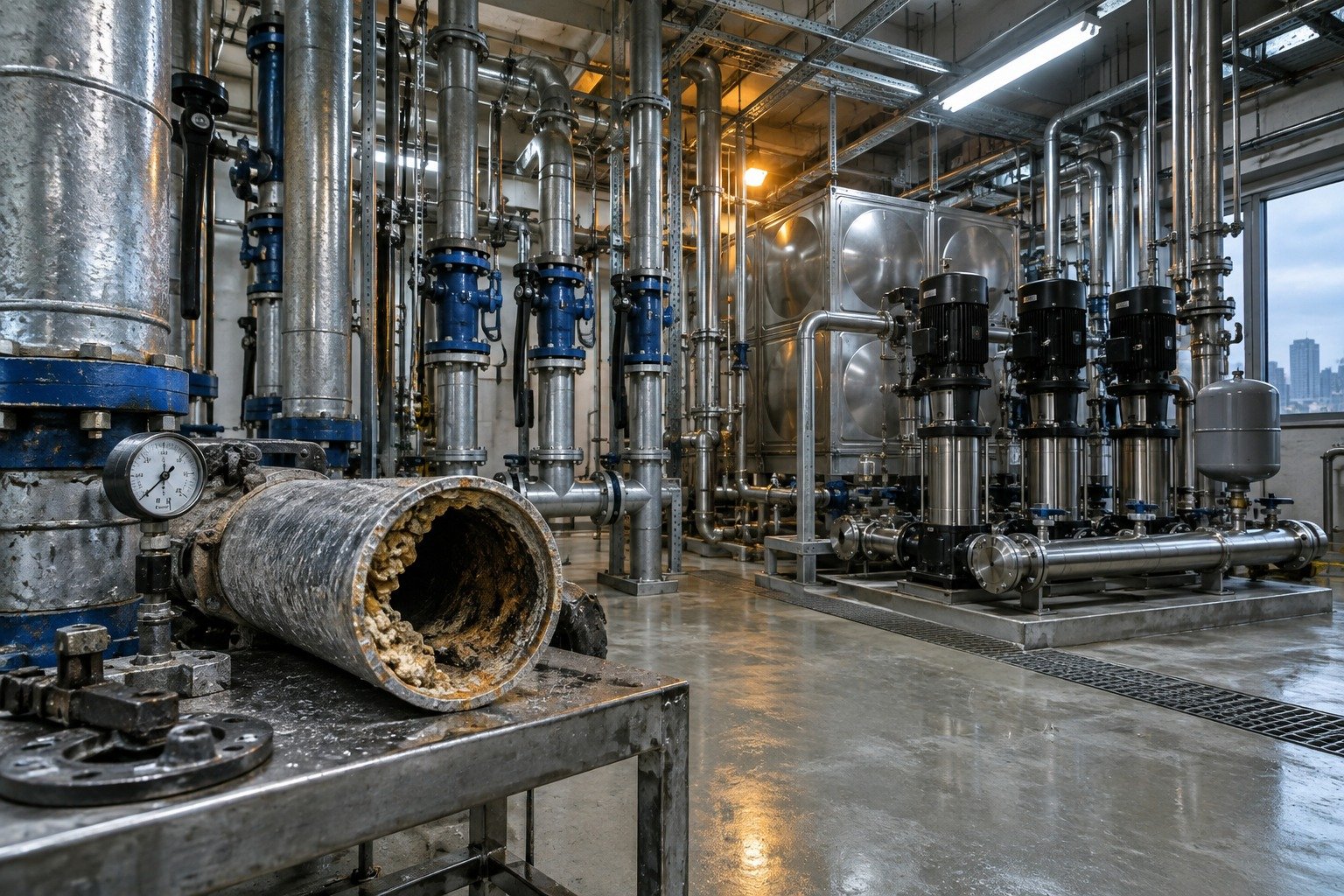
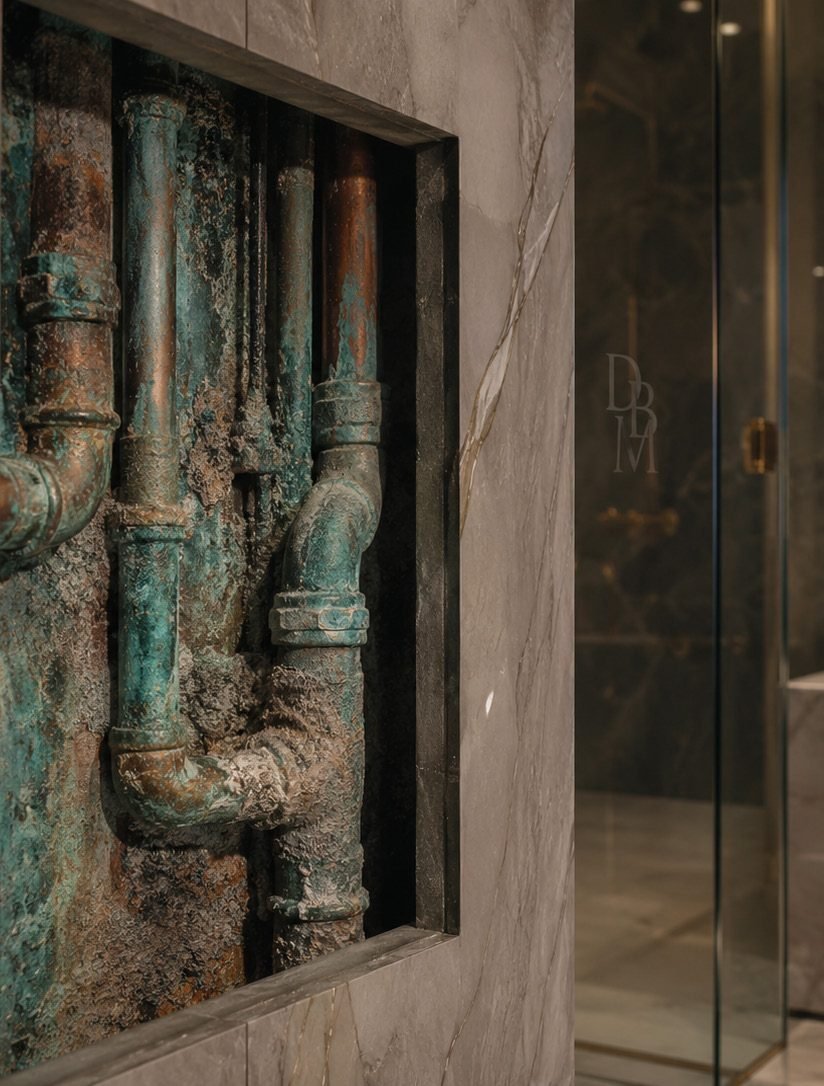
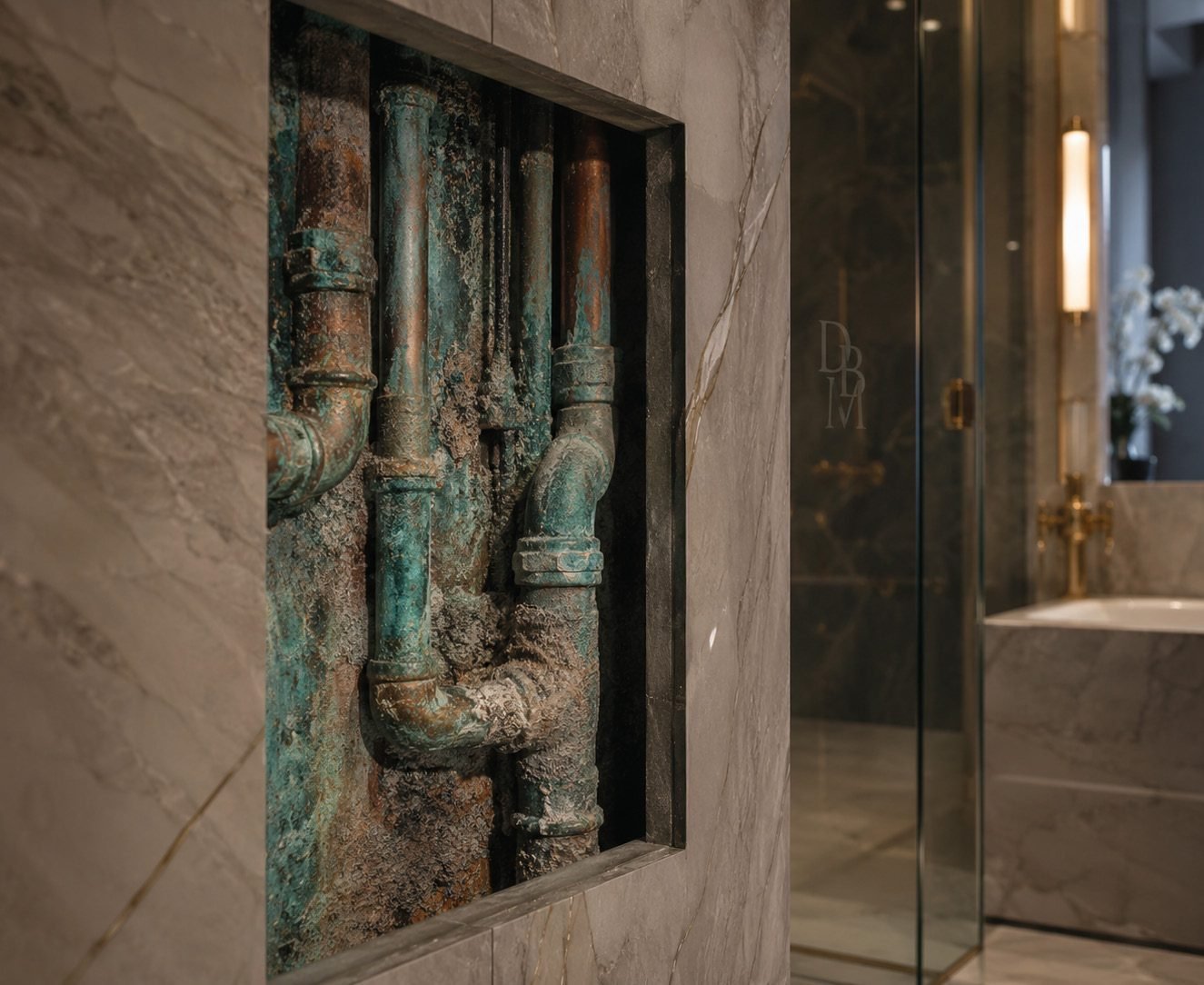
Copper piping installed between 1990 and 2015 is experiencing an epidemic of pitting corrosion. Aggressive water chemistry destabilizes the protective oxide layer that lines the interior of copper pipe. Booster pumps increase dissolved oxygen through cavitation. Pressure-reducing valves scour the oxide at precisely the points where protection is most needed. The building constructed in 2009 is now approaching the critical window, and its pinhole leak rate is accelerating along the nonlinear curve that governs all corrosion phenomena, stable for years and then, suddenly, not. Corrosion does not fail gracefully. It waits, and then it arrives all at once, and by the time a single leak is visible the same conditions have usually been at work throughout the entire zone.
The Diagnostic Revolution
The encouraging development is that none of this has to remain invisible. Continuous sensor-based monitoring transforms water quality management from periodic sampling into real-time data streams. Acoustic sensors mounted on pipe exteriors can distinguish between normal flow turbulence and the incipient signature of a leak with accuracy exceeding ninety percent. Temperature anomalies in riser segments reveal stagnation or recirculation-pump failure, detectable and addressable before consequences arrive. But raw sensor data is only as useful as its legibility, and this is where visualization changes the equation. When continuous monitoring is integrated into three-dimensional building models, the result is a living diagnostic map of the entire water system’s health. Corrosion-prone segments can be identified by their thermal and pressure signatures before the first pinhole appears. Stagnation zones can be mapped and targeted for flushing. A rendered spatial environment makes the building’s circulatory system legible to managers who will never read an engineering report but who immediately understand a color-coded risk map of their own tower. The infrastructure becomes something you can see, and what can be seen can be maintained.
What the Resident Never Sees
The resident of a supertall glass penthouse occupies the most visually transparent living environment ever constructed. Glass walls, glass floors, every surface engineered to dissolve the boundary between interior and atmosphere. And yet this resident does not see the riser corroding behind the drywall, the biofilm colonizing the rooftop tank, or the pinhole leak weeping steadily into insulation two floors below. The most transparent buildings on Earth contain the most opaque infrastructure, and the paradox is not merely poetic. It is the exact mechanism by which these problems are allowed to mature undetected. A stain is treated. A source is ignored. The building’s marketing sold a relationship with the sky and quietly declined to mention the plumbing.
The view from the seventieth floor is breathtaking, and it will remain so whether or not anyone thinks to test the water. That is the quiet danger of altitude sold as a lifestyle. The spectacle is self-evident and the degradation is not, and a system that rewards the visible while concealing the mechanical will always defer the reckoning until the reckoning is expensive. The pipes behind the glass are conducting a slower, quieter, more consequential drama than anything happening at the window, and the only real question is whether the people who own these towers will choose to see the degradation while it is still degradation, before it becomes damage. The water, if anyone thought to ask it, has been trying to tell the story all along.
3D Transformative Digest — ISSN 3067-5510. Published by Modish Global Inc. © 2026 Modish Global Inc. All rights reserved. Licensed distribution only.