3D Transformative Digest | Designs by Modish
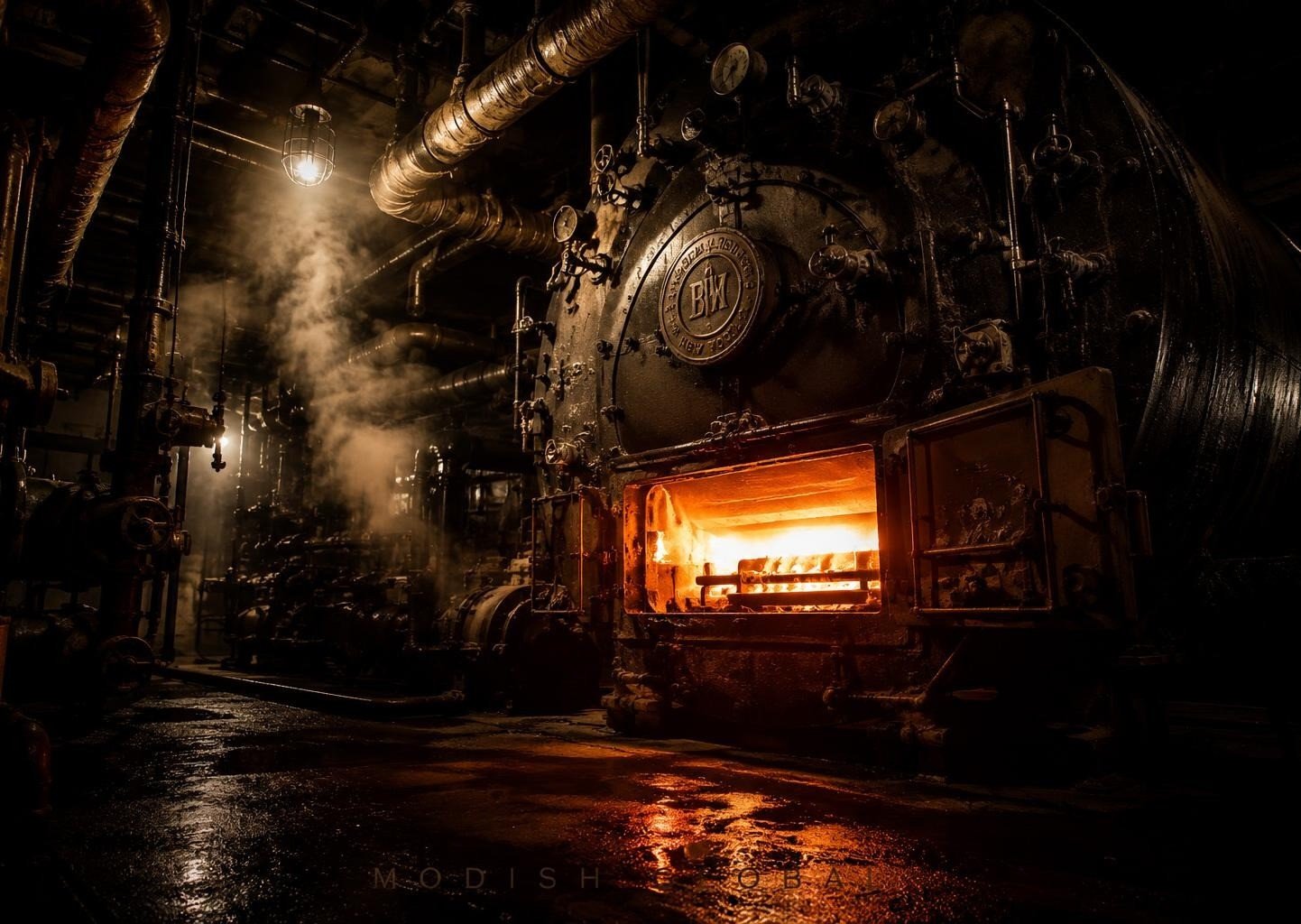
There is a number sitting quietly inside the machinery of Local Law 97 that most building owners have not yet been forced to look at directly, and it is this: somewhere north of nine hundred million dollars, arriving annually, the moment the second compliance period takes hold. Not a projection built on alarmism. A projection built on arithmetic, the kind that does not care how a boardroom feels about it.
To understand why this number exists, and why it has been so easy to ignore until now, you have to understand what the Climate Mobilization Act actually asked of New York City's building stock when it passed in 2019. Buildings account for roughly seventy percent of the city's greenhouse gas emissions. Not transportation, not industry, but the accumulated thermal appetite of towers, walk-ups, and everything in between.
Local Law 97 set out to cap that appetite for any structure over twenty-five thousand square feet, with an ultimate ambition that reads, on paper, almost modest: a forty percent reduction in emissions by 2030, more than eighty percent by 2050. Modest, that is, until you understand how the caps are staged, and what happens at the seam between stages.
The first compliance period, running from 2024 through 2029, was designed to be forgiving. Call it the runway. The caps were set generously enough that the vast majority of covered buildings (currently around ninety-two percent) are already meeting them, and the penalty exposure for the minority that aren't has remained, so far, a rounding error against the value of the assets involved. This has produced a dangerous psychological artifact across the ownership class: the belief that Local Law 97 is a manageable cost of doing business, a line item, something you handle the way you handle a tax filing. That belief is about to meet a cliff.
The Halving
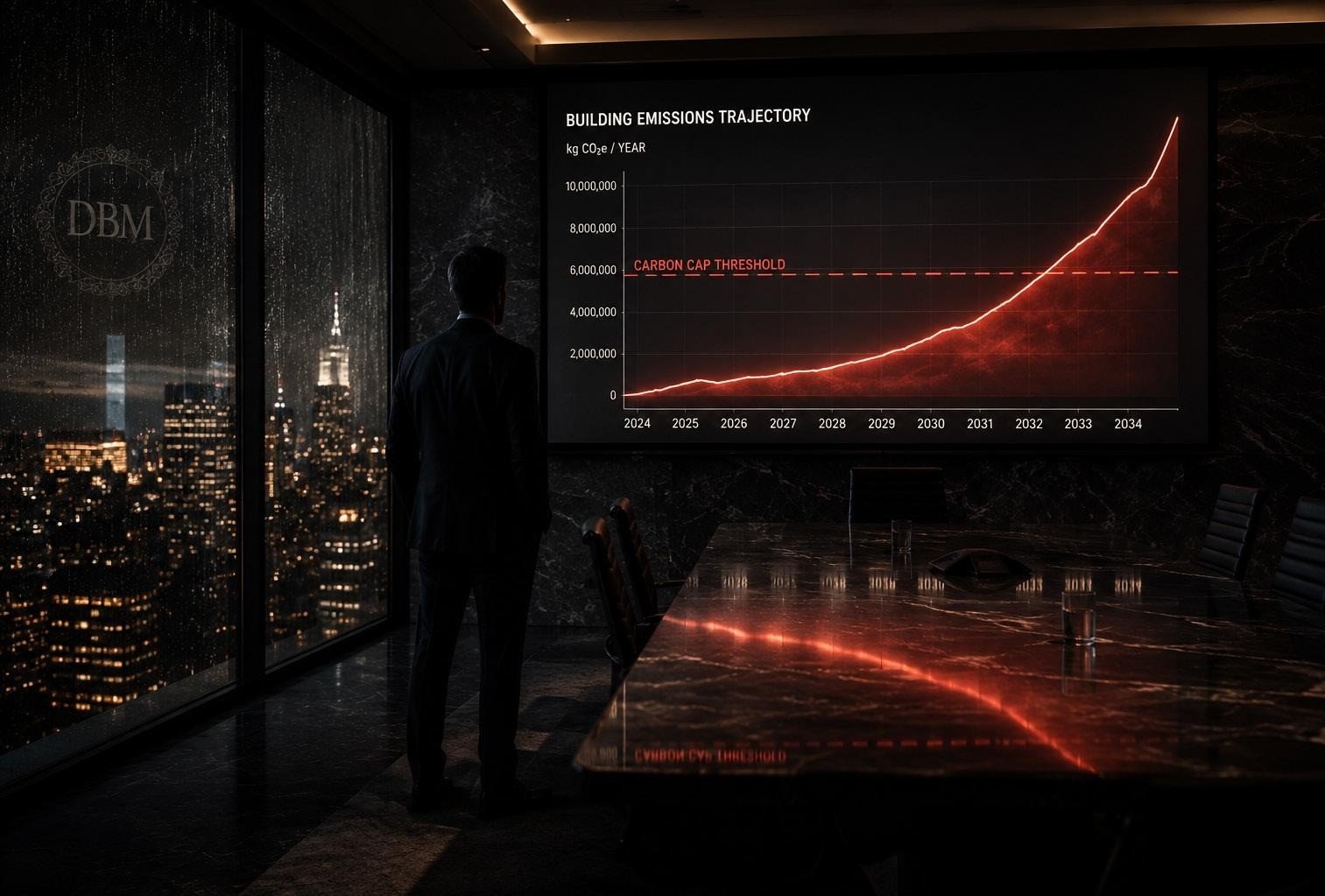
In the second compliance period, beginning in 2030 and running through 2034, the emissions-intensity caps do not tighten incrementally. For most building types, they roughly halve. This is not a gentle curve tightening the way a thermostat ticks down degree by degree. It is a structural reset, the regulatory equivalent of a bridge deck dropping to half its previous clearance overnight. A building that comfortably clears the current bar, emitting well within its allotted intensity per square foot, does not get to carry that comfort forward. The bar itself moves beneath it.
And here is where the number becomes inevitable rather than speculative. Multiply the anticipated gap between actual citywide emissions and the new, halved caps by a penalty rate of up to two hundred sixty-eight dollars per metric ton of carbon dioxide over the limit, apply it across the tens of thousands of buildings that will find themselves suddenly, structurally out of compliance not because they did anything differently but because the target moved, and you arrive at a citywide penalty exposure projected to exceed nine hundred million dollars a year. That is not a fine levied against reckless actors. That is the ambient cost of inertia, distributed across an entire skyline.

Who Is Actually Exposed
The mistake owners make is assuming exposure correlates with age, or with obvious inefficiency: the assumption that if a building has already survived one compliance cycle, it will survive the next. It will not, for a simple reason: the first period rewarded buildings that had already done some baseline work, often decades ago, unrelated to Local Law 97 entirely: a boiler swap here, a curtain wall upgrade there, decisions made for cost or comfort reasons that happened to leave a favorable emissions signature. The second period does not grade on that curve. It asks a harder question: can this building's systems, today, actually deliver the intensity reduction the law now requires, or does it depend on retrofit work that has been discussed, budgeted, delayed, discussed again, and never executed?
This is where exposure becomes forensic. My research has spent sixteen years tracking the gap between what building owners believe about their own mechanical systems and what those systems can actually prove. Belief is cheap. Proof is not. A building's owner may sincerely believe the fossil-fuel boiler was slated for replacement, that the envelope was resealed, that the last local law inspection turned up nothing structural. But belief does not satisfy a penalty calculation, and it does not satisfy a lender's due diligence team, and increasingly, it does not satisfy an insurer's underwriting model. What satisfies all three is documentation: dated, verifiable, continuous. And this is precisely what most of New York's building stock does not have.
The Shape of the Curve
It is worth pausing on why regulators chose to stage the law this way at all, because the staging itself explains the trap so many owners are walking into. A single, immediate cap set at the 2050 target would have been unworkable. No city's building stock can retrofit itself overnight, and a policy that demanded it would have collapsed under its own impossibility within a year. So the law was built in deliberate steps: a lenient first period to establish the habit of measurement and reporting, followed by progressively steeper reductions through the second, third, and fourth periods, each one assuming that owners used the previous period's runway to actually prepare. The design is rational. The problem is that rational design assumes rational uptake, and uptake, so far, has clustered heavily around the buildings that were already positioned to comply cheaply. The buildings that needed the runway most are, disproportionately, the ones that have used it least.
A Building's History, Coming Due
Here is the deeper mechanism at work beneath the spreadsheet math, and it is the one I find most consequential. Local Law 97 does not simply regulate emissions. It functions as a forcing event for institutional memory. Every retrofit an owner postponed, every violation quietly corrected without formal close-out, every inspection whose report lives in a departed facilities manager's inbox rather than in a retrievable system of record: all of it comes due simultaneously in 2030, because compliance now depends on being able to demonstrate, credibly and immediately, exactly what condition a building's systems are in and what work has actually been completed. A building's undocumented history does not disappear with time. It compounds, silently, until a regulatory deadline forces an accounting.
Owners currently sitting inside the ninety-two percent compliant today should not read that figure as safety. They should read it as a snapshot taken before the tide moved. The buildings most at risk in 2030 are not necessarily the oldest or the most visibly inefficient. They are the ones whose actual mechanical condition, retrofit history, and documentation trail cannot be reconstructed quickly enough, or convincingly enough, to satisfy the electrification and efficiency pathways the law now demands: heat pump conversions, the retirement of fossil-fuel heat and hot water systems, the buildout of distributed energy that requires, at every step, a paper trail proving what exists and what has changed.
New York is not asking its buildings to become something new by decade's end. It is asking them to prove what they already are, continuously and verifiably, at a moment when the cost of failing to prove it has finally become severe enough to matter. Nine hundred million dollars a year is what happens when an entire city's building stock discovers, all at once, that memory was infrastructure all along.
The buildings that weather the 2030 cliff will not necessarily be the newest, the tallest, or the most expensively appointed. They will be the ones that can produce, on demand, an unbroken record of what they are, what has been done to them, and what remains to be done, because in the compliance regime now taking shape, the ability to prove a building's condition has quietly become as valuable as the condition itself.
Leave a Reply