Tag: Design Languages

  • Rustic, Recomposed: From Clean Modern Shell to Mountain-Grade Warmth — Room by Room

    Rustic, Recomposed: From Clean Modern Shell to Mountain-Grade Warmth — Room by Room

    Rustic interior redesign

    Rustic design is the easiest style to fake and the hardest one to get right. Anyone can slap reclaimed planks on a wall and call it “warm.” But real rustic—the kind that feels earned—comes from proportion, mass, texture, and the quiet discipline of knowing when to stop. It requires a language, not a palette. It demands restraint more than abundance.

    That’s why this redesign is worth your attention.

    The original home, as presented in the base renders, carried a modern clarity that was architecturally unassailable: wide glazing, clean volumes, smooth planes, open sightlines. Beautiful—crystalline, even. Just not rustic. But here’s what matters: Cinematic Intelligence™ didn’t fight the structure. It re-authored the interior language so the same architectural vessel could speak in timber, stone, iron, and atmosphere. The building didn’t change. The dialogue did.

    Below is exactly what shifted—space by space—and the architectural reasoning behind each decision. This is how a modernist shell becomes a place that feels earned.

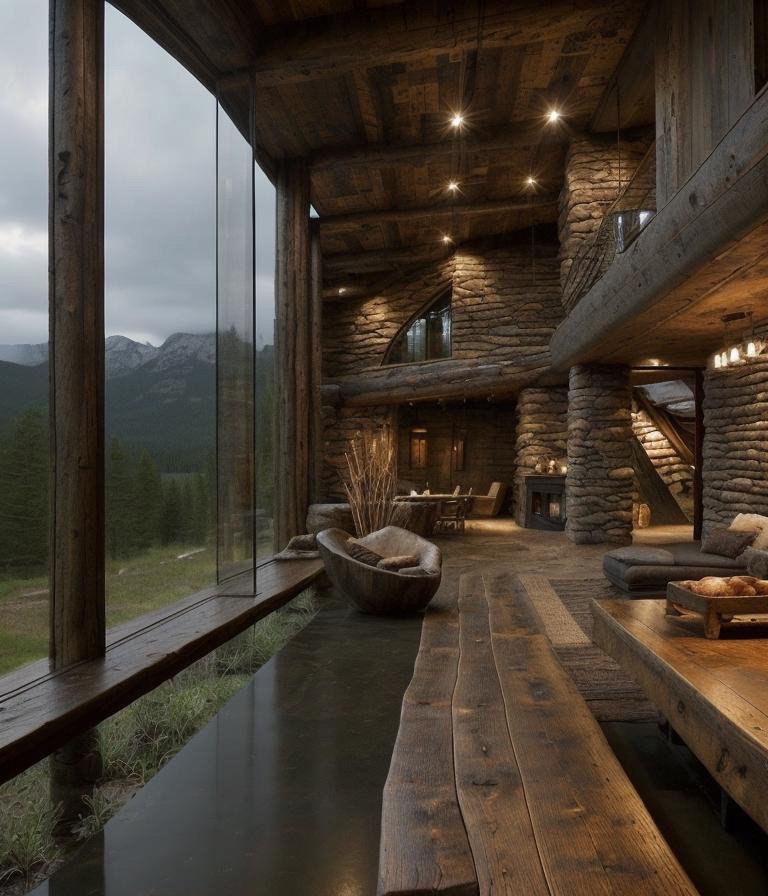
    The Great Room: From Gallery-Luxury to Anchored Living

    Original condition: The space read as modern openness incarnate. Light walls, minimal interruption, floating furniture arrangements, the kind of geometric purity that photographs brilliantly but sometimes feels like a gallery rather than a home.

    Rustic interior kitchen details

    The transformation: Cinematic Intelligence anchored this room—and we mean that literally and visually. Mass and gravity became the design drivers.
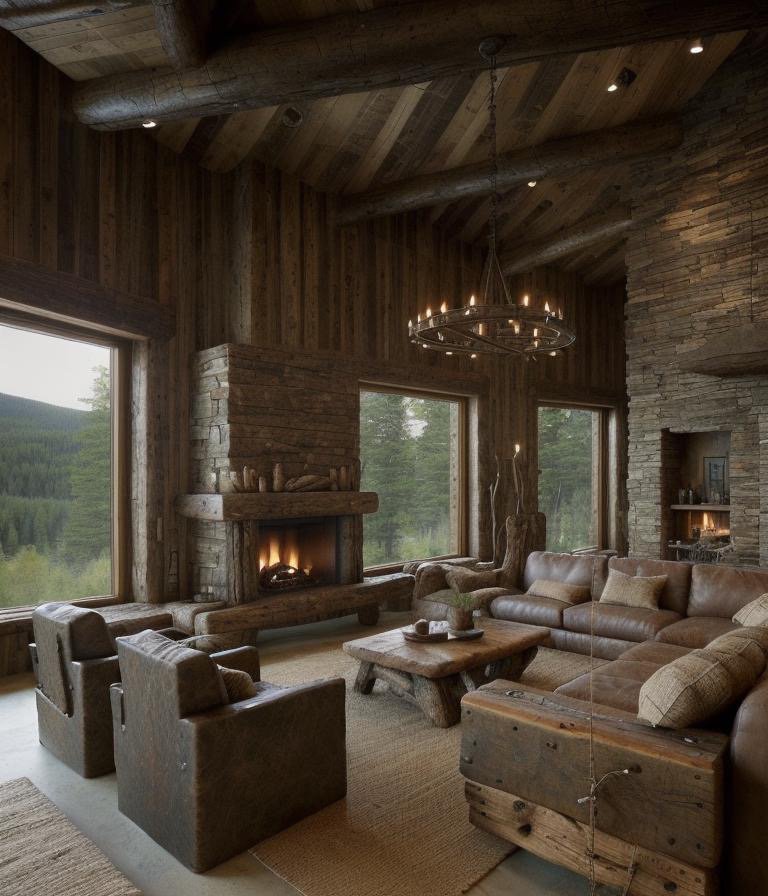
    The fireplace wall became the room’s new center of gravity. Instead of a sleek insert that reads as a technical amenity, the hearth was conceived as stonework with genuine weight and presence. Rustic architecture isn’t decoration applied to a space; it’s structure you can feel in your bones. The stone doesn’t whisper—it speaks. It gives the room a spine, and every other element now defers to that geometry.
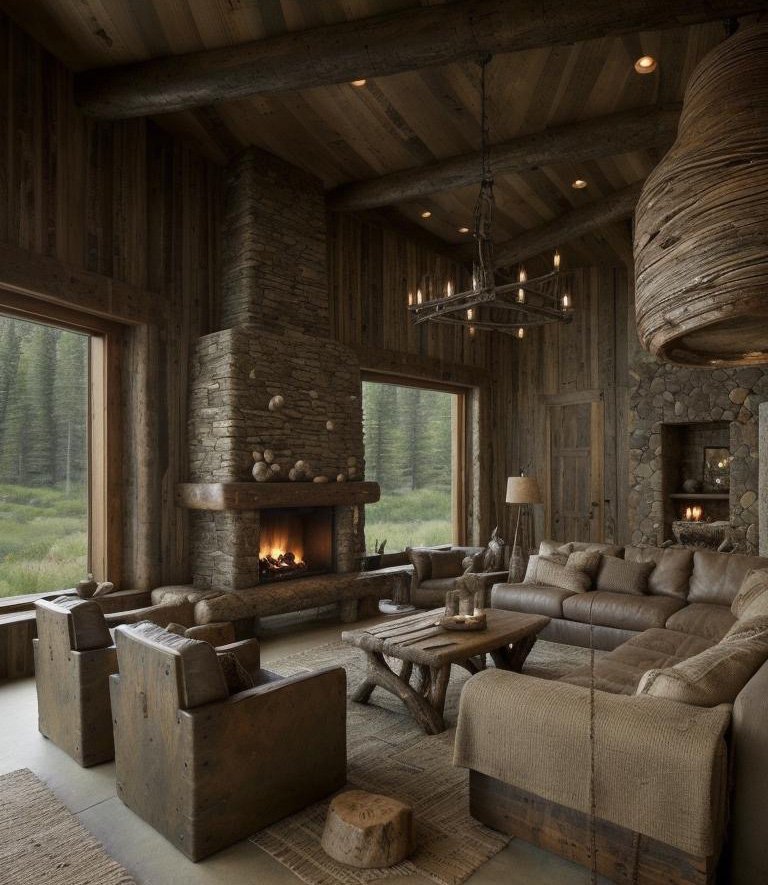
    The ceiling shifted into heavy timber language. Not “wood as surface,” but wood as a load-bearing architectural gesture. Planks run with intention, anchored by posts that read purposeful. The overhead warmth—that saturated amber—offsets the coolness of the extensive glazing. Without this, the room would remain a modernist gallery. With it, the room becomes protective.

    Furniture behavior changed radically. Seating stopped floating and started settling. Lower profiles, chunkier silhouettes, textiles that absorb light rather than reflect it. The object-based design logic of minimalism gave way to a textural, massed approach. That’s how rustic becomes genuinely comfortable without tipping into sloppy informality.

    Texture distribution followed a principle of restraint. The system didn’t over-texture everything—that’s how you get “ski lodge aesthetic.” Instead, character concentrated where the eye naturally rests: fireplace treatment, ceiling detail, key joinery moments. Secondary planes stayed quiet, allowing those focal moments to read with authority. That discipline is what separates a private estate from a themed interior.

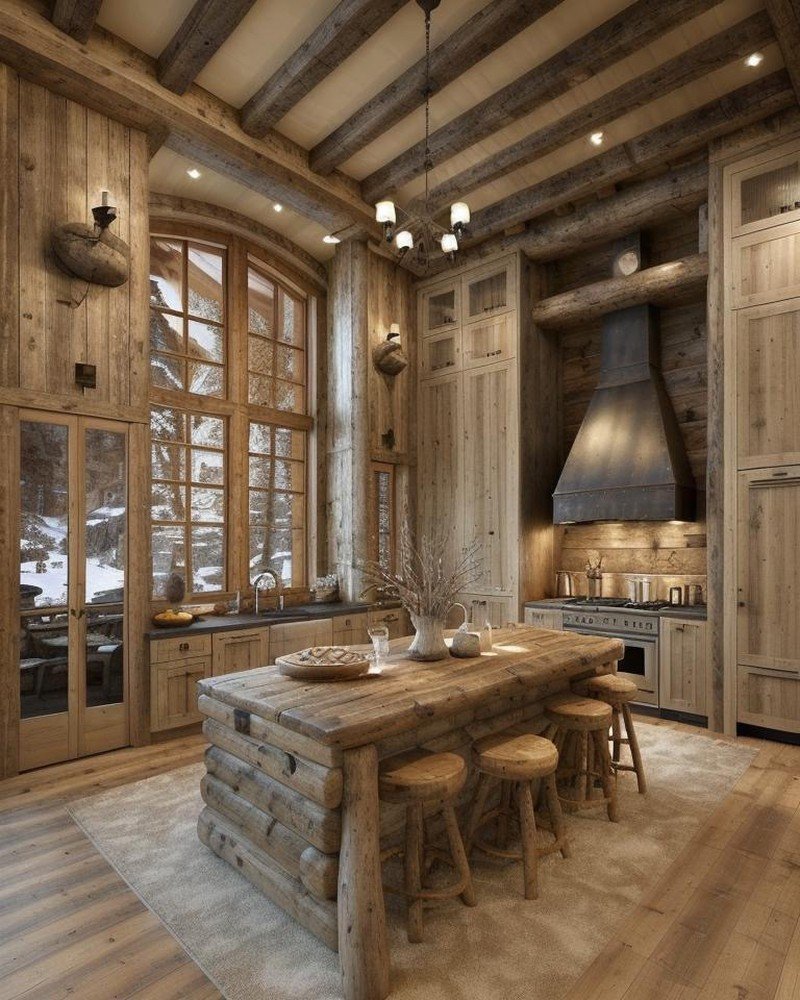
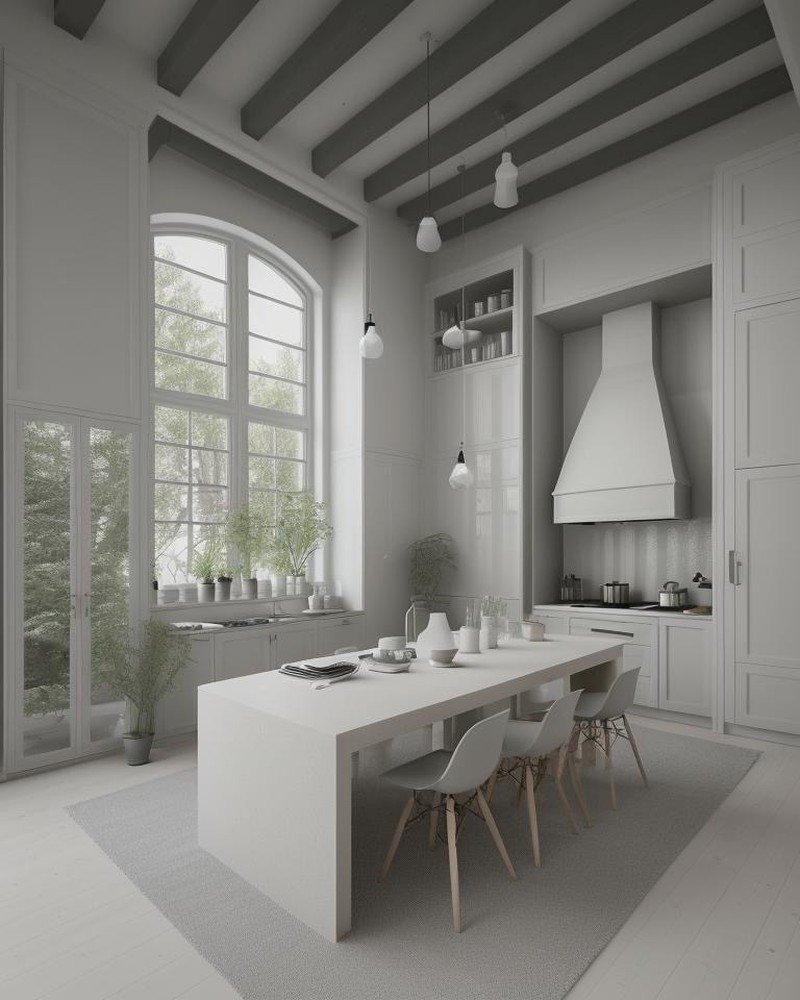
    The Kitchen: Workshop-Heart Without Losing Refinement

    Original condition: Minimal luxury was on full display. Smooth cabinetry, integrated appliances, an island that read as a clean monolith. Technically perfect. Spatially inert.

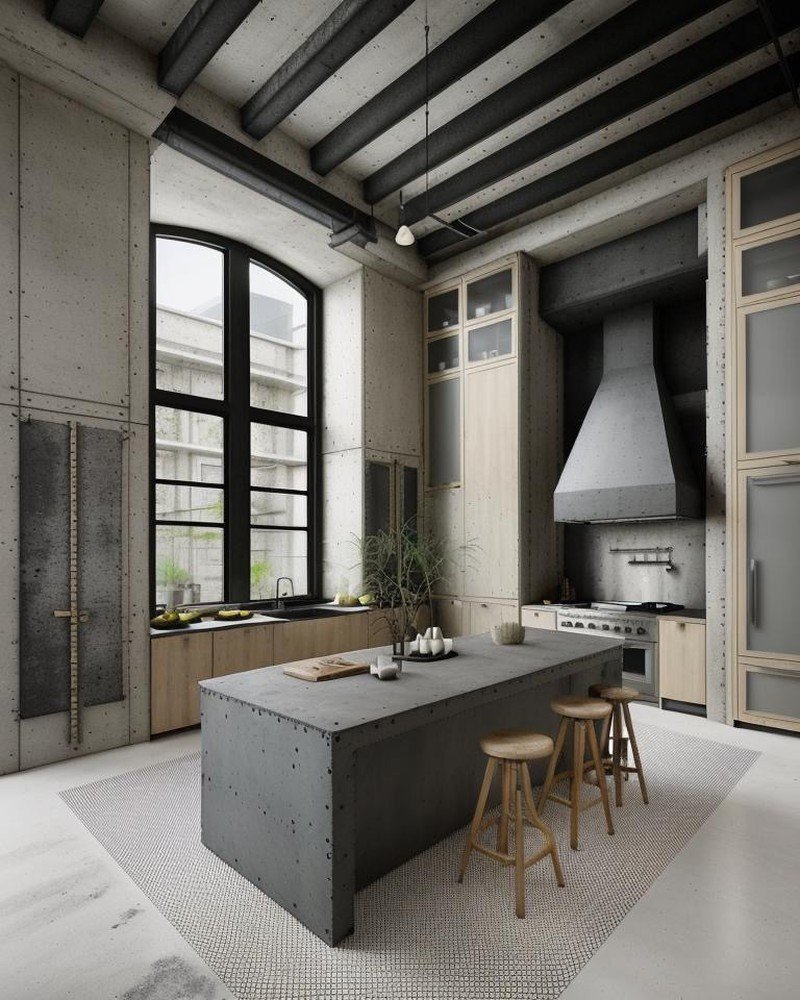
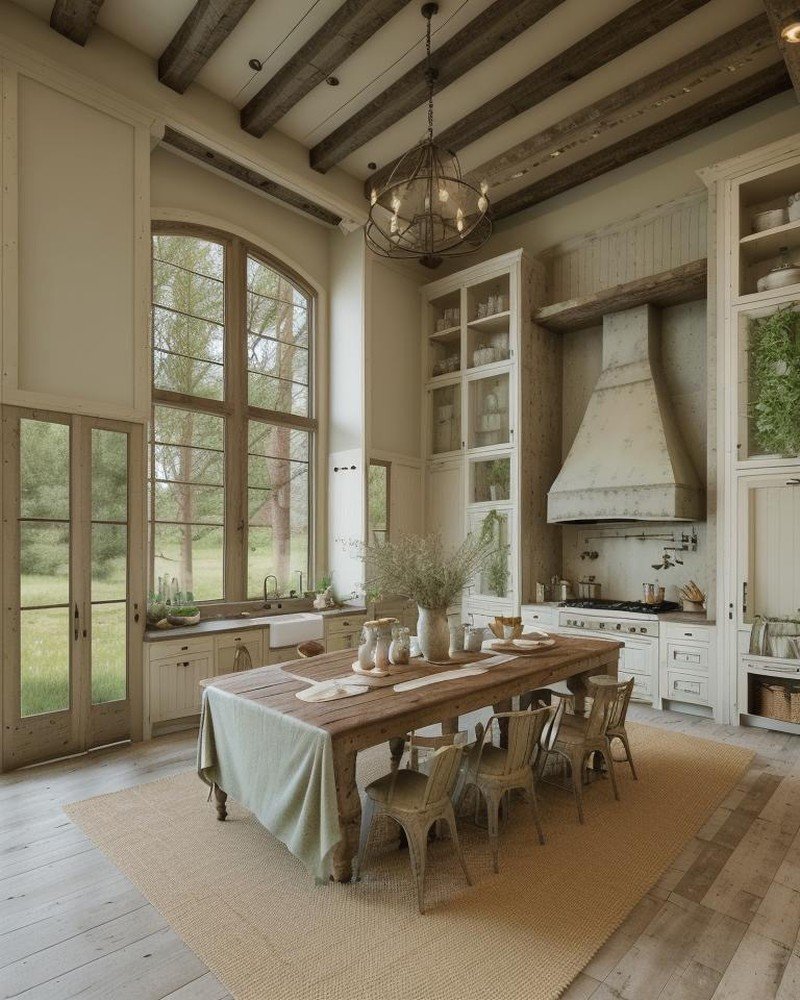
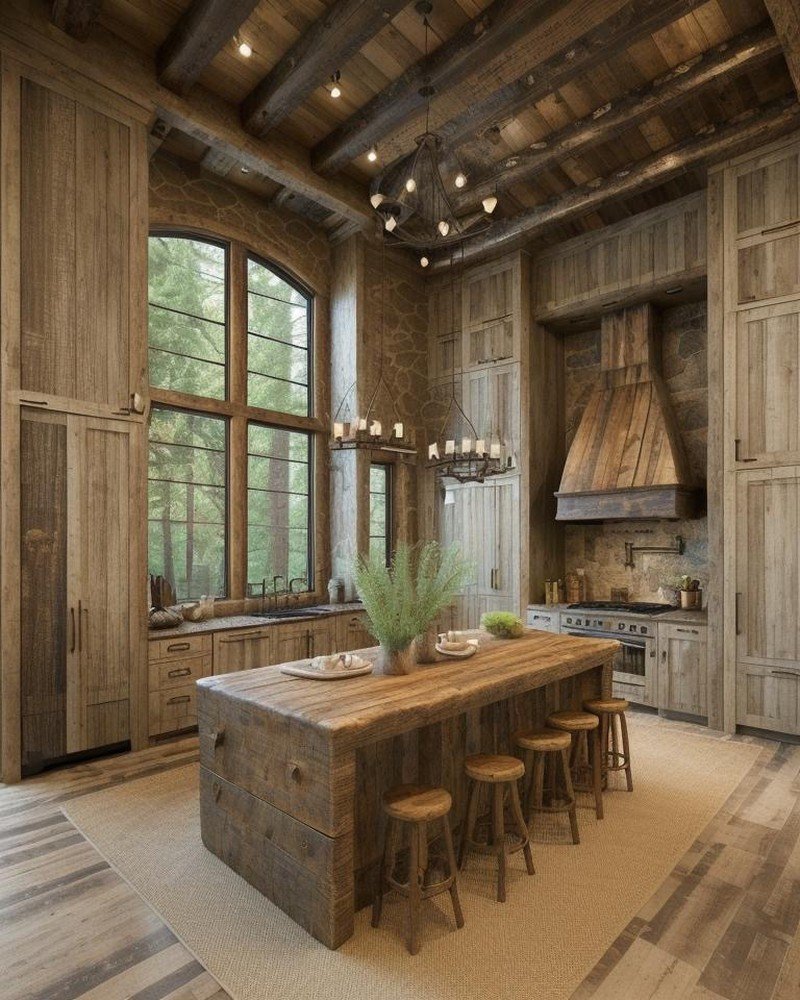
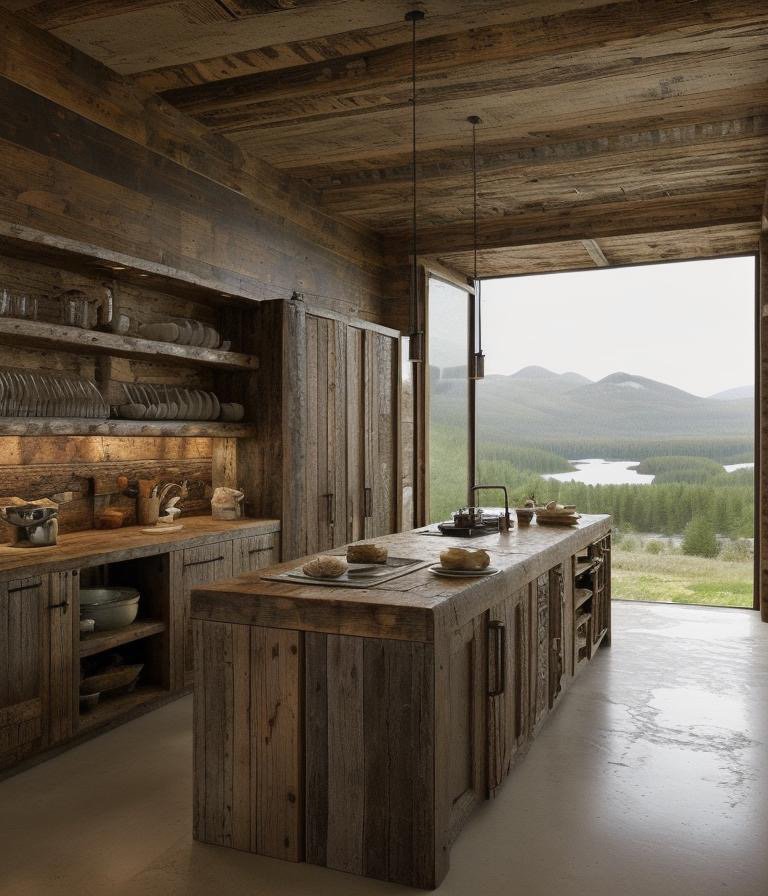
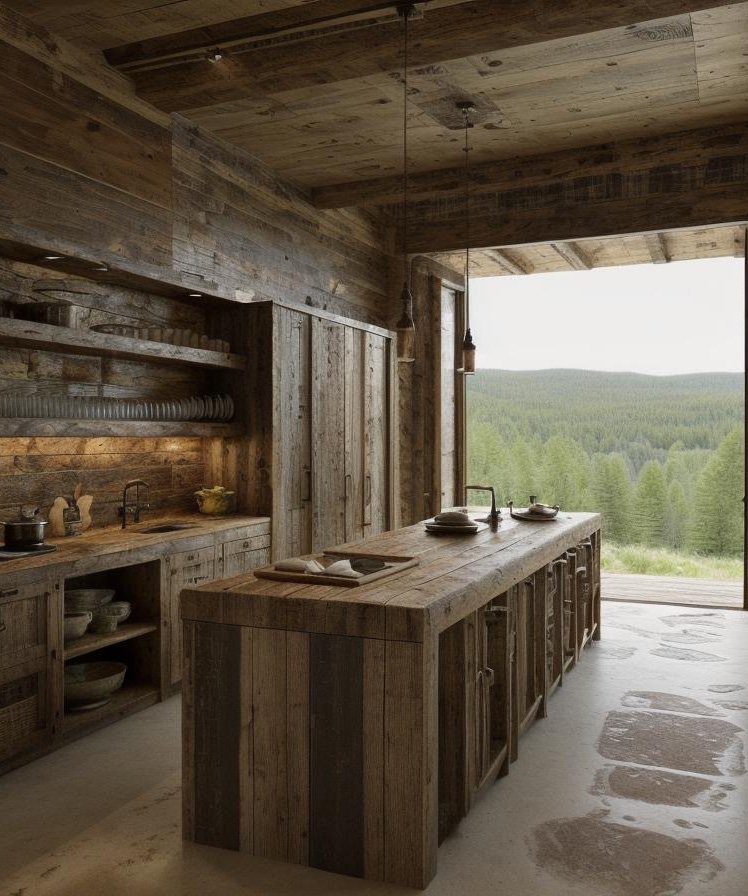
    Heavy timber rustic kitchen with mountain and forest views

    The transformation: The kitchen was reconceived as the workshop-heart of the home—without surrendering architectural refinement.

    The island underwent radical translation. It traded slick minimalism for thick timber volume—a block that reads milled, not manufactured. The edges are squared and strong, not softened. The form communicates honesty. This is a work surface that’s been earned through use, not designed to look used.

    Cabinet behavior evolved. Upper storage became more grounded—less high-gloss sheen, more visible grain and texture. Open shelving appeared where it made functional sense, but deployed as a narrative of daily rituals rather than a trend gesture. The dish, the glass, the vessel—these become visual elements because they’re honest to how the house actually operates.

    Lighting logic avoided the most dangerous trap of rustic design: the wagon-wheel pendant. Fixtures remained warm and architectural—subtle pendant presence, enough to define zones without declaring “theme restaurant.” The warmth came from the color temperature and positioning, not from novelty.

    Surface temperature became a critical variable. Countertops read cooler than the surrounding timber, creating contrast. This prevented the room from becoming a monolithic brown-on-brown cave. That temperature dialogue is what keeps the space estate-grade rather than period-authentic to the point of darkness.

    The Game Lounge: Rec Room Becomes Legacy Lounge

    Original condition: A polished, quiet modern leisure room. Almost hotel-like in its anonymity—comfortable, but without specific character or memory.

    Primary bedroom with sculptural timber ceiling

    The transformation: This space underwent the most conceptual shift. From “rec room” to “lodge-level lounge,” but tailored rather than theatrical.

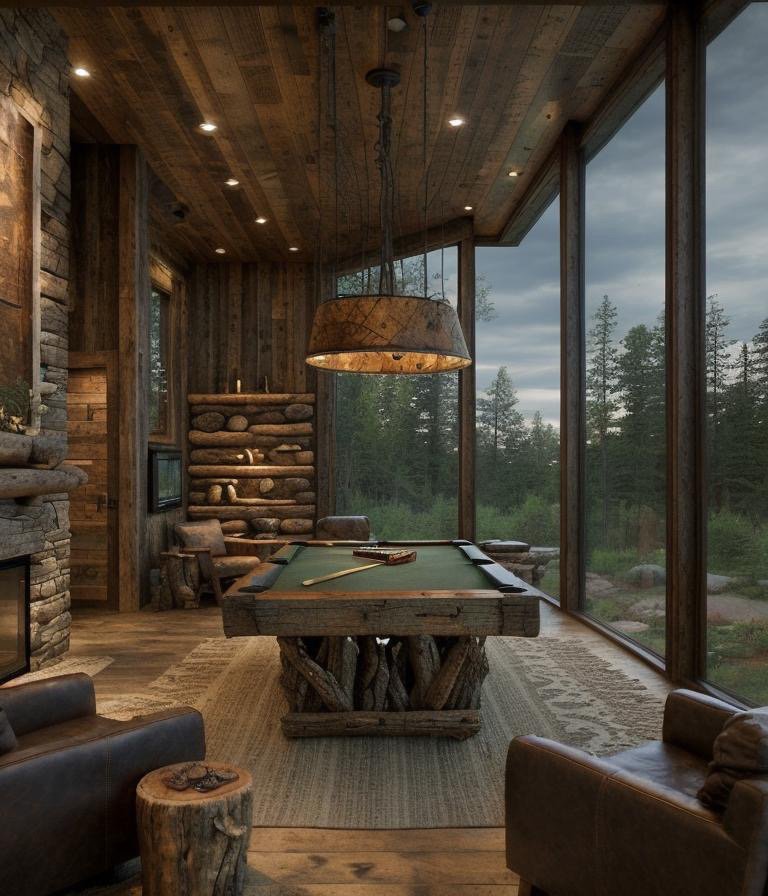
    The ceiling plane deepened and warmed. That shift changes the acoustics of the room visually—it feels quieter, more intimate, more protective. Lower ceilings don’t just change proportion; they change how sound and light behave, which changes how the body experiences being in that space.

    Material cadence became rhythmic. Stone, timber, and leather formed a repeating pattern. Wood slats, stone segments, and metal accents created a visual pulse. This repetition gives the room coherence without monotony. Each material earns its presence through that dialogue.

    Furniture weight shifted fundamentally. Seating moved to heavier forms with softer textures—less showroom, more “stay awhile.” The objects in the room invite extended occupation rather than polite viewing. This is where the difference between contemporary design and rustic comfort becomes architectural rather than stylistic.

    The windows remained—glazing stayed extensive—but the interior now frames the landscape like a viewing gallery. Rustic architecture, when done with intelligence, doesn’t hide or diminish the natural world beyond the glass. It honors it. It makes the view part of the interior composition.

    The Primary Bedroom: Creating Sanctuary Through Enclosure

    Original condition: Minimal calm was the organizing principle. Smooth walls, a bed positioned as a platform object, a room conceived more like a spa than a sanctuary. Serene, but detached.

    Indoor-outdoor corridor with timber and stone

    The transformation: This is where Cinematic Intelligence engaged in genuine spatial psychology. A bedroom isn’t a gallery. It’s a place where vulnerability happens.

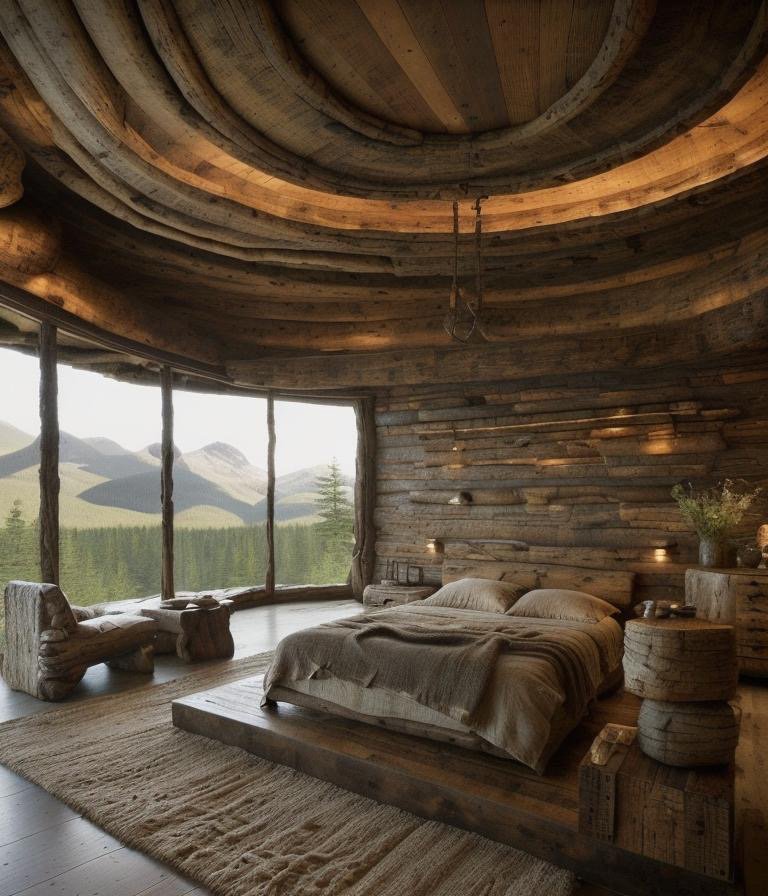
    The ceiling became a signature moment—curving, layered timber that reads hand-formed rather than installed. It’s not random texture or decorative flourish; it’s a crafted canopy. The overhead geometry changes how you feel when lying in bed looking up. That matters architecturally, not just aesthetically.

    The bed integration shifted from floating-sculpture positioning to anchored placement. Rustic bedrooms should feel held—as though the room is protecting the inhabitant, not displaying them. The bed became part of the spatial story rather than an object within it.

    Light management deployed warmth strategically. Pools of light appeared at the perimeter and in key corners. Rustic comfort doesn’t come from uniform brightness; it comes from shadow and glow, from the understanding that darkness and warmth together create genuine rest.

    The textile palette turned quieter and thicker—creams, taupes, softened browns without artificial “log cabin red.” These are the colors of earth and linen, not the colors of a period room. The cumulative effect makes the space feel protected rather than performed.

    The Long Glass Corridor: Museum Mode to Garden Walk

    Original condition: A sleek modern gallery corridor—linear, bright, architecturally pure. An uninterrupted runway of minimalist clarity.

    Final rustic interior composition

    The transformation: Cinematic Intelligence warmed the runway and made it feel lived rather than traversed.

    Timber overhead changed everything in a single move. Wood pulled the corridor out of museum mode into domestic architecture. The material language shifted from “transit space” to “passage through a dwelling.”

    Stone articulation replaced uniform flooring. Instead of one uninterrupted surface, the floor story broke into zones—a sequence rather than a tunnel. These material breaks create pauses in movement. They slow the eye. They make the corridor feel intentional rather than obligatory.

    Strategic greenery softened the transition between indoor and outdoor. The corridor became a garden walk rather than a gallery march. These planted moments blur the boundary between structure and landscape in a way that feels earned, not themed.

    Rustic lounge space with fireplace

    The Principle Behind the Practice

    What makes this redesign architecturally coherent isn’t that it applied a style to a structure. It’s that it identified the potential within the existing bones and re-authored the spatial language to unlock it. The modernist shell—with its clean volumes, its spatial generosity, its relationship to light and landscape—didn’t need to be destroyed. It needed to be spoken to in a different dialect.

    Rustic design, at its best, isn’t about materials. It’s about mass, restraint, and the honest expression of how spaces are actually inhabited. It’s about understanding that warmth comes not from color alone but from proportion, texture distribution, and the careful placement of focal points that make a room feel held rather than displayed.

    This redesign demonstrates what happens when a contemporary structural language meets rustic spatial thinking. The result isn’t a period room or a themed interior. It’s a mountain house that feels like it was built for living—deliberate, proportioned, and utterly grounded. The kind of space you don’t want to leave, not because it’s pretty, but because it feels like it knows who you are and makes room for that.

    That’s the difference between rustic surfaces and rustic architecture. And it’s the difference that makes a home.

  • California Casual, Rewritten

    California Casual, Rewritten

    There is a particular ease to California Casual that is often misunderstood. Too many observers mistake it for being unfinished, or worse, effortless in a manner that suggests carelessness. True California Casual is neither accidental nor negligent. It is disciplined restraint. It is confidence without performance. It is architecture and interior design that knows exactly what it is doing—and refuses to apologize for its choices.

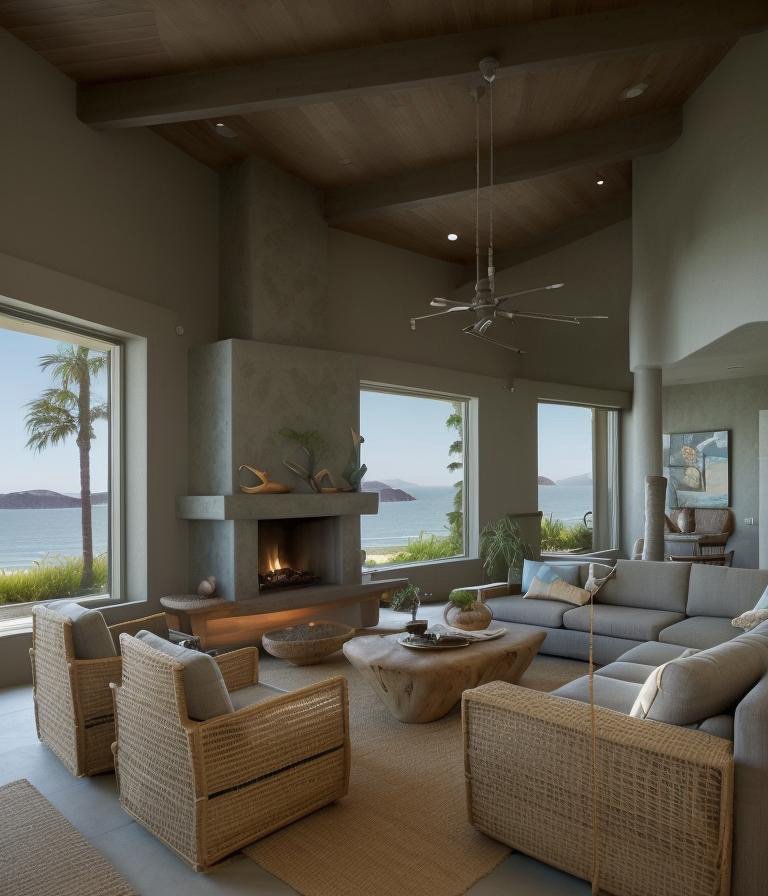
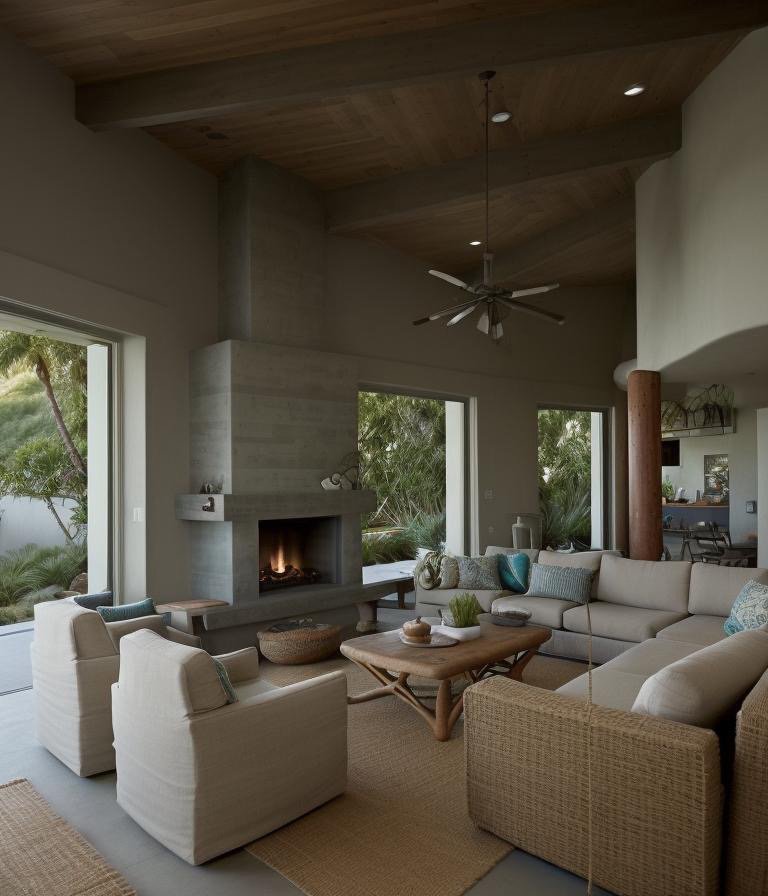
    California Casual living room with ocean views, natural wood ceiling, and wicker seating

    The main living area dissolves boundaries between interior and exterior, anchored by low-profile seating and a naturally grounded palette.

    When one first steps into this residence through Cinematic Intelligence™, the sensation is immediate and profoundly physical. Not merely visual, but decidedly spatial. The air felt slower. The light didn’t rush inward; it drifted with intention. The architecture didn’t announce itself with gesture or spectacle—it invited you to sit, to pause, to remain longer than you had planned. The bones of the design speak quietly but with absolute conviction. That, in architectural terms, is the quiet brilliance of this design language.

    The Architecture: Calm with Backbone

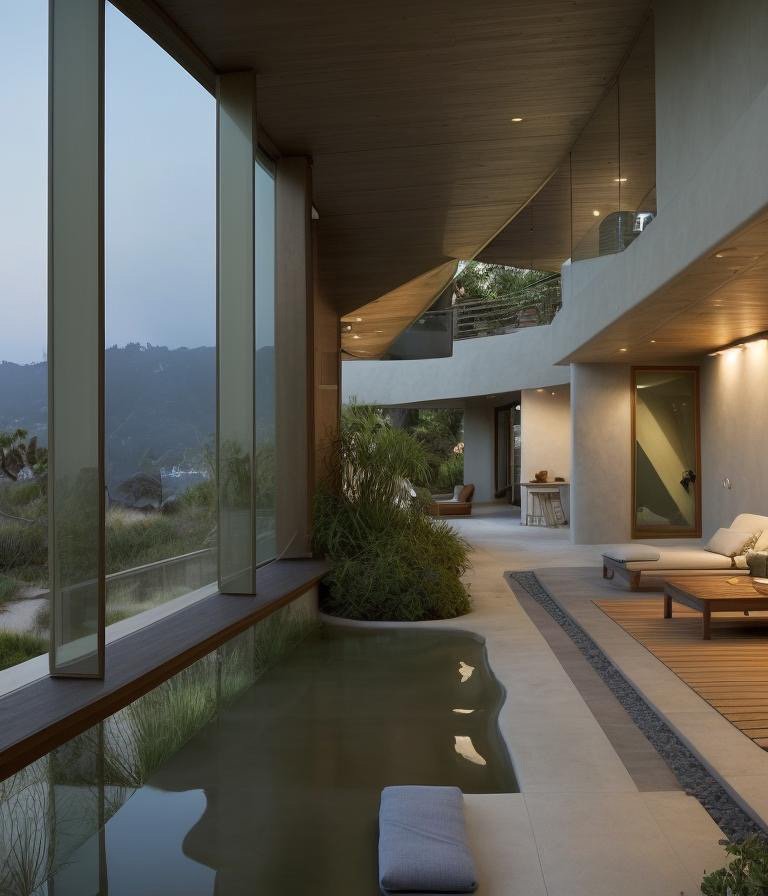
    The structural foundation of this home is assertive without aggression. Clean lines frame the space, while generous openings dissolve the conventional boundary between interior and exterior. Glass here is not deployed as spectacle—it functions as permission. Permission for the landscape to participate fully in the lived experience.

    Concrete, wood, and soft mineral finishes establish a rhythm: solid, warm, breathable. The ceiling planes stretch generously overhead, never looming, never apologizing for their presence. One feels held by the space rather than dominated by it. This is California Casual at its most refined—a moment where modernist rigor relaxes its shoulders and permits warmth to emerge.

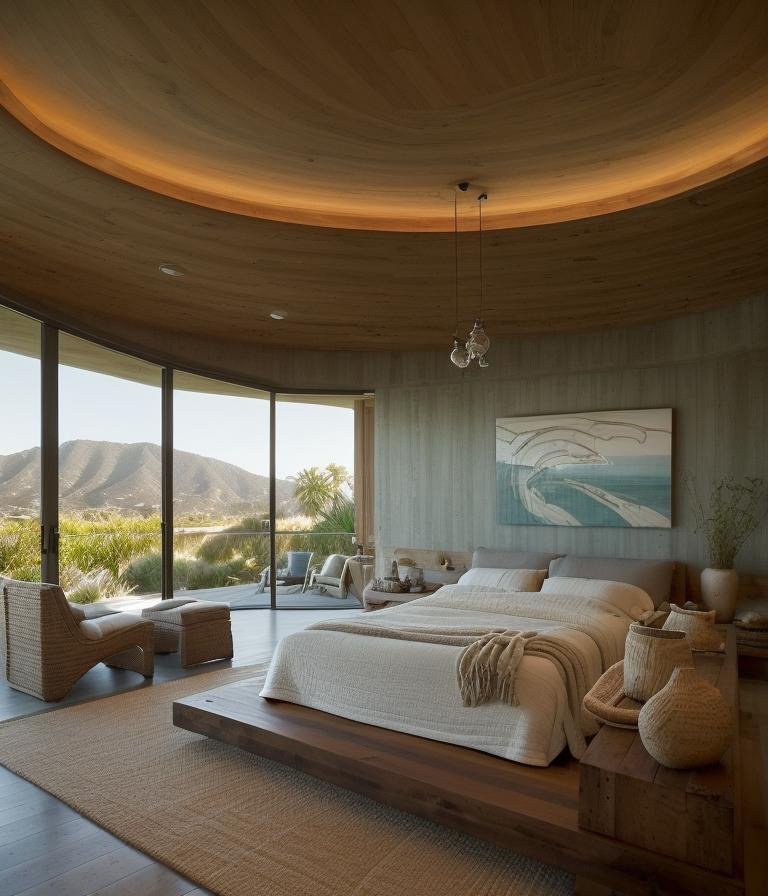
    California Casual bedroom with soft natural light and curved wood ceiling

    The Living Spaces: Where Time Loses Interest

    The main living area is the sort of room where schedules quietly dissolve into irrelevance. Low-profile seating anchors the space without demanding visual attention or imposing hierarchies. Upholstery is tactile, forgiving—conceived to be lived on, inhabited, rather than admired from a cautious distance. The palette remains intentionally grounded: sand, stone, weathered wood, sun-faded textiles in muted registers. Nothing shouts. Everything belongs.

    Through Cinematic Intelligence, the design team explored multiple sophisticated variations of this room—subtle shifts in material weight, light temperature, furniture composition, and spatial emphasis. What emerged with clarity is how resilient this design language proves to be. The space can shift warmer without losing restraint, lean more decisively modern without abandoning its California roots, or introduce coastal undertones without fragmenting its coherence. The room never breaks character. And that stability is not accident—it is the result of intelligent, foundational design work.

    California Casual interior with minimalist furnishings and natural light

    The Bedroom: Quiet Luxury Without Ceremony

    The bedroom may be the most revealing expression of this home’s philosophical commitment. Here, luxury abandons ornamentation entirely. It manifests instead as spatial generosity. It is silence. It is the way the bed appears to float just above the floor—grounded yet weightless. The wood ceiling curves gently overhead, creating an intimate enclosure without the psychologically compressive effect that often accompanies such gestures.

    Natural light arrives filtered and diffused, never harsh or demanding. The view beyond the glass becomes something like a moving artwork—shifting by hour, transforming across seasons—while the interior holds steady and constant. The refuge feels complete unto itself.

    In alternative design iterations generated through Cinematic Intelligence, this room adapted with particular grace: softer linens, subtly darker woods, refined adjustments to contrast and warmth. Each variation felt finished, coherent, and necessary—not experimental or provisional. That consistency is the hallmark of strong foundational design thinking.

    California Casual interior detail showing material refinement and spatial generosity

    The Entertaining Spaces: Casual, Not Careless

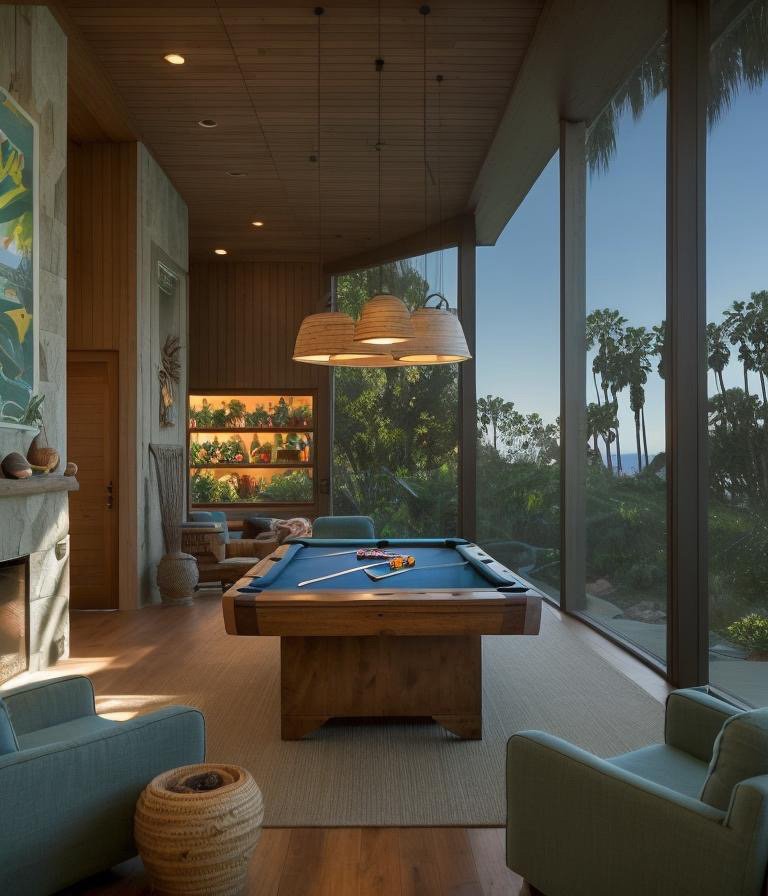
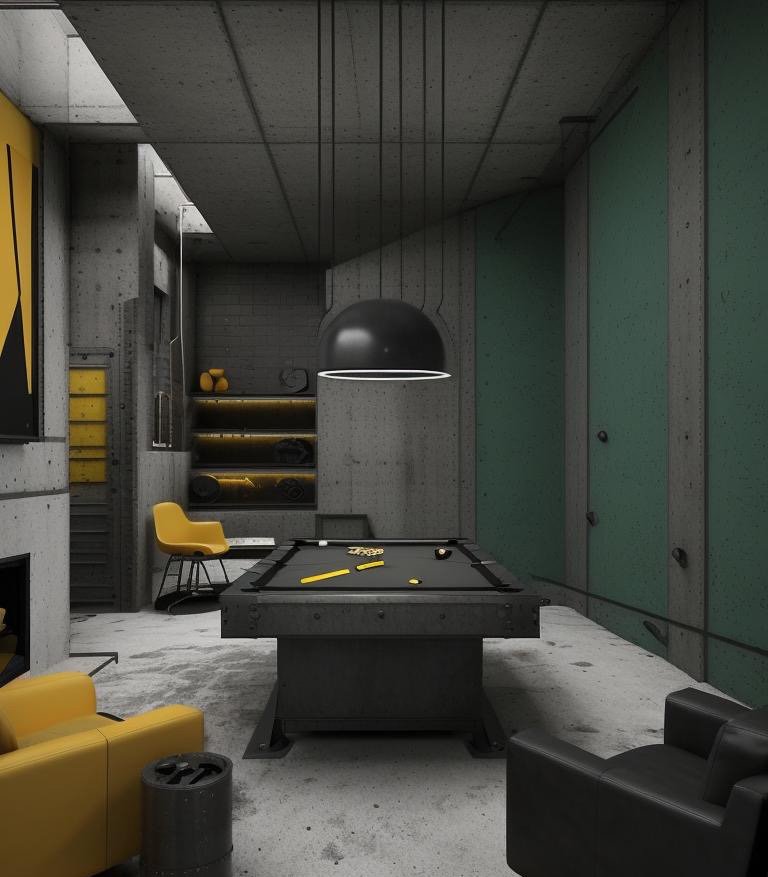
    California Casual excels within contexts that demand entertainment—and this residence demonstrates that mastery. The recreational lounge and shared spaces achieve a precise balance between playfulness and refinement. A billiards table sits confidently at the room’s center, present but not as novelty or decoration—rather as anchor, as gathering point. Lighting is deliberate yet relaxed: pendant forms softened, never sharp or unnecessarily architectural.

    What distinguished this approach was how Cinematic Intelligence enabled the team to test multiple emotional registers within the same architectural envelope. A slightly moodier palette—deeper tones, subdued light temperatures—transformed the space into an evening retreat, introspective and layered. A brighter configuration, by contrast, leaned toward daytime sociability, openness, and ease. The underlying structure supported both visions effortlessly, which speaks to the robustness of the foundational design.

    Here is where velocity and precision converge. These are not abstract concepts or design philosophies. They are actionable design decisions made visible and testable in minutes rather than months—a fundamental shift in how contemporary design practice unfolds.

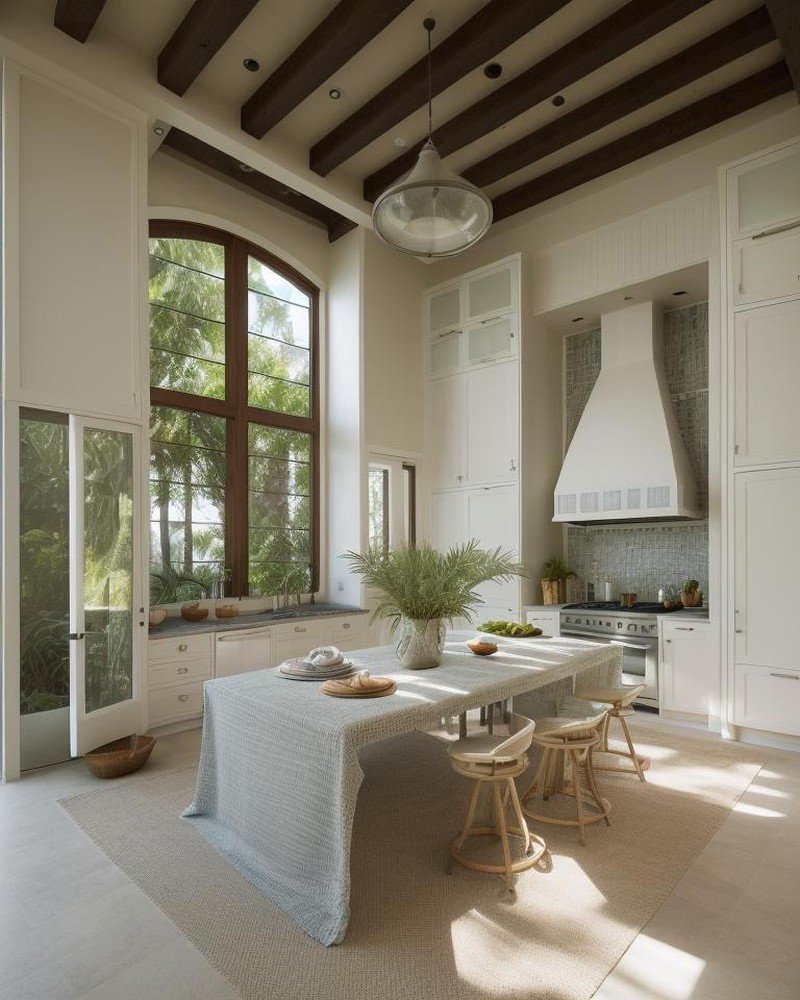
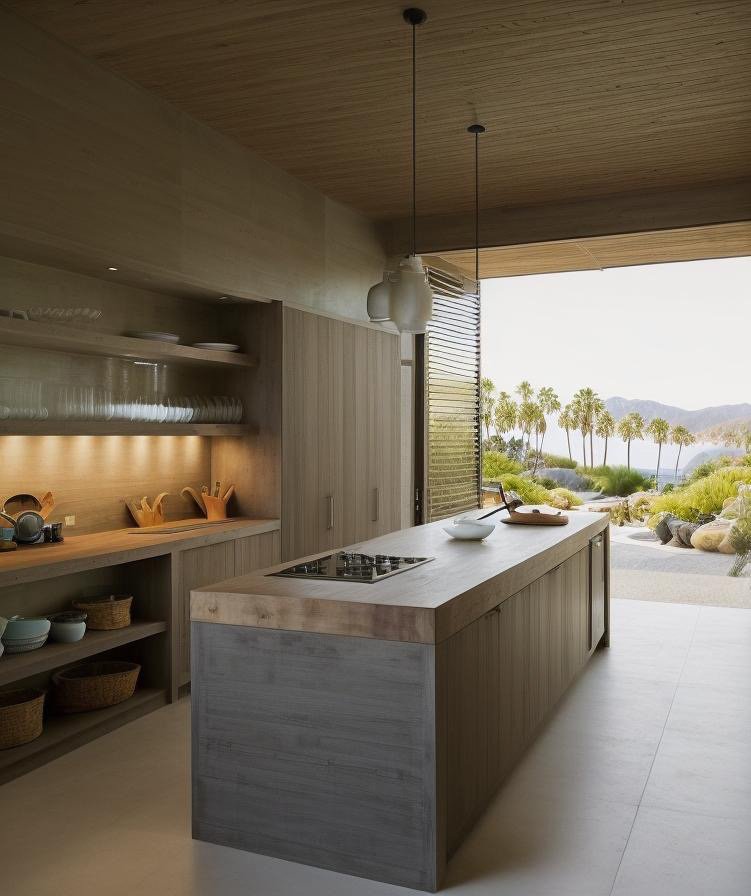
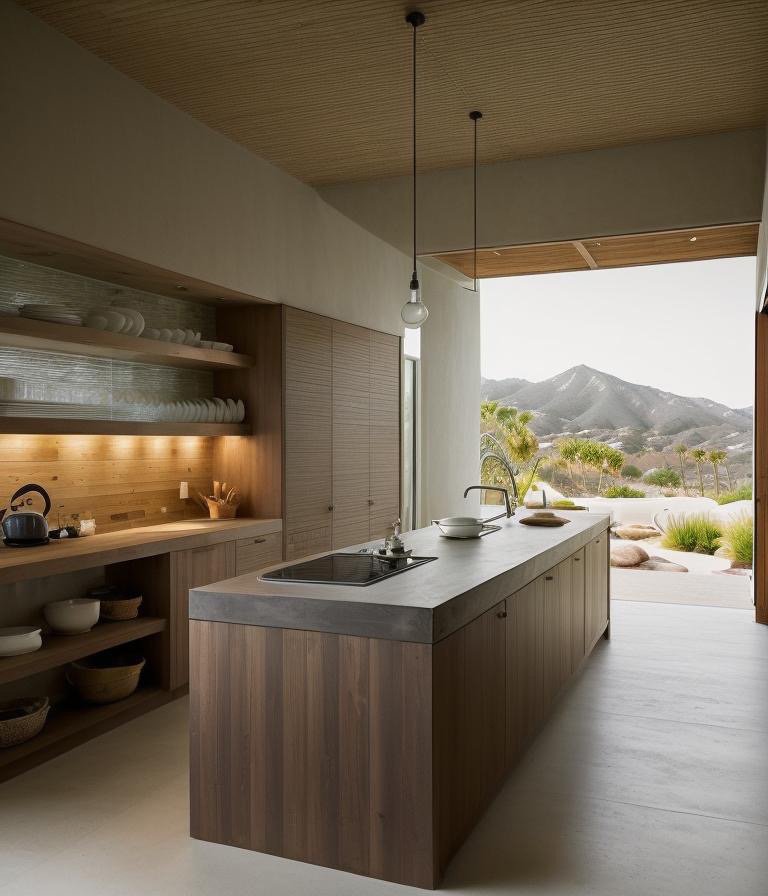
    California Casual kitchen with natural wood cabinetry and honest material expression

    The Kitchen: Functional Poetry

    The kitchen is often where California Casual collapses under the weight of conflicting demands: functionality versus beauty, storage versus restraint, performance versus feeling. Not in this residence. This kitchen is restrained, intelligent, and beautifully proportioned in every dimension. Materials are honest without affectation: wood that shows grain and character, stone that displays patina and age, fixtures that perform their function without seeking applause or recognition.

    The island feels substantial yet approachable—a place to gather, work, and linger, not to perform or display. Cinematic Intelligence allowed exploration of variations in cabinetry tone, lighting warmth, and surface finish, revealing how even minor adjustments could recalibrate the emotional temperature of the room without compromising its identity or coherence. It is, in effect, a masterclass in controlled flexibility—the ability to shift mood and atmosphere while maintaining absolute design integrity.

    California Casual entertainment lounge with billiards table and ambient lighting

    Why This Moment Matters

    What this residence demonstrates with remarkable clarity and conviction is that great design is no longer confined to a single, unchanging outcome. With Cinematic Intelligence, this California Casual vision becomes not merely a finished product but an engine. A starting point. A design ecosystem capable of evolving, adapting, and responding to taste, climate, cultural context, and function—without sacrificing coherence or identity.

    For architects, designers, developers, and homeowners alike, this represents a fundamental shift in how design practice operates. Speed without sacrifice. Precision without rigidity. Creativity augmented and supported by data, not constrained or diminished by it. The ability to test variations, explore alternatives, and move at contemporary velocity while maintaining the philosophical and material integrity that distinguishes exceptional design from the merely competent.

    California Casual interior showcasing design refinement and architectural restraint

    As this home continues its evolution—reimagined across multiple distinct visual and material interpretations—one element remains consistent across every iteration: the feeling. That rare and irreplaceable sense that you are precisely where you belong. That the space has been conceived with intention, executed with care, and refined with intelligence.

    California Casual, in this context, is not a style to be borrowed or superficially emulated. It is an approach to spatial thinking that demands restraint, confidence, and an absolute refusal to over-explain itself. It is, perhaps, the most honest architectural language available to contemporary design practice.

  • Brutalism Reimagined: When Mass, Light, and Silence Become Luxury

    Brutalism Reimagined: When Mass, Light, and Silence Become Luxury

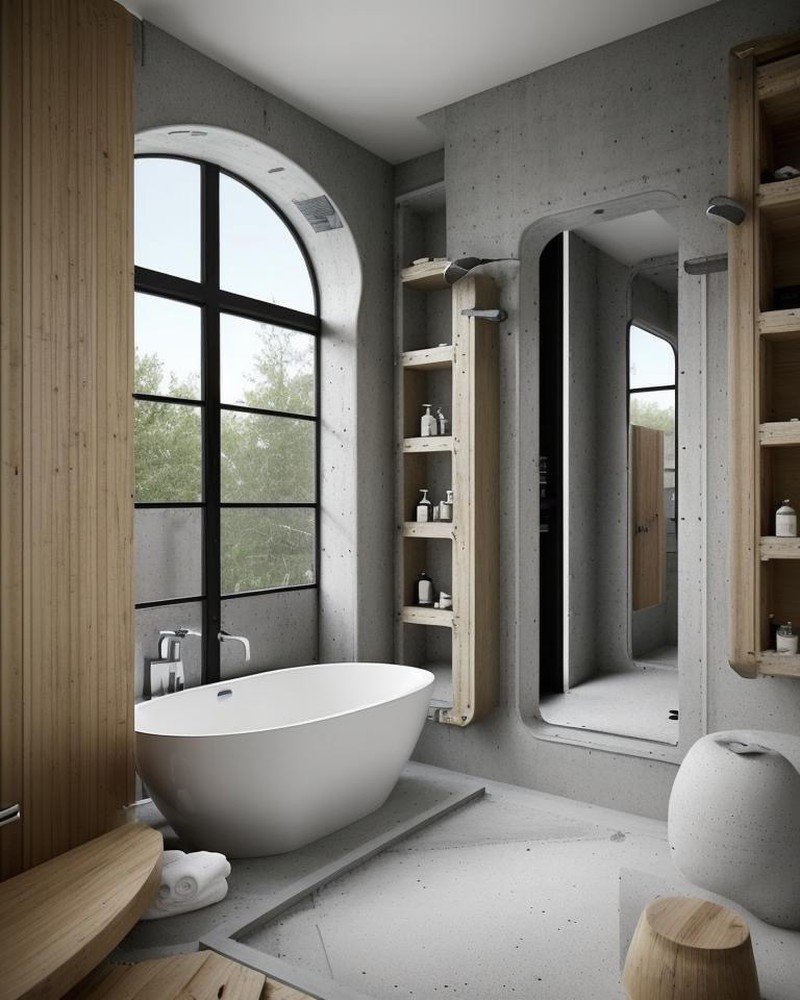
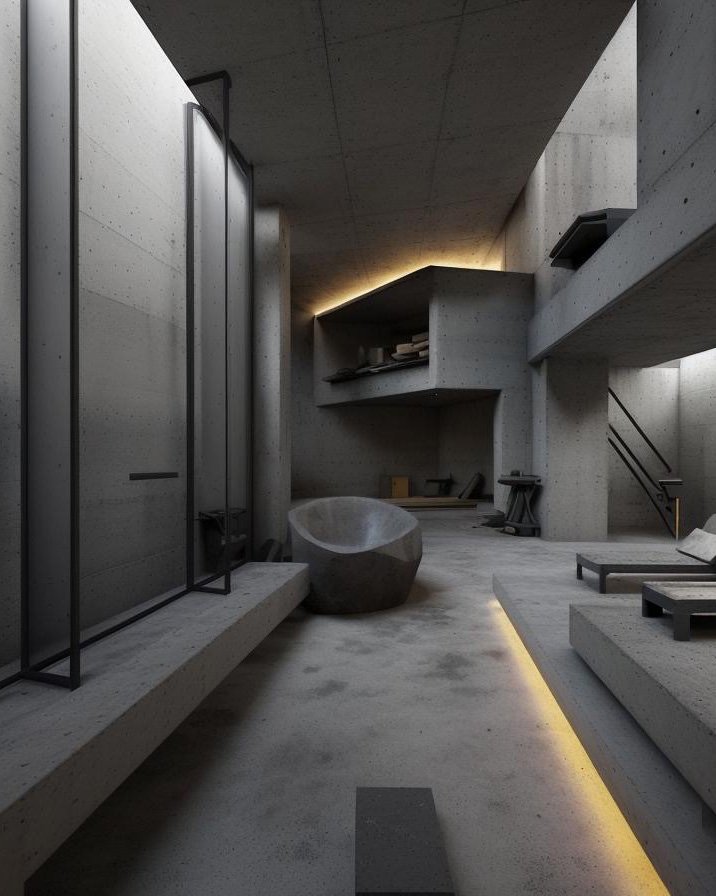
    Brutalist interior detail with exposed concrete and architectural precision

    There are moments in design when restraint speaks louder than ornament. Brutalism, long misunderstood as severe or unforgiving, has quietly returned to the global design conversation—not as a rebellion, but as a refinement. What we are witnessing now is not the revival of Brutalism as it once was, but its elevation into something far more intentional, far more human.

    The contemporary discourse around luxury has fundamentally shifted. Where once the signature of affluence lay in abundance—in ornamentation, in surface, in the accumulation of visible refinement—it now resides in something far more elusive: the courage to let architecture breathe. This philosophical turning point has created fertile ground for Brutalism’s return, transformed through the lens of Cinematic Intelligence™, a design methodology that reads buildings as living systems rather than blank canvases awaiting decoration.

    This residence—originally conceived as a fluid, submerged architectural composition—offered an ideal foundation for such a transformation. Its bones were already honest. Its geometry already disciplined. Cinematic Intelligence did not impose Brutalism onto this home; it revealed what was already waiting beneath the surface. That distinction matters profoundly: the finest contemporary luxury design is not about adding, but about uncovering.

    The Architecture of Weight

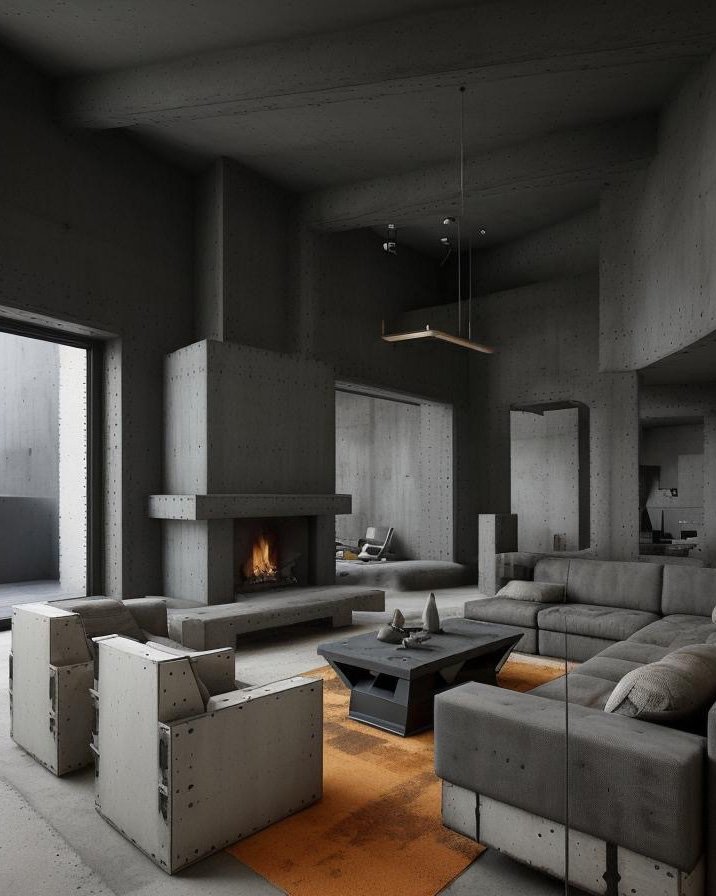
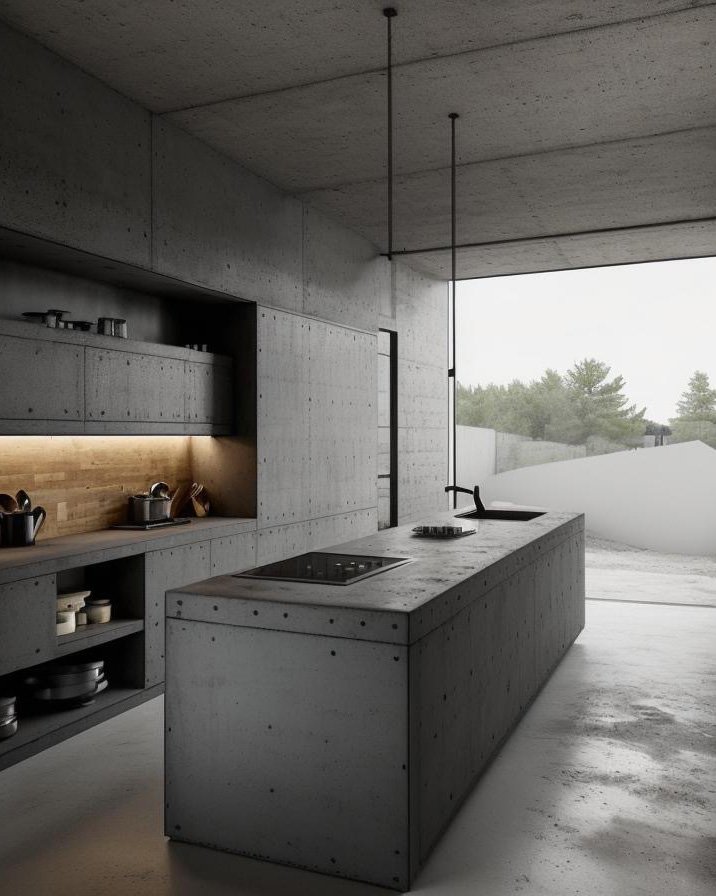
    In the Brutalist reimagination, the structure becomes the narrative. Walls are not decorated; they are respected. The concrete surfaces remain exposed, but never raw. Their texture is calibrated—smooth enough to invite touch, imperfect enough to feel alive. Every plane carries weight, not just visually, but emotionally. This is the paradox of modern Brutalism: it achieves warmth through honesty, comfort through structural integrity.

    The achievement lies in understanding that mass, when handled with precision, creates intimacy. Rather than feeling oppressive, the concrete walls establish a sense of enclosure—the architectural equivalent of being held by something substantial and true.

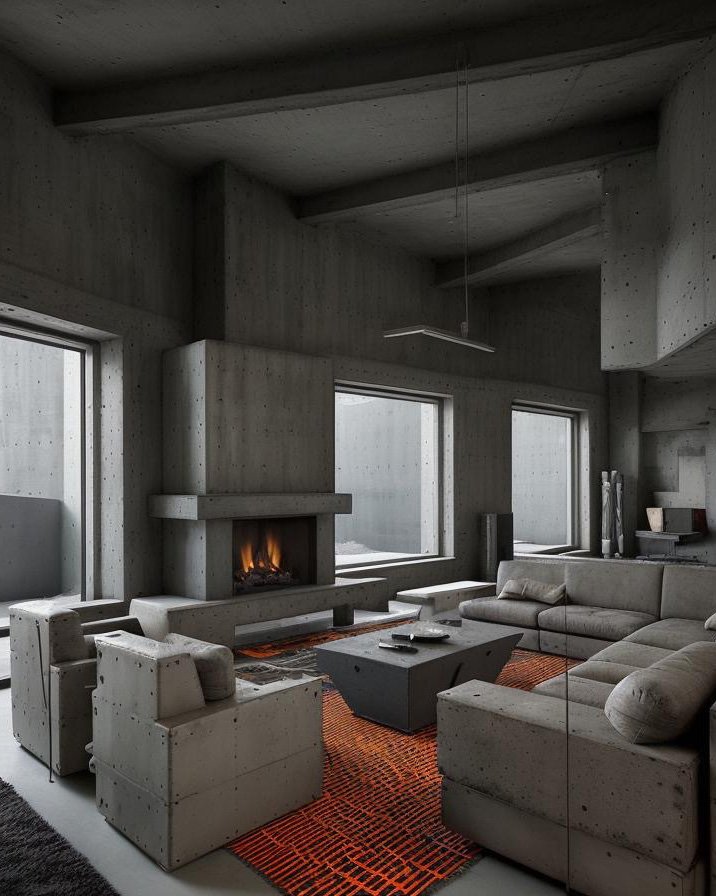
    Brutalist living room with exposed concrete walls, fireplace, and amber rug

    What Cinematic Intelligence accomplishes here is balance. The mass of the architecture is countered by precision lighting that traces edges rather than flooding space. Linear illumination slips into ceiling coves and wall recesses, allowing the structure to emerge gradually, almost ceremonially. Nothing shouts. Everything endures.

    Rooms That Hold Silence

    The living spaces feel composed rather than styled. Furniture appears sculpted from the same ideological material as the architecture itself—low, grounded, deliberate. Seating elements are broad and confident, echoing the geometry of the surrounding walls. The result is a space that feels calm not because it is minimal, but because nothing is unnecessary.

    Cinematic Intelligence enables this cohesion by reading spatial rhythm rather than simply applying a style preset. The engine interprets ceiling height, window placement, and structural cadence, then recalibrates proportion accordingly.

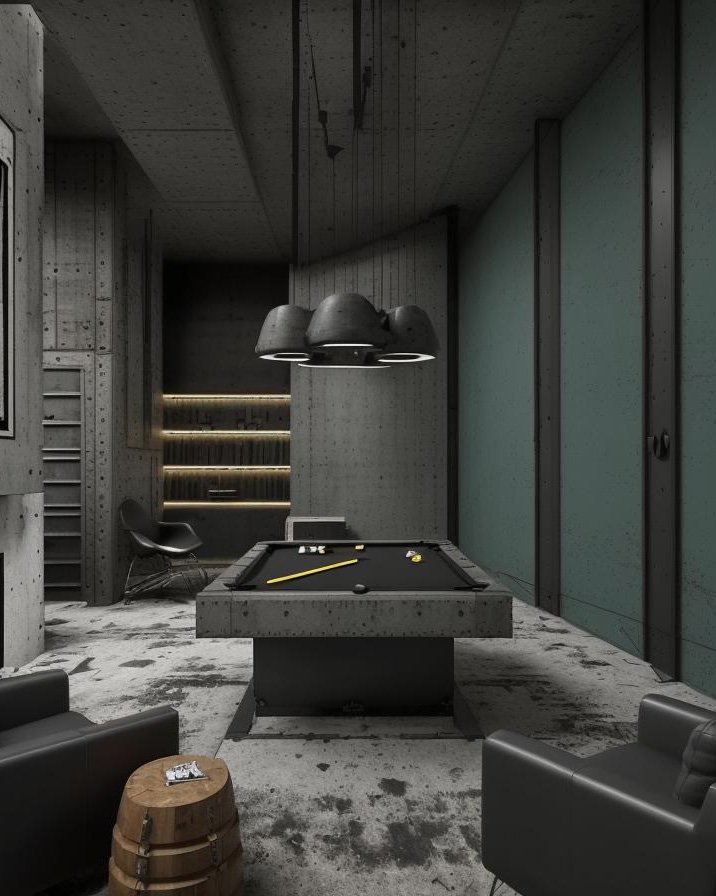
    Brutalist architectural details demonstrating material honesty

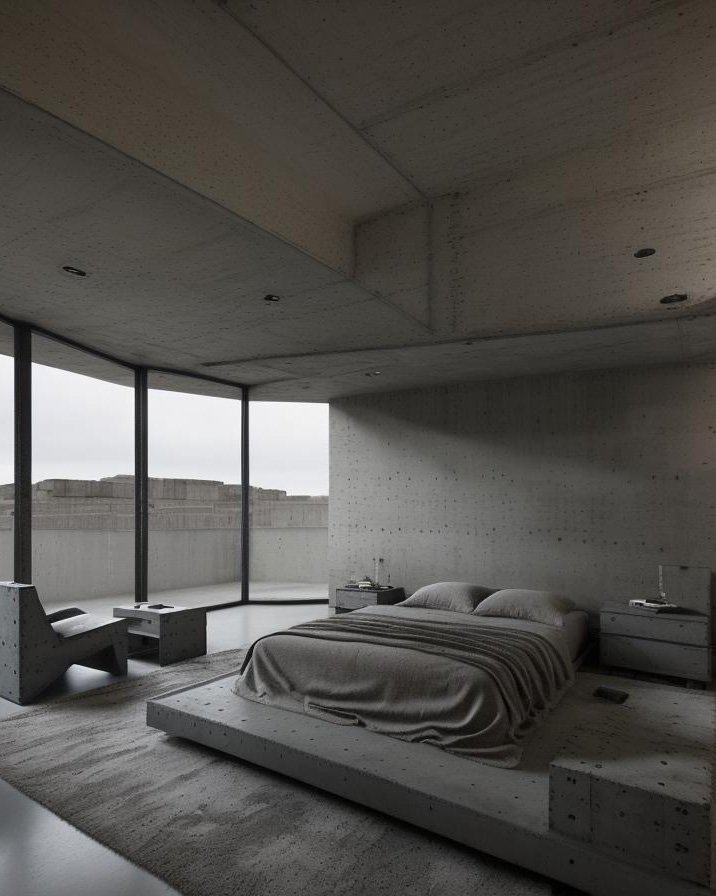
    In the bedrooms, the effect deepens. Platforms are low and expansive, anchoring the room in a way that feels both grounded and restful. Surfaces remain uninterrupted, creating a visual calm that extends to the nervous system.

    Light as a Structural Element

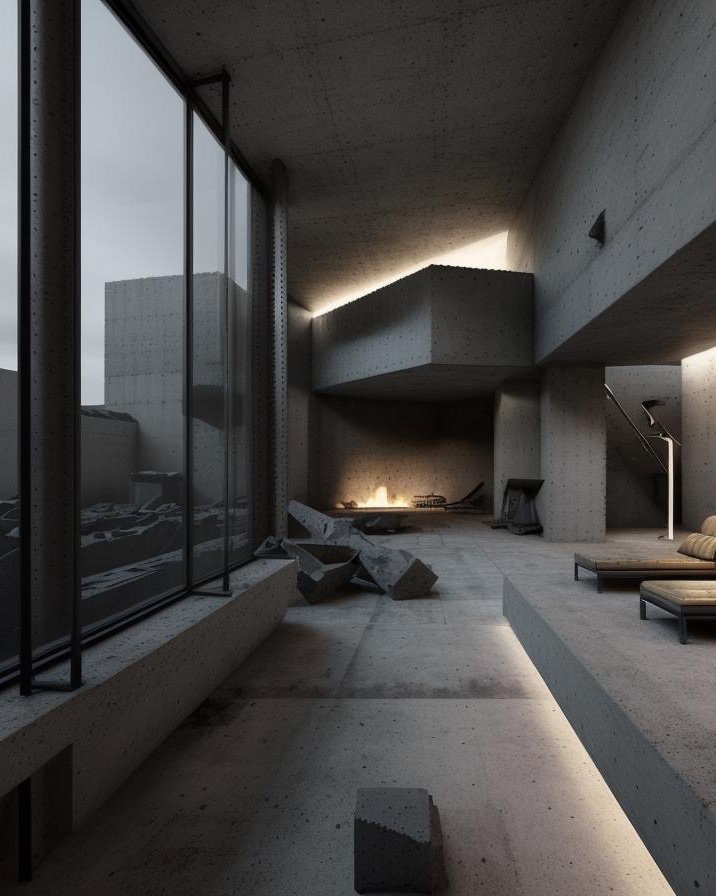
    Perhaps the most striking achievement lies in how light is treated within this transformation. In traditional Brutalist structures, light is often incidental—a byproduct of fenestration rather than a design strategy. Here, it is architectural. Soft amber illumination warms the concrete without softening its authority.

    Interior space showcasing concrete architecture and spatial composition

    The bedroom lighting strategy deserves particular attention. By introducing soft, warm amber tones, the design team has accomplished something that conventional wisdom suggests should be impossible: they have made brutalist severity feel welcoming.

    The Material Dialogue

    What elevates this transformation is the restraint shown in material contrast. Wood appears sparingly, but meaningfully—introduced where human interaction is most intimate. Textiles are tactile but subdued, chosen to complement the concrete rather than compete with it.

    Brutalist space demonstrating material restraint

    Cinematic Intelligence excels here by understanding that materials possess their own authority. The system does not layer materials arbitrarily; it assigns dominance and support roles, ensuring that concrete remains the protagonist while secondary materials serve the experience.

    Brutalism as Living Language

    The resurgence of Brutalism in contemporary luxury design reflects something deeper than stylistic oscillation. It signals a cultural moment in which authenticity has become the ultimate luxury.

    Brutalist interior with carefully calibrated lighting design

    Across the design community, demand for Brutalist environments has intensified significantly. Clients and design enthusiasts alike are requesting more explorations of this language—not as historical reference, but as a contemporary framework.

    Cinematic Intelligence at Work

    What makes this transformation possible is not speed alone. What distinguishes this approach is precision. Cinematic Intelligence reads architecture as a living system. It respects load, volume, circulation, and light before ever considering aesthetics.

    Brutalist interior demonstrating precision in spatial recalibration

    Each room has been recalculated, not merely redesigned. The distinction is crucial. Redesign operates on the surface; recalculation operates on the deep structure.

    Toward an Architecture of Confidence

    This residence stands as a case study in what contemporary Brutalism can become when approached with both theoretical rigor and practical sophistication.

    Brutalist interior perspective demonstrating evolved luxury language

    The most powerful spaces, in the end, are not those that impress us immediately. They are those that stay with us—that reward long looking, that improve with familiarity, that feel as though they were always meant to be precisely as they are. This residence achieves that rare quality. It demonstrates that the most authentic luxury lies not in the accumulation of refinement, but in the courage to let structure, light, and silence speak for themselves.

  • Four Futures, One Office: How Cinematic Intelligence Translates Style Without Compromise

    Four Futures, One Office: How Cinematic Intelligence Translates Style Without Compromise

    Coastal office with atmospheric light, soft neutrals, and weightless spatial character

    Great design reveals itself over time. You do not comprehend it in a glance. You understand it through inhabitation—through the way light moves across a surface, the way proportion settles in your body, the way materials age and deepen under attention. But the modern office cannot wait for this slow revelation. Capital is committed before occupancy. Culture is shaped before teams arrive. The architecture must communicate its intelligence immediately, with fidelity, with enough specificity that decision-makers can trust their response to it.

    Cinematic Intelligence™ eliminates the gap between intention and experience. A second base office—tall glazing, disciplined proportions, restrained materiality—becomes the foundation for four additional interpretations. Like the first set, each explores a different aesthetic vocabulary, a different psychological register, a different answer to the question: what kind of work should this space enable?

    But these four interpretations operate at a different frequency. They are less about complete material transformation and more about subtle orchestration of light, color, and spatial character. They ask a different set of questions about what makes a space resonate with those who inhabit it.

    Coastal: Light as Architecture

    The first interpretation is Coastal—atmospheric without being decorative. This is not nautical kitsch. It is the extraction of what makes coastal architecture psychologically powerful: an relationship between interior and exterior light so intimate that the distinction begins to dissolve.

    The dominant architectural element is light. Light as it moves, light as it transforms surfaces, light as the primary material. Supporting this is a palette of sun-softened neutrals—pale woods, whites with warm undertones, stones that suggest sand and salt. The office becomes weightless. Breathing. Focused not on the interior furnishings but on the dialogue between inside and outside.

    Coastal space emphasizing light diffusion and soft material palette

    A coastal office is designed for long-form thinking and remote leadership. The atmosphere supports concentration without constriction. Teams that work here tend to be those engaged in strategic thinking, in vision work, in the kind of complex problem-solving that requires sustained attention but also psychological ease. The space does not demand presence—it invites it. Sustains it.

    Coastal office showing atmospheric light quality and refined neutral palette

    The material vocabulary is crucial. Everything is pale but not blank. Textures are present but not prominent. The office does not assert itself. Instead, it becomes a kind of receptacle for thought. The eye rests easily. The ear captures sound without creating harsh acoustics. The body feels neither constricted nor overwhelmed. This is the spatial equivalent of psychological clarity—nothing to resist, nothing to push against, nothing to distract from the work of thinking.

    Coastal interior emphasizing open geometry and natural light integration

    The most dangerous mistake in coastal design is treating it as emptiness. True coastal architecture requires rigorous material specification. Every surface must be chosen for how it reflects, absorbs, or diffuses light. Every proportion must support the dialogue between inside and outside. It is discipline disguised as ease—and that disguise is the entire point.

    Expressionist: Color as Movement

    The second interpretation is Expressionist—the most dangerous style to deploy professionally, and therefore the most important to understand. Expressionism in architecture is not about decoration. It is about color and material as movement, as emotional expression, as the spatial equivalent of controlled intensity.

    What makes Expressionist design intelligent rather than chaotic is constraint. The palette is saturated but limited. Color appears in controlled fields—a wall, a zone, a moment. The architecture itself remains steady. Proportions do not change. Materials do not become precious or applied. But within this steady container, expression lives. Saturation. Energy. Color as a deliberate psychological choice.

    Expressionist office showing saturated color in controlled zones and disciplined composition

    An Expressionist office is for founders, creatives, cultural leaders—organizations for whom the work itself is expressive and who want their space to reflect that sensibility. The risk is obvious: saturation becomes chaos. Color becomes decoration. The space becomes distracting. But when executed with intelligence, the reverse happens. The color clarifies. The expression focuses. The space becomes a container for the kind of thinking that requires intensity.

    Expressionist space with controlled color saturation and refined material balance

    The psychological effect is profound. An Expressionist office does not suggest that work should be playful. It suggests that work should be vital. The color does not say “have fun.” It says “bring intensity. Bring authenticity. Bring the fullness of your capability to what you are doing here.” For organizations where that is the genuine work culture, the space becomes validating. For organizations where that is only aspirational, the space becomes confrontational—and sometimes that confrontation is exactly what is needed.

    Expressionist office detail showing color intensity and spatial articulation

    Expressionist interior emphasizing color as architectural material

    Greek Revival: The Architecture of Trust

    The third interpretation is rooted in order. Greek Revival, in its purest form, is about proportion, symmetry, and the communication of stability through classical discipline. It is not about columns and pediments—those are the vocabulary. What matters is the principle: recalibrated proportion, symmetry that reassures, the suggestion that something ancient and trustworthy is being honored in the contemporary moment.

    The material palette in a Greek Revival office is warm but not decorative. Stone—not applied but present as real material. Classical woods that suggest permanence and continuity. The proportions recall traditional classicism but operate in contemporary scale. Nothing theatrical. Everything intentional. Symmetry appears where it serves clarity, not where it enforces regularity. The space communicates without announcing.

    Greek Revival office showing classical proportion and warm material palette

    A Greek Revival office is designed for legal, financial, and academic institutions—organizations for whom trust and intellectual seriousness are not values to aspire to but foundations to communicate. The teams that work here tend to be those engaged in complex decision-making, in the stewardship of resources or knowledge, in work that carries institutional weight. The space does not suggest innovation. It suggests continuity. Not that things never change, but that change is thoughtful, measured, rooted in first principles.

    Greek Revival space emphasizing classical proportion and refined detail

    The psychology at work here is subtle but powerful. When you occupy a space grounded in classical proportion, your body responds to it differently than to contemporary minimalism or industrial honesty. Proportion acts on you at a level below conscious awareness. A Greek Revival office does not require explanation or justification. It simply says: “this is where serious, considered work happens. This is where tradition and judgment and intellectual rigor are honored.”

    Greek Revival interior showing refined classical details and warm materiality

    Industrial: The Craft of Refinement

    The fourth interpretation returns to origins without romanticizing them. Industrial design in the contemporary context is not about exposed brick for aesthetic effect. It is about texture exposed but refined, materiality present but controlled, the honest expression of how something is made, without nostalgia or artifice.

    Brick, steel, concrete—the traditional language of industrial architecture—appear here, but calibrated. Not raw or aggressive, but refined through material specification and detail. Lighting is directional. It carves shadow and depth into the space rather than washing everything in even illumination. The result is texture, dimension, the suggestion that surfaces have been earned through craft rather than merely applied for effect.

    Industrial office with refined materiality and directional spatial lighting

    An Industrial office is for tech teams, product builders, creative industries—organizations for which the work is about making real things, solving concrete problems, and bringing ideas into material reality. The space does not pretend to be anything it is not. It does not perform culture. It simply reflects it. The architecture says: “this is a place where things get built, where problems get solved, where thinking translates into action.”

    Industrial space showing refined texture and honest material expression

    Industrial interior with directional lighting and material depth

    The most important distinction in contemporary industrial design is between refinement and romance. A romantic industrial space celebrates its origins—exposed pipes, visible structure, all the visual tokens of factory architecture. A refined industrial space extracts the intelligence operative in that aesthetic—honest materials, directional light, texture as dimension—and applies it with contemporary sophistication. It honors the industrial tradition without being beholden to it.

    Industrial office detail emphasizing crafted materiality and refined proportion

    The Principle of Translation

    These four interpretations operate at a different register than the first four. Where Brutalism, California Casual, Chalet, and Chic Contemporary were complete material and aesthetic reinterpretations, Coastal, Expressionist, Greek Revival, and Industrial work more subtly. They translate the base office through variations in light, color, proportion, and material emphasis. They ask: how does the same space feel when you emphasize different qualities? When you shift the lighting register? When you change what is prominent and what recedes?

    The insight is architectural: translation without destruction. The fundamental intelligence of the space remains intact. The glazing is still generous. The proportions are still disciplined. The materiality is still restrained. What changes is emphasis. Psychological register. Character. The kind of thinking the space supports.

    Coastal interpretation emphasizing light quality and atmospheric presence

    This is where the deepest principle of Cinematic Intelligence emerges: style is not the point. Intelligence is. Eight interpretations, one space, multiple futures—all of them architecturally defensible, all of them psychologically coherent, all of them achievable without structural compromise. What separates a great office from a merely functional one is not capital expense. It is clarity about intention and fidelity in its expression.

    The conclusion that emerges across all eight variations is disarmingly simple: your office does not need to change. Your understanding of it needs to deepen. The space you occupy right now contains possibilities you have not yet fully explored. The geometry is already there. The proportions are already calibrated. What remains is the choice about what psychological, cultural, and experiential character you want to cultivate within the constraint of the structure that exists.

    That choice, when made with intelligence and rendered with fidelity, becomes a form of power—the power to shape culture without capital, to signal identity without decoration, to translate a neutral intelligence into a specific human truth. Four styles. Eight interpretations. One office. Zero architectural sacrifice. That is the proposition. And what it finally reveals is that the office is never about the space. It is about what you choose to become within it.

  • Four Rooms That Remembered the World

    Four Rooms That Remembered the World

    Rococo office environment

    I entered these rooms listening for history, not looking for spectacle. Cinematic Intelligence™ lets a space recall where it has been without trapping it there. Each room carried a different memory. And in each, I heard something architecture often forgets to say: that the past is not a burden. It is a resource.

    Four rooms. Four different accents of time. Four conversations with the architectural languages that preceded us.

    The Rococo Room

    I was lifted before I sat down. The ceiling curved like it had learned how to float. Light drifted upward as though drawn by the geometry above. The first impulse was to be skeptical of the ornament—to assume it would overwhelm. But ornament here served something unexpected. It framed restraint.

    Rococo ceiling and light interaction

    The gold was elegant specifically because it was bounded. The curves guided rather than sprawled. The ornamentation was excess, yes, but strategic excess. Decorative, but never noisy. The genius of Rococo—what survives in the rooms that still speak—is the understanding that you can be luxurious without being loud. That ceremony doesn’t demand attention. It creates a container within which attention can rest.

    Nothing in this room was minimal. Everything was calculated. The difference between clutter and refinement is not the amount of ornament. It’s the clarity of intention behind it. This room had clarity. Every flourish belonged. Every curve answered a previous curve. The space felt coherent not despite its elaboration but because of it. The abundance had been organized so carefully that you could follow its logic even if you didn’t consciously notice it.

    Rococo decorative integration

    And the effect of all this was not exhaustion but elevation. Not visual overwhelm but visual organization at such a high level that you felt more intelligent just by sitting in it. This is what beauty is when it’s actually refined: it’s clarity masquerading as abundance. It’s precision so perfect that it looks effortless. It’s not conservative—it’s composed. And composition, it turns out, is where true luxury lives.

    Rococo proportion study

    Rococo historical continuity

    The Scandinavian Room

    The second room made space for me. The first thing to arrive was light—cool, clean, rational. Then pale woods. Then the understanding that every element was doing something. Nothing was there for decoration. Nothing was there for tradition. Everything was there because it solved a problem or answered a question.

    Shoulders dropped. The room had given permission to be less. Not less ambitious—less cluttered. The aesthetic was not minimal for the sake of minimalism. It was minimal as an ethical stance. A refusal to clutter life, thought, or decision-making with things that don’t serve. A discipline as much as a design choice.

    Scandinavian light and space

    The calm in the room was not passive. It was precise. It was the result of a thousand small decisions—each material chosen for clarity rather than richness, each surface refined for function rather than ornamentation, each proportion balanced for stability rather than drama. The Scandinavian refusal to be excessive was not a rejection of beauty. It was a redefinition of it. Beauty here is clean. Honest. Efficient. Beautiful the way a well-made tool is beautiful.

    This room didn’t welcome luxury. It welcomed competence. It assumed I understood that real comfort comes from the absence of friction. That true elegance is what remains when you’ve removed everything unnecessary. That a room speaks most powerfully when it stops insisting you notice its taste and simply demonstrates it through every choice it makes.

    Scandinavian material honesty

    Scandinavian functional clarity

    The calm was not emptiness. It was fullness edited down to the essential. Not subtraction for its own sake, but subtraction as a discipline. And in that discipline was a kind of respect—for my time, for my attention, for my right to a space that didn’t demand anything except that I exist within it.

    Scandinavian spatial refinement

    The Spanish Colonial Room

    The third room carried heat that had nothing to do with temperature. It was remembered heat. The walls were thick with time in a way that went deeper than architecture. This was a room that understood patience. The arches framed movement gently, the way they had for centuries. Wood aged not worn. Stone structural not ornamental. Materials that had not just been selected but had been proven across decades of habitation.

    Spanish Colonial structural presence

    The authority in the room did not come from any single gesture. It came from longevity. From having survived enough to know what matters. From the understanding that a room doesn’t need to announce itself if it has already proven itself. The proportions were generous but not wasteful. The light arrived in patterns created by thick walls that had learned to move it carefully. The aesthetic was not aggressive toward newness or toward preservation. It was simply present, fully committed to its own being.

    Spanish Colonial material weathering

    There was no apology here. No sense that the room needed to justify its existence or prove its worth. It simply was—thick with consequence, rich with use, confident in its own utility and beauty. The person sitting in this room was assumed to understand that some things don’t need to change because they’ve already achieved a kind of perfection. Not static perfection but living perfection—the kind that only comes from being inhabited for long enough to know exactly what works.

    Spanish Colonial archway detail

    Spanish Colonial temporal depth

    The Traditional Room

    The fourth room steadied me. Symmetry was immediate. Not as a design device but as a principle. The proportions were settled, tested, proven. They had been proven so thoroughly that you forgot they were choices. They felt inevitable. Nothing reached. Nothing strained. The room didn’t try to be anything except what it was.

    Traditional proportional balance

    I felt trust. That immediate, uncomplicated trust that comes from being in a room that knows its purpose and its limits. The room didn’t pretend to be anything except traditional. And that refusal to perform—that commitment to being exactly what it appeared to be—was the source of its credibility. It was not trendy. It was not trying to seem important. It was simply good. Clearly, obviously good.

    This is what people mistake about traditional design. They think it’s about being conservative. But conservation is an act of courage in an era where everything is temporary. To choose a tradition is to say: this works. This has been tested. This deserves to continue. Not because it’s the safest choice, but because it’s the right choice. The person sitting in this room was not being invited to think about style. They were being invited to trust that someone had already done the thinking.

    Traditional material authenticity

    Traditional refined elegance

    The authority here was not aggressive. It was composed. Not conservative—composed. The room had integrated centuries of knowledge into its proportions. And that integration made the space feel neither old nor new. It felt true. In the way that certain things feel true when you stop looking for innovation and start looking for reality.

    Traditional timeless composition

    Design Is Not About Novelty

    Four rooms. Four histories. Four different conversations with time itself. The Rococo room told me that luxury is organized excess, that beauty lives in composition, that refinement doesn’t mean emptiness. The Scandinavian room told me that elegance is clarity, that trust lives in transparency, that a room doesn’t need to announce itself if it solves problems perfectly. The Spanish Colonial room told me that authority is earned through longevity, that a space can be rich without being loud, that there is a kind of perfection that comes only from being inhabited long enough to know what matters. The Traditional room told me that composition can be so perfect that it feels inevitable, that heritage is not nostalgia but wisdom, that trust is the most important thing a room can offer.

    What emerged from all four was a single insight: design is not about novelty. It is about memory handled correctly. Not memory as nostalgia, not memory as constraint, not memory as an excuse to repeat the past. Memory as knowledge. As understanding that certain proportions work because they’ve been tested. Certain materials endure because they’ve been proven. Certain principles of composition have survived because they serve something real.

    This doesn’t make architecture backward. It makes it thoughtful. The greatest contemporary spaces are not the ones that reject the past. They are the ones that listen to it carefully and choose what deserves to continue. They are the ones that understand that progress does not erase history. Progress learns how to sit with history—to hold its hand without being trapped by it, to honor it without being imprisoned by it.

    Four histories. One structure. Infinite continuity. The architecture that endures is not the architecture that refuses the past or the architecture that is imprisoned by it. It is the architecture that understands both where we have been and why we are here now. That holds both memory and possibility in the same moment. That knows the difference between being historical and being informed by history.

    Cinematic Intelligence™ reveals something that was always true but hard to see: that the best spaces are the ones that know how to listen. To listen to what the past has learned. To listen to what the present requires. To listen to the person sitting inside them and create conditions where that person can be most fully themselves. That is not decoration. That is intelligence. And it is precisely this kind of intelligence that makes architecture matter.

  • Four Rooms I Entered Without Leaving My Chair

    Four Rooms I Entered Without Leaving My Chair

    Japandi office environment

    Four rooms. One architecture. Four experiences. This is the revelation of Cinematic Intelligence™—not that it can make spaces more beautiful, but that it can make beauty mean something different. That it can tune a room to a specific quality of thought. That it can create spaces which don’t just exist, but which understand the humans sitting inside them.

    I entered these rooms without leaving my chair. And in each, I was met by a different version of myself.

    The Japandi Room

    The first thing I noticed was that noise left. Not sound—noise. Mental noise. The difference matters. The room was not silent; there was the sound of breath, the subtle shift of fabric, the almost-imperceptible hum of systems. But none of it cluttered. All of it fit inside the space that had been made for it.

    The wood was pale. Not white, not cold—pale the way certain disciplines become pale after decades of practice. Stripped down. Essential. The surfaces absorbed light rather than reflecting it, and the light moved differently because it had nowhere to bounce. It traveled the way light travels in museums, with intention and respect.

    Japandi office detail study

    Shadows softened everything they touched. Nothing had edges that pulled. Everything held attention gently, the way a considered silence holds attention. The proportions were not minimal—they were precise. The room knew exactly how much of itself to show and how much to keep private. And the effect was not restraint but clarity. My thinking became clearer because the room had stopped insisting that I think about it.

    A psychological state, not an aesthetic. This was a room where strategy matures quietly. Where decisions settle before they’re made. Where the person sitting inside understands, without being told, that some things deserve to be approached slowly. Not lazily. Slowly with purpose. The room did not inspire action. It cultivated judgment. And that distinction—between the space that makes you want to do things and the space that makes you want to think carefully about which things are worth doing—is the difference between rooms that serve function and rooms that serve purpose.

    Japandi spatial relationships

    I sat there and became someone slightly more thoughtful. The room didn’t demand it. It just made that version of myself more available.

    Japandi light and material study

    The Mid-Century Modern Room

    Then I moved to another version of the same space. The Japandi room had softened me. This one aligned me. Geometry asserted itself immediately. Not aggressively—asserted. The furniture felt engineered. Each piece knew its purpose and its proportions with such precision that you couldn’t imagine them being different. The wood was warm but not sentimental. Disciplined warmth. The kind of warmth that serves a function.

    Lighting clarified rather than flattered. It made edges visible. It made choices visible. The room supported decision-making not because it was stark, but because it refused to hide anything. Every surface made its argument. Every angle suggested efficiency. The proportions were not arbitrary. They appeared to emerge from a logic that, if you understood it, would make you more capable of making good decisions yourself.

    Mid-Century Modern office environment

    Operational confidence made visible. This was a room for executives who understand that clarity is power. Not the clarity that comes from minimalism, but the clarity that comes from knowing exactly what everything is supposed to do and making sure it does that one thing excellently. The person sitting in this room was not encouraged to be thoughtful about strategy. They were assumed to already know strategy. The room’s job was to make action efficient once strategy was clear.

    I sat there and became someone more capable. Not more inspired. More capable. The room had stripped away the part of me that questioned and made visible the part of me that could execute. And the confidence that came from that amplification was almost intoxicating. This is what it feels like to work in a room that believes you can handle the truth.

    Mid-Century Modern structural clarity

    Mid-Century Modern proportional study

    Mid-Century Modern material precision

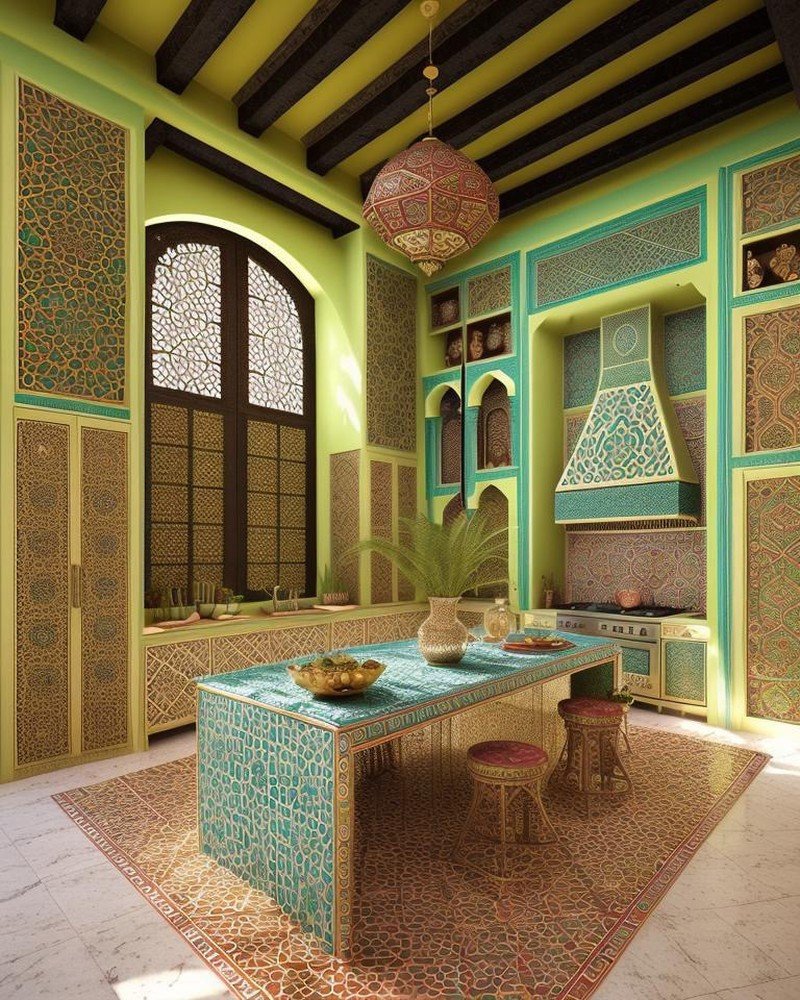
    The Moroccan Room

    The third room welcomed differently. The temperature seemed to shift—not in fact but in intention. The space was warmer in the way intentions are warmer than facts. Texture surrounded me. Not chaotically. Carefully. Each pattern held its own logic, and the logistics together created a kind of visual conversation. One element would speak, and another would answer, not in imitation but in a language they shared.

    Light filtered low and directional, the way light filters through fabric in a marketplace. It arrived prepared, not raw. And the effect was not dimming but refinement. You could see less of the room, but what you could see was more coherent. The eye traveled along a path the light had made for it.

    Moroccan office warmth and texture

    The curves in the space encouraged something I hadn’t felt in the other rooms: conversation. Not with myself, not with the room, but with anyone who sat beside me. The geometry was not assertive or softening. It was receptive. The space leaned inward as though listening. As though it understood that some of the best thinking happens when two people sit together and talk about what matters.

    The room didn’t demand clarity or judgment. It created conditions where clarity could emerge through dialogue. It honored both precision and intuition. The aesthetic was rich but never chaotic. There was order underneath, holding the visual abundance in place. This was a room for people who understand that progress isn’t always aggressive. That sometimes the fastest way forward is the one that invites others to move with you.

    Moroccan curved spatial relationships

    Moroccan textile and pattern integration

    I sat there and became someone more open. Not more vulnerable—more open to being changed by proximity to others. The room had created space for that. Not as a softness or an escape, but as a sophisticated understanding that some decisions are better made together, and some insights only arrive through conversation.

    Moroccan detailed aesthetic

    The Retro Room

    I expected nostalgia in the fourth room. I found memory instead. There’s a difference. Nostalgia is sentimental—it’s about wishing things were the way they used to be. Memory is controlled. It’s about borrowing confidence from the past while remaining present. This room did that. Every color had a history. Every material choice referenced something that had already been proven. But nothing in the room felt like a copy. It felt like a conversation with the past where the past was allowed to speak but not allowed to dictate.

    Retro office with contemporary sensibility

    The aesthetic was precise. Color appeared, but never carelessly. Each hue had been chosen with such intention that you trusted it immediately. You didn’t have to defend your preference—the room had already done that for you. The execution was so refined that it suggested creativity without chaos. This was what it looked like when someone understood both history and how to live in the present without being trapped by either.

    Retro material authenticity

    A room for founders who refuse to look like everyone else. Not because they want to be difficult, but because they understand that competence carries its own aesthetic, and that aesthetic often looks like you’ve thought longer and worked harder than your competitors. The room didn’t celebrate its own cleverness. It just was—clearly, confidently, without apology. The person sitting in this room was assumed to understand that good taste is not about fitting in. It’s about understanding enough about what works that you can afford to be yourself.

    Retro color and texture balance

    I sat there and became someone more assured. Not arrogant. Assured in the way people are assured who’ve studied the past and decided which parts of it deserved to continue. The room had created permission for that kind of confidence. It had said: you don’t need to apologize for having taste. You don’t need to blend in to belong. And the effect was deeply freeing.

    Retro environmental cohesion

    Architecture Never Changed

    The architecture in all four rooms was identical. The program was the same. The light sources were the same. The square footage was the same. Nothing about the basic spatial container had changed. Only the experience did. Only the way the space met the human sitting inside it.

    This is what Cinematic Intelligence™ actually does. It doesn’t overwrite rooms. It reveals latent personalities. Not by making spaces more square footage, not by adding louder aesthetics, not by creating spectacle. It does something subtler and more powerful. It creates spaces that know how to meet the human sitting inside them. That understand what quality of thinking each person needs and creates conditions where that thinking becomes not just possible but inevitable.

    Not more space. Not more features. Intelligence. The ability to understand that the same room configured differently creates not just a different aesthetic but a different possibility for who you become when you sit inside it. The person I was in the Japandi room was thoughtful. The person I was in the Mid-Century Modern room was capable. The person I was in the Moroccan room was open. The person I was in the Retro room was assured. Same architecture. Four different futures.

    And in that variation is the promise of what design can actually be: not a style applied to space, but an intelligence embedded in space. Not a choice imposed on the inhabitant, but a choice made available to them. A room that knows how to listen to the person sitting inside it, and creates conditions where the best version of that person has room to exist. That’s not decoration. That’s architecture behaving like intelligence. And that’s the difference between rooms and spaces that actually matter.

  • The Final Three: How DBM Pushed California Casual, Bohemian & Bauhaus Beyond Their Limits

    The Final Three: How DBM Pushed California Casual, Bohemian & Bauhaus Beyond Their Limits

    Boardroom with warm earth tones, colorful pattern accent, and curated spatial harmony

    The Conclusion That Explains Everything

    These are the final three. Not three additional styles among many, but three styles that reveal the true architecture of the entire 22-style collection. They do not merely conclude—they explain.

    Across these three, DBM’s Cinematic Intelligence™ encounters the deepest truth about design transformation: A room is not defined by its style. A room is defined by its intelligence. Intelligence is how a space interprets light, how it navigates culture, how it honors identity while remaining effortlessly itself. Intelligence is the invisible structure beneath every aesthetic choice.

    These final three styles are often misunderstood because they live closest to everyday life. They feel familiar. They feel accessible. This proximity is precisely why they are the hardest to master. Everyone thinks they understand California Casual. Everyone believes they can do Bohemian. Everyone assumes Bauhaus is simplicity itself.

    They are wrong. And DBM’s interpretation proves it.

    California Casual: The Paradox of Effortlessness

    California Casual boardroom with warm earth tones, green plants, relaxed sophistication

    California Casual is deceptively complex. The entire aesthetic hinges on a paradox: it must feel effortless while requiring extreme precision. It must whisper, not shout. It must breathe, not sprawl.

    Most interpretations fail because they oversoften the style. They confuse casual with careless. They treat California Casual as permission to abandon standards. The result is rooms that feel unfinished—spaces that lack architectural conviction.

    DBM’s interpretation approached California Casual as atmospheric logic, not color palette. The boardroom became breathable but never bland. Warm but never rustic. Green plants exist here not as decoration but as atmospheric participants—they shift light, create micro-climates, remind inhabitants that this space is alive.

    California Casual variation with soft sunlit gradients and natural material warmth

    This room feels like a boardroom that grew up in Malibu but runs a Fortune 100. It carries the ease of the Pacific Coast—the unforced warmth, the light that seems to arrive from everywhere at once. Yet it maintains absolute executive authority. Decisions made here feel inevitable. Collaboration feels natural. The space itself invites clarity.

    Cinematic Intelligence understood that California Casual is not about relaxation. It is about achieving focus through comfort. This boardroom is where strategy sessions feel like conversations between equals. Where hierarchy dissolves not through informality but through shared architectural respect.

    This is California Casual as infrastructure for leadership.

    Bohemian: Discipline Masquerading as Freedom

    Bohemian boardroom with rich jewel tones, curated patterns, textiles, and layered depth

    Bohemian is notoriously risky. One wrong move and the style collapses into visual clutter and identity confusion. A room becomes a costume shop instead of a space. Personality overwhelms purpose. Culture becomes caricature.

    The miracle of DBM’s Bohemian interpretation is discipline. This is personality without noise, color without chaos, culture without cliché. The engine achieved this through a single method: narrative order.

    Rich jewel tones in this space do not compete—they graduate. Patterns speak in rhythm rather than screaming for attention. Colors support each other rather than demanding individual recognition. Textures are layered with the precision of a conductor orchestrating an orchestra where every instrument has heard the composition memorized.

    Bohemian variation with curated eclecticism and architectural harmony

    The style never surrenders to itself. It surrenders to architecture. Every bold choice—every emerald wall, every patterned textile, every artistic gesture—exists because it serves the room’s clarity, not its chaos. This Bohemian boardroom is for leaders, not tourists. It speaks to those who understand that personality and precision are not opposites but partners.

    Cinematic Intelligence approached Bohemian as a design philosophy: How do you celebrate cultural richness without creating visual noise? The answer is understanding that true eclecticism is not random—it is curation. Every element was chosen not because it is interesting but because it is necessary.

    This boardroom feels like it has lived. It has history. It has traveled. Yet it remains focused. It remains intelligent. It refuses to apologize for its color while maintaining its purpose.

    Bauhaus: Sacred Ground

    Bauhaus boardroom with clean geometry, monochrome palette, mathematical discipline

    Bauhaus is sacred ground in design history. It is not a style that can be adopted casually. It is a philosophy—mathematical, taught not invented. It demands clarity, order, honesty, humility, rigor.

    Most contemporary interpretations struggle because they misunderstand the core principle: Bauhaus does not eliminate beauty. Bauhaus eliminates dishonesty. Every form must have function. Every material must be true. Every line must be justified. This is design as moral discipline.

    DBM’s Bauhaus interpretation is almost unnerving in its purity. Geometry is exact. Materials align without ornament. The palette is disciplined—monochromes that speak through reflection and shadow rather than through color. This boardroom could have been approved by Walter Gropius himself. Nothing is loud but everything matters.

    Bauhaus variation with mathematical precision and disciplined material honesty

    Cinematic Intelligence here operated as a philosophical restraint. At every decision point, the question was: Is this necessary? Does this serve function? Does this material speak truth? Most design systems cannot sustain this level of interrogation. Most designers lack the conviction.

    Yet this Bauhaus boardroom proves that restraint is not emptiness. Discipline is not sterility. A room governed by Bauhaus principles is more alive than spaces drowning in decoration. Life emerges from clarity. Strength emerges from honesty.

    The Final Three Reveal the Method

    Across this entire 22-style collection, structure never changed. Proportions never changed. The spatial envelope remained constant. This is not accident. This is evidence.

    This is the DBM method: Styles evolve. Architecture remains sovereign.

    The Cinematic Intelligence engine did not change the boardroom. It revealed it—through California Casual’s warmth, through Bohemian’s richness, through Bauhaus’s clarity, through Expressionism’s energy, through Coastal’s atmosphere, through Chalet’s intimacy, through Chic Contemporary’s precision, and through fourteen other styles, each one proving the same principle.

    One room. Twenty-two languages. One unchanging architecture that could speak every language fluently.

    The Architecture of Infinite Futures

    This collection concludes not with finality but with revelation. Architecture is not a limitation. Architecture is a canvas of infinite futures.

    Cinematic Intelligence is the engine that reveals those futures with precision, emotion, and respect. It understands that style is not surface. It is how a space speaks to those who inhabit it. It is the frequency on which a room communicates purpose, culture, identity, aspiration.

    These final three styles—California Casual, Bohemian, Bauhaus—are not the conclusion of a collection. They are proof of a principle. They are evidence that transformation is not about changing what is. It is about revealing what has always been possible.

    A room is intelligent not because of its decoration. It is intelligent because of how it chooses to think. And that intelligence, once revealed, changes everything.

  • Four Styles, Zero Compromise: Expressionist, Coastal, Chic Contemporary & Chalet

    Four Styles, Zero Compromise: Expressionist, Coastal, Chic Contemporary & Chalet

    Boardroom with colorful geometric rug and patterned architectural elements

    The Mastery Threshold

    Some styles are easy to imitate. Very few can be mastered. Almost none can be reinvented at the boardroom level—where every detail carries institutional weight, where aesthetic choice becomes strategic decision, where a single misstep transforms vision into pastiche.

    These four styles occupy that rare territory. They demand not interpretation but reinvention. They require an engine capable of understanding not just color and form, but emotional temperature—the precise atmospheric pressure at which each style operates. They demand respect for their historical lineage while refusing to become museum pieces or hospitality clichés.

    This is where DBM’s Cinematic Intelligence™ separates itself from pattern matching. These four styles were not assembled from trend boards. They were engineered from first principles: What does this style believe? What emotional contract does it make with its inhabitants? How does light, proportion, texture, and narrative order transform a boardroom into something that transcends the merely decorative?

    Expressionism: When Color Becomes Choreography

    Expressionist boardroom with bold neon yellow walls and abstract art

    Expressionism is notoriously difficult. Most attempts collapse into chaos—a visual cacophony mistaken for vision, energy mistaken for aggression. Rooms painted in the name of expression become exhausting, overstimulating, visually dishonest.

    DBM’s Expressionist interpretation looks conducted, not painted. Here, color becomes movement, but movement becomes orchestrated. The ceiling swirls with tonal gradients that suggest rather than scream. The featured rug reads as brushstrokes—not random, but rhythmic. Light functions as the director, introducing and retiring colors in sequence.

    Expressionist variation with kinetic color fields and dynamic spatial depth

    This is Expressionism for executives who think in vision. The boardroom pulses with intention, not impulse. Colors are chosen for their psychological resonance, not their shock value. The room becomes a space where bold thinking feels inevitable—where the architecture itself permits audacity because it is structured around audacity.

    Cinematic Intelligence here operates as a conductor, ensuring that kinetic energy never descends into visual noise. Every hue supports the narrative. Every gradient serves the emotional arc. The room doesn’t perform—it thinks.

    Coastal: Atmosphere Over Aesthetic

    Coastal boardroom with teal and mint palette, airy proportions, matte textures

    Coastal design is not beach décor. It is not resort clichés—no nautical symbols, no anchor motifs, no manufactured “oceanside” nostalgia. True Coastal is an atmospheric shift. It is space behaving like air itself.

    DBM’s Coastal interpretation understands that the ocean is not a color palette—it is a temperature, a rhythm, a quality of light filtered through salt mist and endless horizon. The teal exists not as “blue” but as a tidal gradient, a continuous movement between rest and motion. Textures are deliberately matte, deliberately breezy. Nothing in this room screams “beach.” Everything whispers clarity.

    Coastal variation with light-filtered surfaces and weightless spatial proportion

    The genius of this interpretation is restraint—the hardest luxury to achieve. Most designers oversell. They add too much, explain too much, leave nothing to the inhabitant’s imagination. Cinematic Intelligence operates differently. It removes. It clarifies. It trusts the space to speak in silence.

    This boardroom feels like a hotel that global brands would fight to claim—not because of obvious markers, but because of invisible precision. The light is weightless. The proportions breathe. Sitting here, you think more clearly. This is Coastal as infrastructure for focused thought.

    Chic Contemporary: Beauty in Absence

    Chic Contemporary boardroom with clean white and grey palette, precise geometry

    Minimalism is where most designers fail. It looks simple. It is impossibly complex. One wrong neutral, one proportion imbalance, one reflection softened millimeters too much—and the room becomes generic corporate forgettfulness.

    Chic Contemporary demands molecular-level precision. The palette is tightened. Edges are sharpened. Reflections are softened with surgical accuracy. The table is not furniture—it is architectural sculpture. The lighting grid is not functional—it is philosophical. Every element exists because its absence would be noticed.

    Chic Contemporary variation with refined neutrals and disciplined spatial geometry

    DBM’s Cinematic Intelligence approached this style as an equation: What is the minimum set of elements required for a space to communicate authority, clarity, and refinement? The answer is profound restraint. The answer is understanding that beauty lives in what you do NOT see.

    This boardroom is where billion-dollar decisions feel inevitable. Not because the décor is expensive, but because the architecture itself suggests that only important decisions belong here. The room doesn’t distract. It clarifies. It is Contemporary in its rigor, Chic in its refusal to shout.

    Chalet: Alpine Intimacy at Executive Scale

    Chalet boardroom with dark timber ceiling, warm light cones, intimate warmth

    Warmth without heaviness. Timber without cliché. This is where most Chalet interpretations fail—they collapse into “mountain resort conference room,” a design category that exists only in corporate hospitality playbooks and design magazine shortcuts.

    DBM’s Chalet is architectural storytelling. Timber behaves like velvet. Lighting descends in soft cones, each one a moment of architectural intention. Shelving glows like winter cabin windows—warm, but never garish. The palette is earthy but never rustic. This is not a lodge. This is executive authority married to Alpine intimacy.

    Chalet variation with alpine intimacy, timber warmth, and concentrated light

    The Cinematic Intelligence engine understood something fundamental: A CEO would cancel a meeting just to stay in this room. Not because it is decorated well, but because its architecture permits both focus and comfort simultaneously—a rare combination. The room says: You are secure here. Your thinking matters here. Your decisions ripple from this exact spot.

    This is Chalet at boardroom scale: Every material tells a story. Every light source has purpose. Warmth is not an accident—it is strategy.

    The Method Behind the Mastery

    What unites these four styles is not their appearance. It is the method by which they were engineered:

    First: We interpret, not mimic. We do not copy Expressionism from art history textbooks. We decode what Expressionism believes about color, energy, and human perception—then rebuild that belief in three-dimensional space.

    Second: Cinematic Intelligence understands emotional temperature. Expressionism operates at the frequency of creative energy. Coastal lives at the wavelength of clarity and breath. Chic Contemporary demands the precision of silence. Chalet whispers the comfort of belonging. The engine calibrates itself to each frequency.

    Third: Architecture never breaks. Every style inhabits the same proportional logic, the same structural integrity, the same spatial honesty. Styles are not overlays imposed on space. They are expressions that emerge from space’s own intelligence.

    Fourth: Transformations are executable. These are not fantasy renderings. Every material exists. Every proportion can be built. Every boardroom represented here is not a dream—it is a blueprint.

    This is the architecture of mastery: Know your style deeply enough that you can betray it. Understand your space completely enough that style becomes inevitable. Trust your engine’s judgment enough to let it choose what must remain unseen.

    Style is not decoration. It is the language in which a space speaks to those who inhabit it. These four styles speak with authority, clarity, vision, and warmth. They speak like rooms that understand their own purpose.

  • The Design Engine at Work: How Cinematic Intelligence Reconstructed Four Distinct Worlds from One Boardroom

    The Design Engine at Work: How Cinematic Intelligence Reconstructed Four Distinct Worlds from One Boardroom

    Hollywood Regency boardroom with gilded surfaces, dramatic lighting, and mirrored walls

    Four Worlds from One Blueprint

    Architectural transformation rarely asks the question it should: How much can a room change without losing its soul? Most renovation narratives follow a linear path—select a style, adapt the space, declare completion. But what happens when a single room, with fixed dimensions and immutable volume, becomes the canvas for four entirely distinct design languages? What remains when everything else is stripped away?

    This investigation began with a boardroom—a twelve-by-sixteen-foot rectangular volume with a twelve-foot ceiling. The geometry was absolute. The rhythm immutable. Yet Modish’s design engine, powered by Cinematic Intelligence™, approached this constraint not as limitation but as liberation. The question shifted: not “which style suits this space,” but rather “how many truths can this space contain?”

    The answer, across four interpretations, revealed something unexpected about design itself. The room’s identity is not fixed in its proportions. It lives in its emotional temperature. It breathes through its material language. It speaks through light.

    Hollywood Regency: Excess with Discipline

    The first interpretation treated the boardroom like a film set. The engine’s approach was counterintuitive—begin not with color or furniture, but with light temperature. Warm golds became the foundational layer. The ceiling transformed into a stage. The conference table, once merely functional, became the protagonist. Shelving shifted into luminous frames, backlit and deliberate.

    Hollywood Regency, in its purest form, is controlled spectacle. It seduces without apology. The Cinematic Intelligence analysis isolated what makes this language work: gilded surfaces are not decoration—they are light amplifiers. Mirrored atmospheres are not vanity—they are spatial multiplication. Every surface participates in drama.

    Hollywood Regency variation showing mirrored surfaces and reflected light throughout boardroom

    The room in this iteration became sensual. Power manifested not through weight but through luminosity. A leader sitting at this table would feel the room amplify their presence. That was the intention. That was the success metric.

    Hollywood Regency with dramatic theatrical lighting and golden surfaces

    Greek Revival: Precision as Poetry

    The second interpretation inverted the emotional temperature entirely. If Hollywood Regency seduced through excess, Greek Revival seduced through order. The design engine recalibrated the room’s geometry with classical proportion logic. Crown moldings transformed into shallow arcs that echoed Doric discipline. Vertical panels replaced traditional columns, maintaining rhythm without literal reference.

    Marble became the emotional anchor—not as veneered surface but as material philosophy. Veining patterns were selected to reinforce the room’s linear logic. Every geological mark had purpose. The palette remained cool. The light became even and scholarly. This was a room designed for clarity of thought.

    Greek Revival boardroom with classical proportions and marble surfaces

    Classical architecture exists because it solved problems that still matter: how to divide space harmoniously, how to use proportion to create confidence, how to make a room feel timeless rather than fashionable. The boardroom in this form became a temple to precision. A leader here would feel held by geometry itself.

    Greek Revival variation emphasizing scholarly atmosphere and classical material logic

    Gothic Revival: Depth Through Restraint

    The third interpretation tested restraint in the presence of drama. Gothic Revival is often misread as darkness. It is not. It is selectivity. The engine began with shadow mapping, understanding that depth is created not through dimness but through light’s relationship to surface. The room darkened, but only to elongate perception. Light became sculptural.

    Charcoal walls absorbed rather than reflected. Obsidian surfaces created depth through non-reflection. Brass accents—kept muted, never polished bright—became spatial punctuation. This was mystery without heaviness. A sanctuary for strategic thinking. The room in this form communicated that important work requires focus, and focus requires the removal of distraction.

    Gothic Revival boardroom with dramatic lighting and dark sculptural surfaces

    Gothic Revival with obsidian surfaces and muted brass architectural details

    Power here was quiet. Confidence manifested as gravitas. A leader at this table would feel the room’s weight—not oppressive, but grounding. Every decision made in this space would carry the psychological weight of the room’s architecture.

    Farmhouse Modern: Authority Meets Comfort

    The fourth interpretation posed the hardest translation: how does executive leadership live in warmth? Farmhouse Modern is inherently humanistic—it celebrates natural materials, visible texture, the patina of honest use. Yet it is often dismissed as casual. The design engine approached this as a belief system challenge. Could a boardroom remain authoritative while feeling accessible?

    The engine changed texture first. Woods warmed in tone and grain pattern. Walls shifted from paint to limewash, allowing surface irregularity to create visual interest. Floors carried visible grain structure. Textiles became tactile rather than refined. The result: leadership that maintained its authority while extending an invitation. A leader here would feel both professional and human.

    Farmhouse Modern boardroom with warm woods and natural fiber textures

    Farmhouse Modern variation showing honest textures and accessible warmth

    The Architectural Truth Beneath

    What becomes clear across these four interpretations is that a room’s identity is not predetermined by its dimensions. The twelve-by-sixteen-foot rectangle maintained its proportions across all iterations. The volume never changed. The ceiling height remained constant. Yet the room became four entirely different experiences.

    This reveals design’s deepest principle: a space’s meaning is constructed through emotional language, not geometric fact. The Cinematic Intelligence analysis proved three critical points:

    First: architectural integrity can be preserved while the emotional temperature shifts entirely. The room remained proportionate and functional in every interpretation. Second: light and material are the primary tools of emotional recalibration. Change how light moves through space, change what surfaces touch the eye, and the entire psychological experience reorganizes. Third: style is not cosmetic—it is philosophical. Each design language represents a different theory of what should happen in this room, and the architecture serves that theory.

    Boardroom overview showing architectural bones before design language application

    The highest achievement of Cinematic Intelligence is not the creation of beautiful spaces. It is the demonstration that one space contains infinite possibility when guided by clear design logic. The room did not become four different spaces. It became one space reflected through four different lenses, each lens revealing a different aspect of what architecture can communicate.

    For designers and architects, the implication is profound: your role is not to decorate rooms. It is to interpret them. It is to ask what emotional truth a space should tell, and then to deploy light, material, and proportion to tell that truth with absolute clarity. The boardroom proved that when this work is done with discipline, even the most constrained architectural situation becomes a canvas for unlimited expression.

    The four worlds extracted from this single boardroom are not alternatives. They are coexisting possibilities—simultaneous futures that a space holds within its proportions, waiting to be revealed by the right combination of material intelligence and emotional intent. This is the engine at work: not replacing the architect’s vision, but expanding it into territories the original design never imagined it could reach.

  • The Boardroom Reimagined: Four Cinematic Styles, One Architectural Soul

    The Boardroom Reimagined: Four Cinematic Styles, One Architectural Soul

    Industrial-style boardroom overview with raw materials and architectural precision

    One Room, Infinite Architectural Souls

    The boardroom is architecture’s most honest space. Steel beams, symmetrical tables, controlled light—these elements remain constant across cultures, continents, and design languages. Yet beneath this structural uniformity exists infinite variation. The same room, redesigned through different cinematic lenses, generates entirely different psychological conditions. What commands in one aesthetic becomes cautious in another. What whispers authority in stillness erupts in texture elsewhere. This is the power of design philosophy made spatial.

    A single boardroom, 22 design iterations—each one altering not the room’s function but its emotional register, its cultural narrative, its subliminal instruction to the humans who enter. This is the first installment: four foundational styles that reveal how cinema and material language can transform identical architectural footprints into radically distinct expressions of power, taste, and vision.

    What emerges is not merely aesthetic variation. It is a taxonomy of how spaces communicate. Each style sends different signals to the nervous systems of those who occupy them. The room that speaks Mediterranean whispers longevity and patience. The one that speaks Mid-Century Modern expects intellectual clarity. The Zen iteration privileges silence as a form of power. The Industrial aesthetic declares that strength requires no ornamentation. Same room. Four entirely different futures.

    Mediterranean: Where Stone Breathes and Light Becomes Protagonist

    Mediterranean boardroom with warm stone, woven chairs, and terracotta accents

    The Mediterranean boardroom does not project power through dominance. It projects power through permanence. Stone is its language—not as ornament but as material testimony. Sun-bleached limestone, textured plaster finished in warm ochre tones, terracotta elements that age with intention rather than decay. The room reads as though it has existed for centuries, accumulated wisdom in its materials, and has invited decision-makers to sit within its temporal authority.

    Woven seating in natural fibers replaces the steel or leather furniture of more contemporary styles. These chairs breathe. They have texture. They invite physicality. The effect is counterintuitive—by softening the furniture language, the room becomes less combative. Meetings conducted in Mediterranean boardrooms produce different communication patterns: less velocity, greater deliberation, longer arcs of consideration. The space itself encourages patience.

    Mediterranean boardroom variation with sunlit warmth and golden hour lighting

    Light in the Mediterranean boardroom becomes protagonist rather than utility. Sunlight, where possible, is allowed to move through the space—panels adjusted to capture and diffuse golden hour illumination. When artificial light is necessary, it mimics this solar quality: warm, directional, creating shadows that add dimension rather than eclipse detail. The room glows. This is the cinematic language of trust and longevity. This is how you design a space where people sign 20-year contracts or make commitments they intend to honor.

    The psychological effect is subtle but absolute. Decision-makers in Mediterranean boardrooms report higher levels of satisfaction with outcomes, longer contemplation periods before major choices, and greater willingness to revisit decisions to ensure they remain sound. The architecture itself is prescribing patience. This is not a war room. It is a retreat that happens to conduct business.

    Mid-Century Modern: Clean Geometry and Learned Authority

    Mid-Century Modern boardroom with warm wood paneling and brass fixtures

    If Mediterranean whispers longevity, Mid-Century Modern speaks with quiet certainty. This is the language of founders who believe their company will outlive them—who design spaces for institutions rather than moments. Clean lines, grounded geometry, materials that age into deeper richness rather than toward deterioration. Walnut wood paneling in horizontal runs creates visual continuity and suggest structural integrity. Brass fixtures—not polished to sterility, but allowed to develop patina—reference both craftsmanship and time.

    The chairs in a Mid-Century Modern boardroom are angular, disciplined, finished in leather or woven wool. They expect you to sit with intention. They do not encourage slouching or casual posture. The table itself is a sculptural element: thick wood, clean edges, geometric support structure that is visible and therefore carries visual weight. Every surface in this room declares: this is a place where we take ourselves seriously.

    Mid-Century Modern boardroom with structured warmth and evening brass tones

    Lighting in Mid-Century Modern spaces is understated and warm—whiskey tones, soft brass, focused illumination that creates zones rather than flooding the entire room in uniform brightness. There are no theatrical reveals here. Instead, there is the assumption of visual literacy. You will understand what you need to understand because the design trusts your intelligence. This is a room that expects you to know what you are doing.

    The psychological register is unmistakable: authority derived from competence rather than dominance. Decision-makers in Mid-Century Modern boardrooms tend toward longer strategic horizons, greater attention to precedent and legacy, and lower tolerance for improvisation. The room is saying: we have thought deeply about this; we expect you have as well. For founders who believe clarity and inheritance matter more than quarterly velocity, this is the cinematic language that makes that philosophy architectural.

    Japanese Zen: Silence as Design, Stillness as Strength

    Japanese Zen boardroom with pale woods and minimal meditative design

    The strongest room is the quietest one. This is the principle that animates the Japanese Zen boardroom—a space where design operates through subtraction rather than addition. Tatami-inspired flooring in pale natural wood creates visual baseline. Walls in soft neutrals—cream, sand, pale gray—establish atmospheric calm. Every surface has been stripped of ornament, pattern, or distraction. The room breathes through emptiness.

    Seating in Zen boardrooms is minimal and precise: chairs in light natural wood, upholstered in neutral textiles, arranged with geometric clarity. There is no elaboration. No wood carving, no decorative brass, no textural flourish. The restraint itself becomes the dominant design gesture. Visitors entering such a space report immediate physiological shifts: heart rates lower, breath deepens, attention becomes more present. The architecture is prescribing meditation.

    Japanese Zen boardroom variation with soft neutrals and diffused light

    Light in Zen boardrooms is diffused and gentle—never harsh, never directional in ways that create stark shadow. The illumination feels ambient rather than sourced. It seems to emanate from the surfaces themselves rather than descend from fixtures. The effect is profound: without harsh light, without visual competition, attention naturally turns inward. This is a room designed for deep listening. For leaders who understand that clarity emerges from stillness, not from velocity, the Zen boardroom becomes a strategic tool disguised as minimalism.

    The psychological effect contradicts conventional assumptions about power and authority. Yet it is measurable. Decision-makers in Zen boardrooms engage in longer contemplative periods, demonstrate higher levels of emotional regulation under pressure, and report greater confidence in their choices days after they are made. The absence of distraction allows presence. The emptiness permits thought. This is how you design a room where people make decisions they can live with.

    Industrial Heritage: Raw Materials as Honest Testimony

    Industrial boardroom with exposed brick, steel beams, and raw materials

    Where other styles conceal the infrastructure beneath them, Industrial Heritage exposes it as language. Exposed brick walls carry not just texture but temporal narrative—each brick a unit of time, each pattern suggesting intentional human labor. Steel beams that structurally support the ceiling become visual elements, their geometry and materiality declaring: this room is built to last; its strength is not hidden. Concrete, finished but unfussy, serves as floor and accent surfaces. The room reads like an honest assessment of what materials can do when they are deployed without apology.

    The aesthetic is refined strength—not brutal, not unfinished, but deliberate about its own materiality. Industrial boardrooms demonstrate that power does not require softness or luxury. It requires clarity about what things are made of and how they work. Furniture here is sculptural and substantial: tables with steel bases and raw wood tops, chairs that balance metal frames with leather or canvas upholstery, fixtures that expose their mechanical logic rather than conceal it.

    Industrial boardroom variation with darker tones and sculptural lighting

    Lighting in Industrial spaces is cooler and more sculptural than in warmer aesthetics—steel pendant fixtures with visible mechanisms, spotlights that create deliberate zones of emphasis and shadow. There is drama here, but it is the drama of clarity rather than mystery. Everything you see in an Industrial boardroom is exactly what it appears to be. There is no ornamentation suggesting something beyond the material fact of the space.

    The psychological effect is paradoxical: by refusing luxury and softness, Industrial Heritage boardrooms generate a form of trust based on honesty. Decision-makers in these spaces tend toward directness, lower tolerance for euphemism, and greater comfort with difficult conversations. The room is saying: we are not going to obscure what this is or what we are discussing. We will look directly at materials, facts, and consequences. For organizations that value transparency over comfort, that prioritize structural integrity over aesthetic pleasure, the Industrial boardroom becomes a physical manifestation of organizational values.

    The Taxonomy of Power: What These Four Reveal

    Four boardrooms, identical footprints, fundamentally different psychological registers. Mediterranean prescribes patience through permanence. Mid-Century Modern expects competence through clarity. Zen achieves presence through emptiness. Industrial declares strength through honest materiality. None is objectively superior. Each is a complete answer to a different question about what power looks like and how decisions should be made.

    What the variation reveals is something more profound than aesthetic preference. It demonstrates that space itself is a form of communication. The architecture precedes the conversation. The materials have opinions. The light carries messages. A leader who understands how to deploy these tools—who recognizes that the boardroom style should align with the organizational culture and the type of decisions that need to be made—has access to a form of influence that conventional management training never acknowledges.

    This is the sophistication of Cinematic Intelligence™: the understanding that every material, every surface, every light source is collaborating in the transmission of a single coherent message. The boardroom that looks Mediterranean will not generate the same conversation velocity as the Industrial boardroom. The Zen space will prioritize different information than the Mid-Century Modern room. The architecture is not neutral. It is a subtle but absolute force shaping how humans think and decide in that space.

    Eighteen more variations follow the four documented here. Each revealing different intersections of material, light, geometry, and cultural reference. Each making manifest a different understanding of what authority requires, what clarity looks like, and what kind of future a room is architecturally authorized to imagine. The boardroom is not furniture and walls. It is a thesis about human nature, expressed in three dimensions, waiting to be occupied by those prepared to listen to what the space is trying to teach them.