Four Worlds from One Blueprint
Architectural transformation rarely asks the question it should: How much can a room change without losing its soul? Most renovation narratives follow a linear path—select a style, adapt the space, declare completion. But what happens when a single room, with fixed dimensions and immutable volume, becomes the canvas for four entirely distinct design languages? What remains when everything else is stripped away?
This investigation began with a boardroom—a twelve-by-sixteen-foot rectangular volume with a twelve-foot ceiling. The geometry was absolute. The rhythm immutable. Yet Modish’s design engine, powered by Cinematic Intelligence™, approached this constraint not as limitation but as liberation. The question shifted: not “which style suits this space,” but rather “how many truths can this space contain?”
The answer, across four interpretations, revealed something unexpected about design itself. The room’s identity is not fixed in its proportions. It lives in its emotional temperature. It breathes through its material language. It speaks through light.
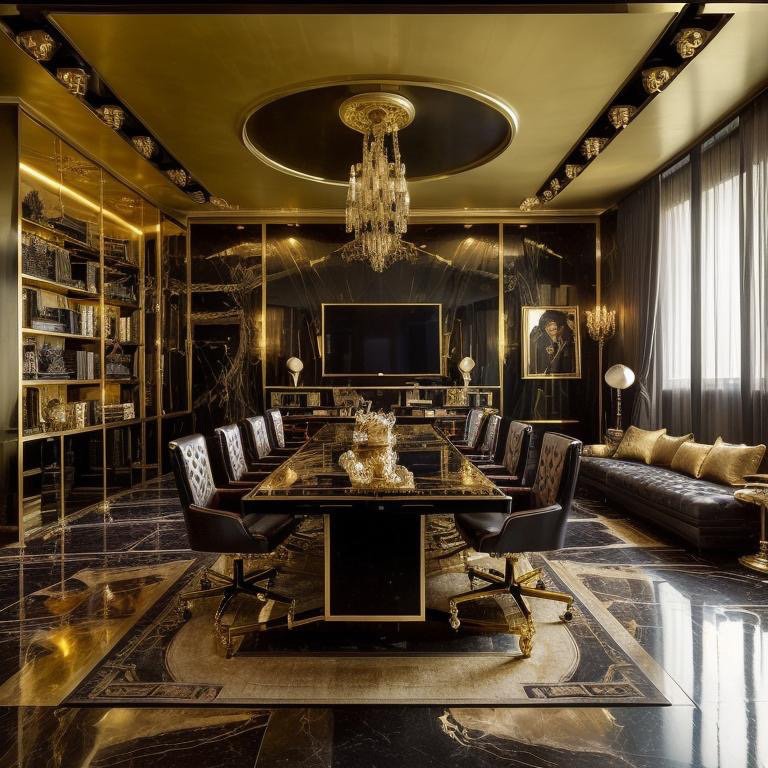
Hollywood Regency: Excess with Discipline
The first interpretation treated the boardroom like a film set. The engine’s approach was counterintuitive—begin not with color or furniture, but with light temperature. Warm golds became the foundational layer. The ceiling transformed into a stage. The conference table, once merely functional, became the protagonist. Shelving shifted into luminous frames, backlit and deliberate.
Hollywood Regency, in its purest form, is controlled spectacle. It seduces without apology. The Cinematic Intelligence analysis isolated what makes this language work: gilded surfaces are not decoration—they are light amplifiers. Mirrored atmospheres are not vanity—they are spatial multiplication. Every surface participates in drama.

The room in this iteration became sensual. Power manifested not through weight but through luminosity. A leader sitting at this table would feel the room amplify their presence. That was the intention. That was the success metric.
Greek Revival: Precision as Poetry
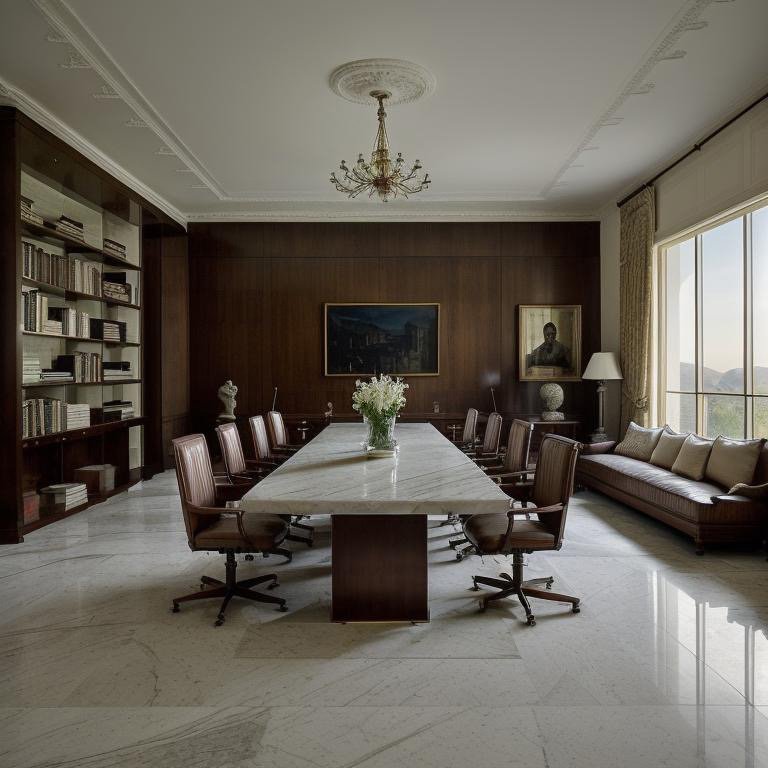
The second interpretation inverted the emotional temperature entirely. If Hollywood Regency seduced through excess, Greek Revival seduced through order. The design engine recalibrated the room’s geometry with classical proportion logic. Crown moldings transformed into shallow arcs that echoed Doric discipline. Vertical panels replaced traditional columns, maintaining rhythm without literal reference.
Marble became the emotional anchor—not as veneered surface but as material philosophy. Veining patterns were selected to reinforce the room’s linear logic. Every geological mark had purpose. The palette remained cool. The light became even and scholarly. This was a room designed for clarity of thought.
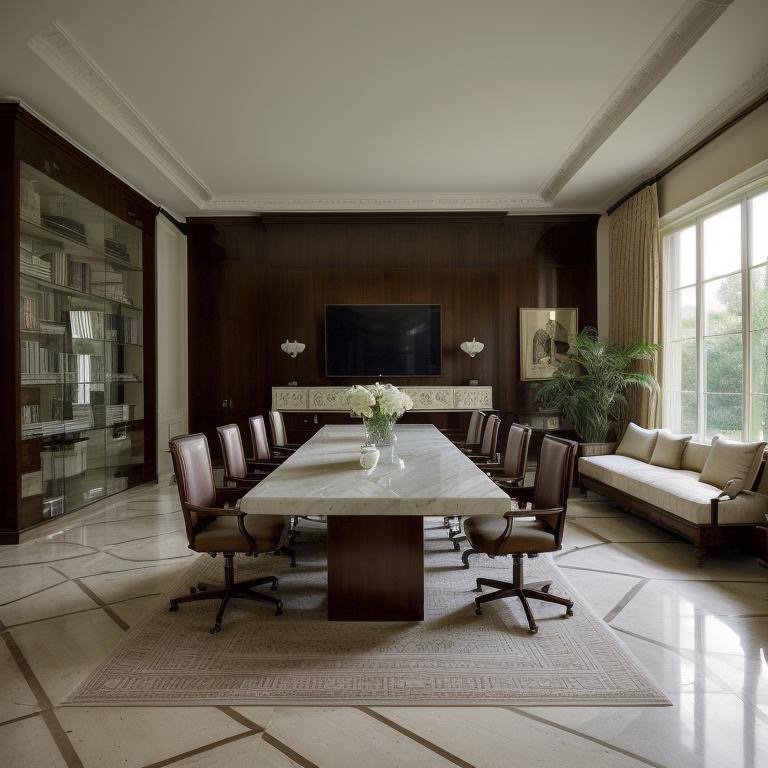
Classical architecture exists because it solved problems that still matter: how to divide space harmoniously, how to use proportion to create confidence, how to make a room feel timeless rather than fashionable. The boardroom in this form became a temple to precision. A leader here would feel held by geometry itself.
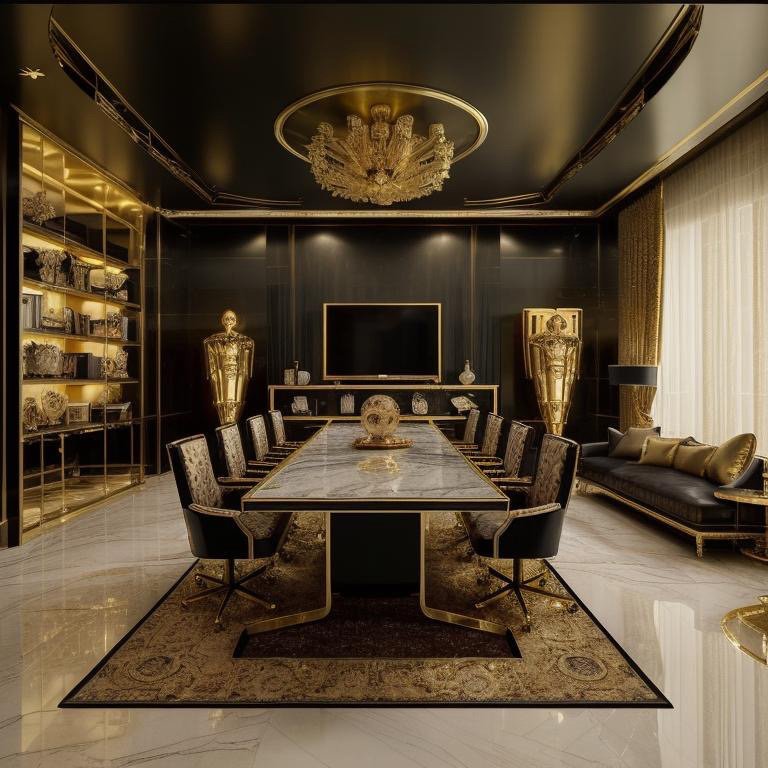
Gothic Revival: Depth Through Restraint
The third interpretation tested restraint in the presence of drama. Gothic Revival is often misread as darkness. It is not. It is selectivity. The engine began with shadow mapping, understanding that depth is created not through dimness but through light’s relationship to surface. The room darkened, but only to elongate perception. Light became sculptural.
Charcoal walls absorbed rather than reflected. Obsidian surfaces created depth through non-reflection. Brass accents—kept muted, never polished bright—became spatial punctuation. This was mystery without heaviness. A sanctuary for strategic thinking. The room in this form communicated that important work requires focus, and focus requires the removal of distraction.
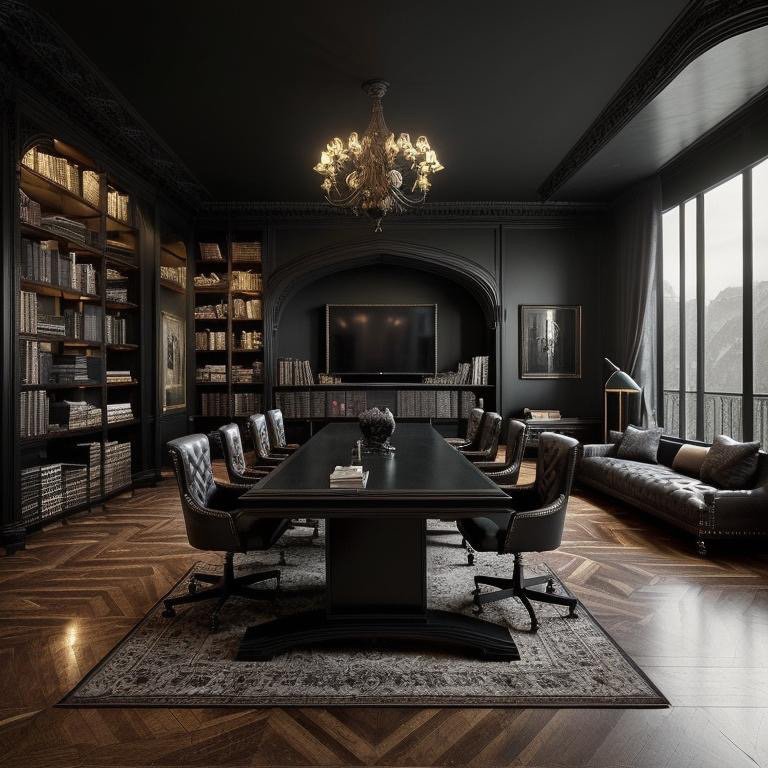
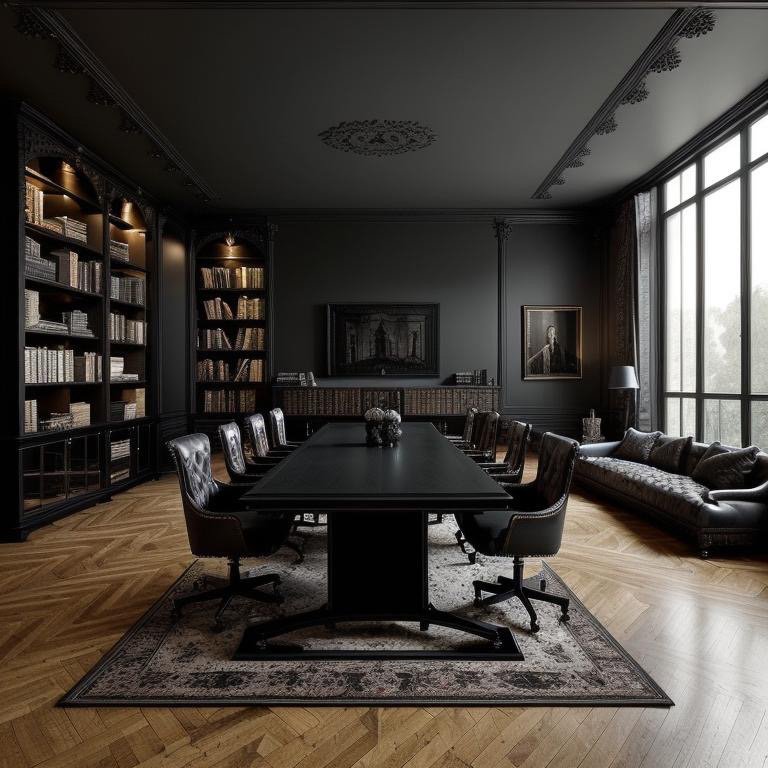
Power here was quiet. Confidence manifested as gravitas. A leader at this table would feel the room’s weight—not oppressive, but grounding. Every decision made in this space would carry the psychological weight of the room’s architecture.
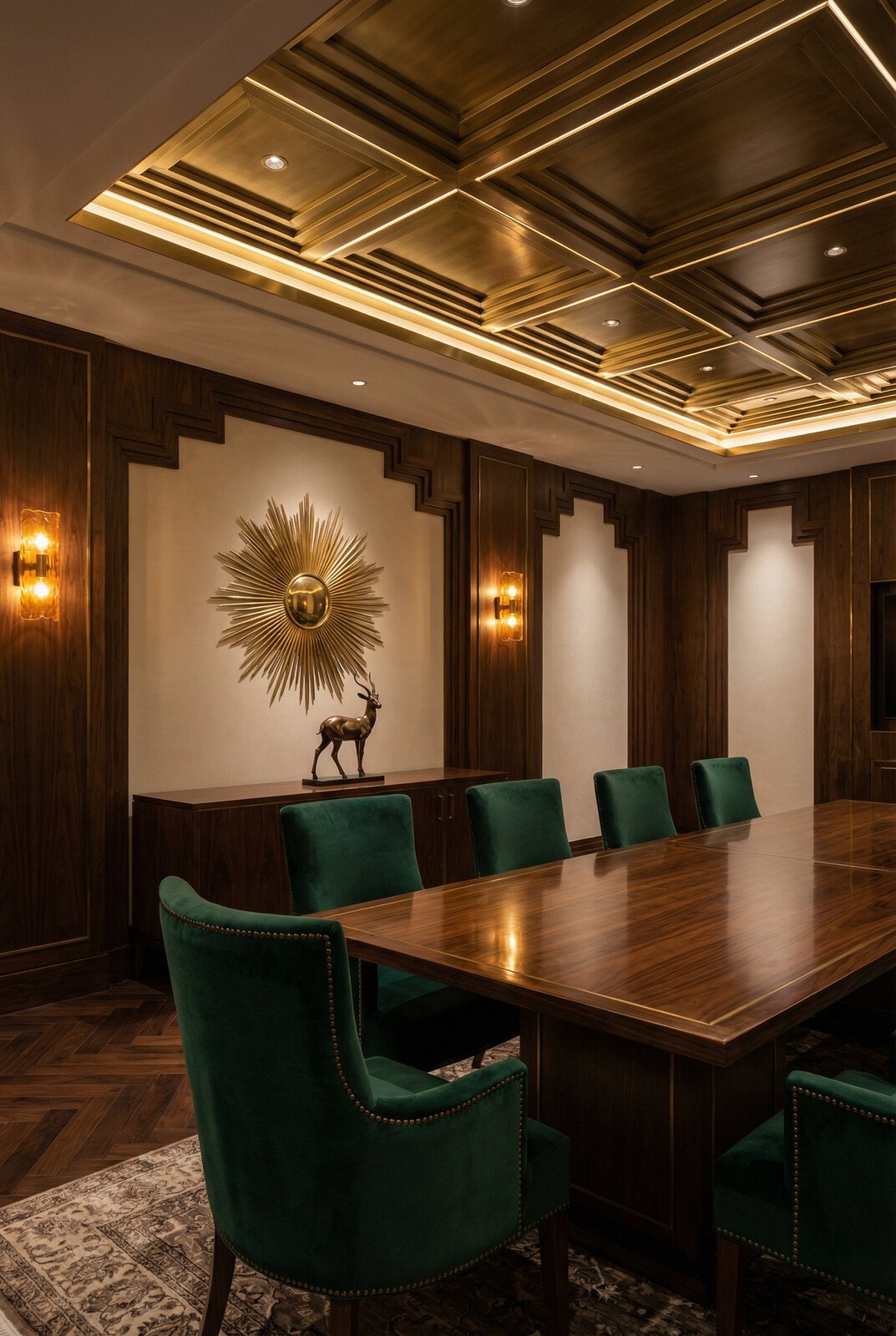
Farmhouse Modern: Authority Meets Comfort
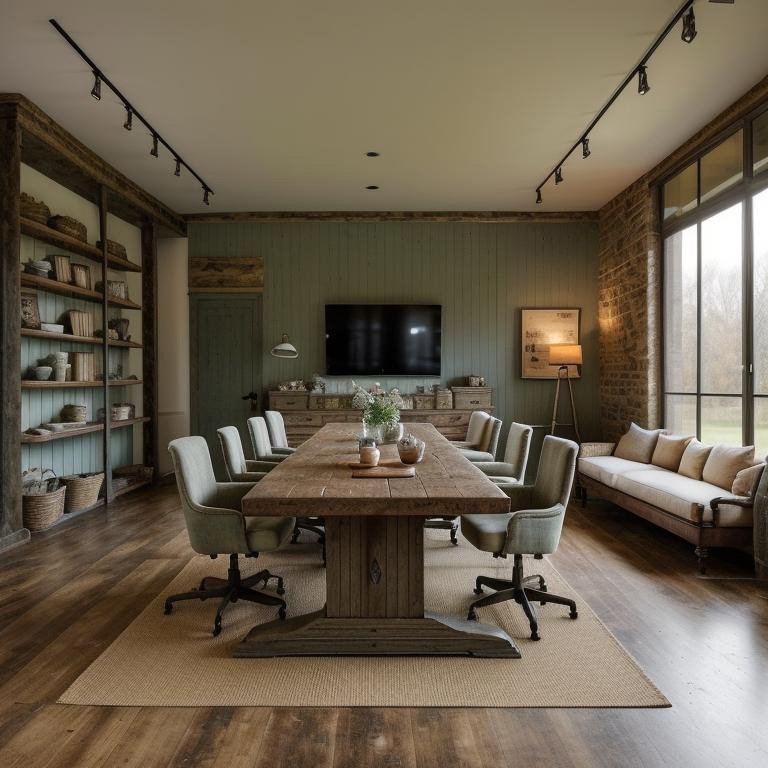
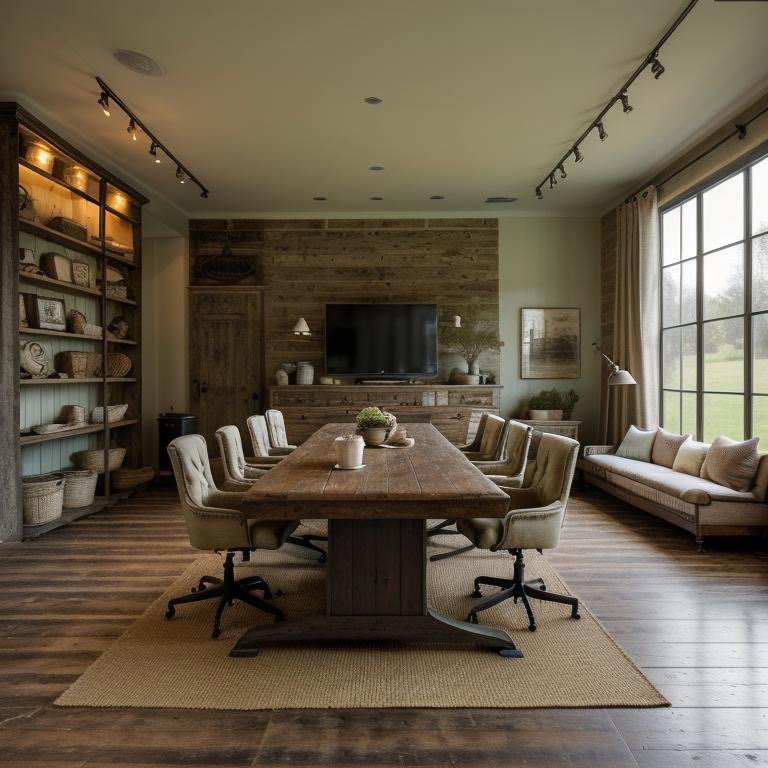
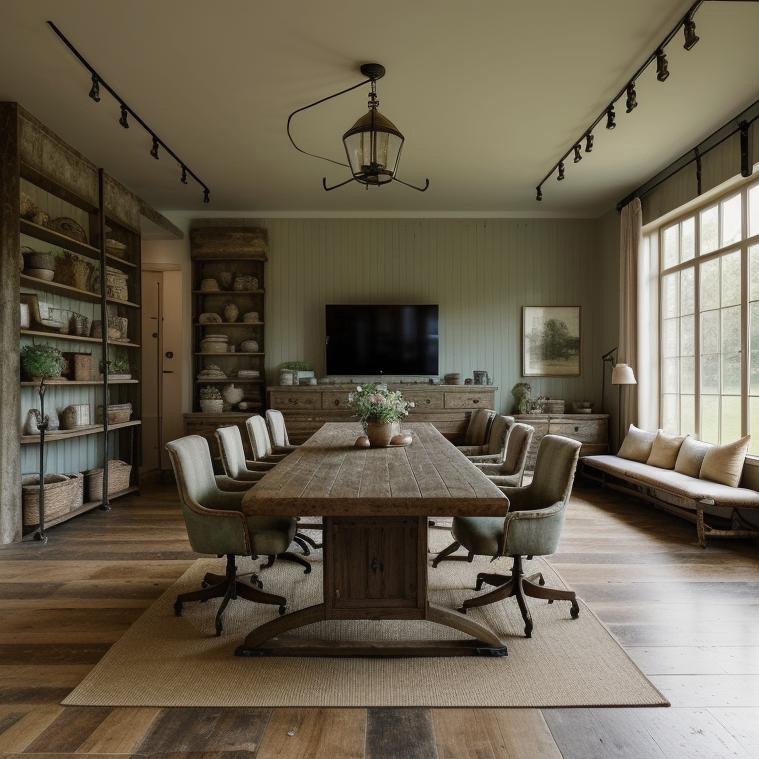
The fourth interpretation posed the hardest translation: how does executive leadership live in warmth? Farmhouse Modern is inherently humanistic—it celebrates natural materials, visible texture, the patina of honest use. Yet it is often dismissed as casual. The design engine approached this as a belief system challenge. Could a boardroom remain authoritative while feeling accessible?
The engine changed texture first. Woods warmed in tone and grain pattern. Walls shifted from paint to limewash, allowing surface irregularity to create visual interest. Floors carried visible grain structure. Textiles became tactile rather than refined. The result: leadership that maintained its authority while extending an invitation. A leader here would feel both professional and human.
The Architectural Truth Beneath
What becomes clear across these four interpretations is that a room’s identity is not predetermined by its dimensions. The twelve-by-sixteen-foot rectangle maintained its proportions across all iterations. The volume never changed. The ceiling height remained constant. Yet the room became four entirely different experiences.
This reveals design’s deepest principle: a space’s meaning is constructed through emotional language, not geometric fact. The Cinematic Intelligence analysis proved three critical points:
First: architectural integrity can be preserved while the emotional temperature shifts entirely. The room remained proportionate and functional in every interpretation. Second: light and material are the primary tools of emotional recalibration. Change how light moves through space, change what surfaces touch the eye, and the entire psychological experience reorganizes. Third: style is not cosmetic—it is philosophical. Each design language represents a different theory of what should happen in this room, and the architecture serves that theory.
The highest achievement of Cinematic Intelligence is not the creation of beautiful spaces. It is the demonstration that one space contains infinite possibility when guided by clear design logic. The room did not become four different spaces. It became one space reflected through four different lenses, each lens revealing a different aspect of what architecture can communicate.
For designers and architects, the implication is profound: your role is not to decorate rooms. It is to interpret them. It is to ask what emotional truth a space should tell, and then to deploy light, material, and proportion to tell that truth with absolute clarity. The boardroom proved that when this work is done with discipline, even the most constrained architectural situation becomes a canvas for unlimited expression.
The four worlds extracted from this single boardroom are not alternatives. They are coexisting possibilities—simultaneous futures that a space holds within its proportions, waiting to be revealed by the right combination of material intelligence and emotional intent. This is the engine at work: not replacing the architect’s vision, but expanding it into territories the original design never imagined it could reach.
Leave a Reply