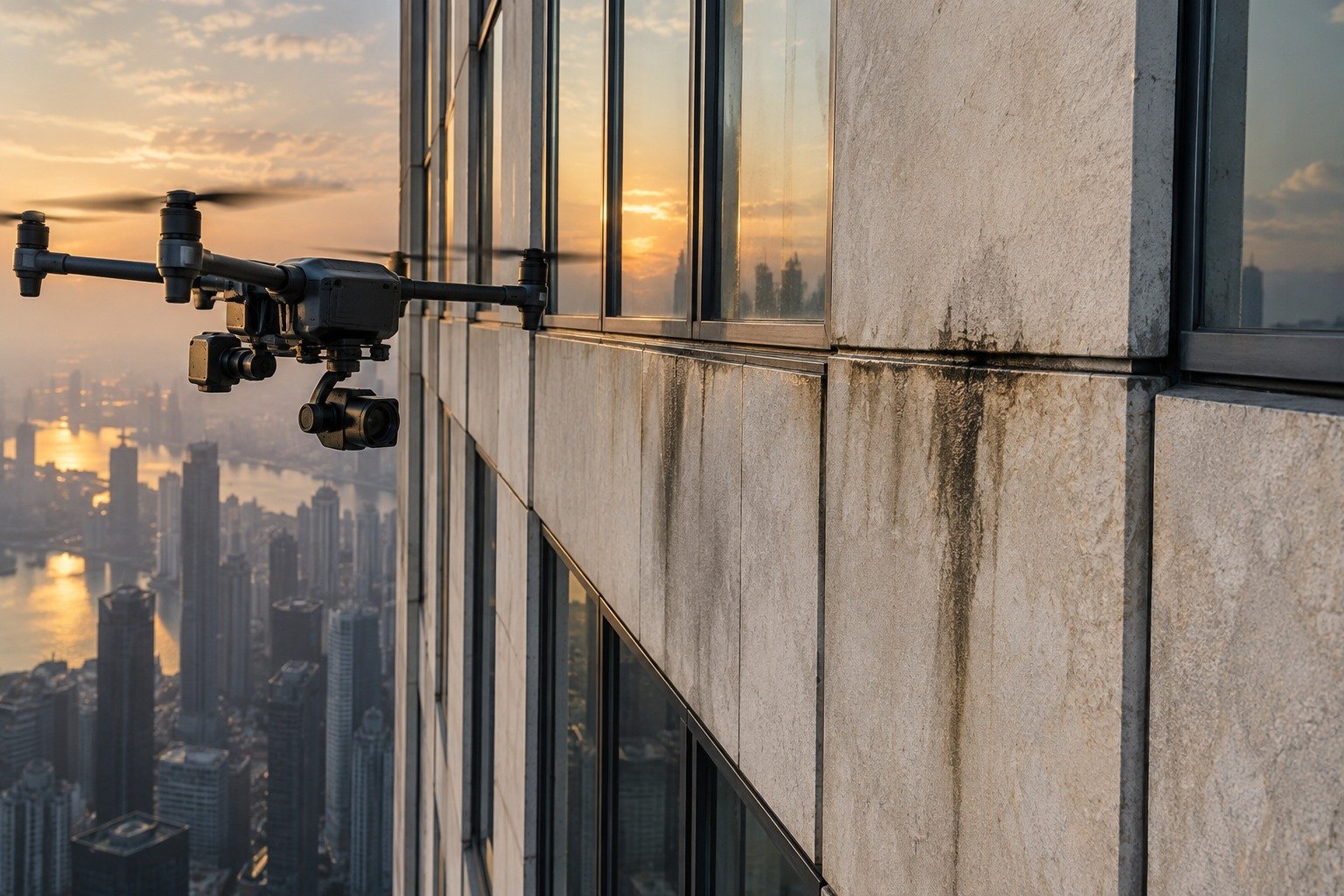
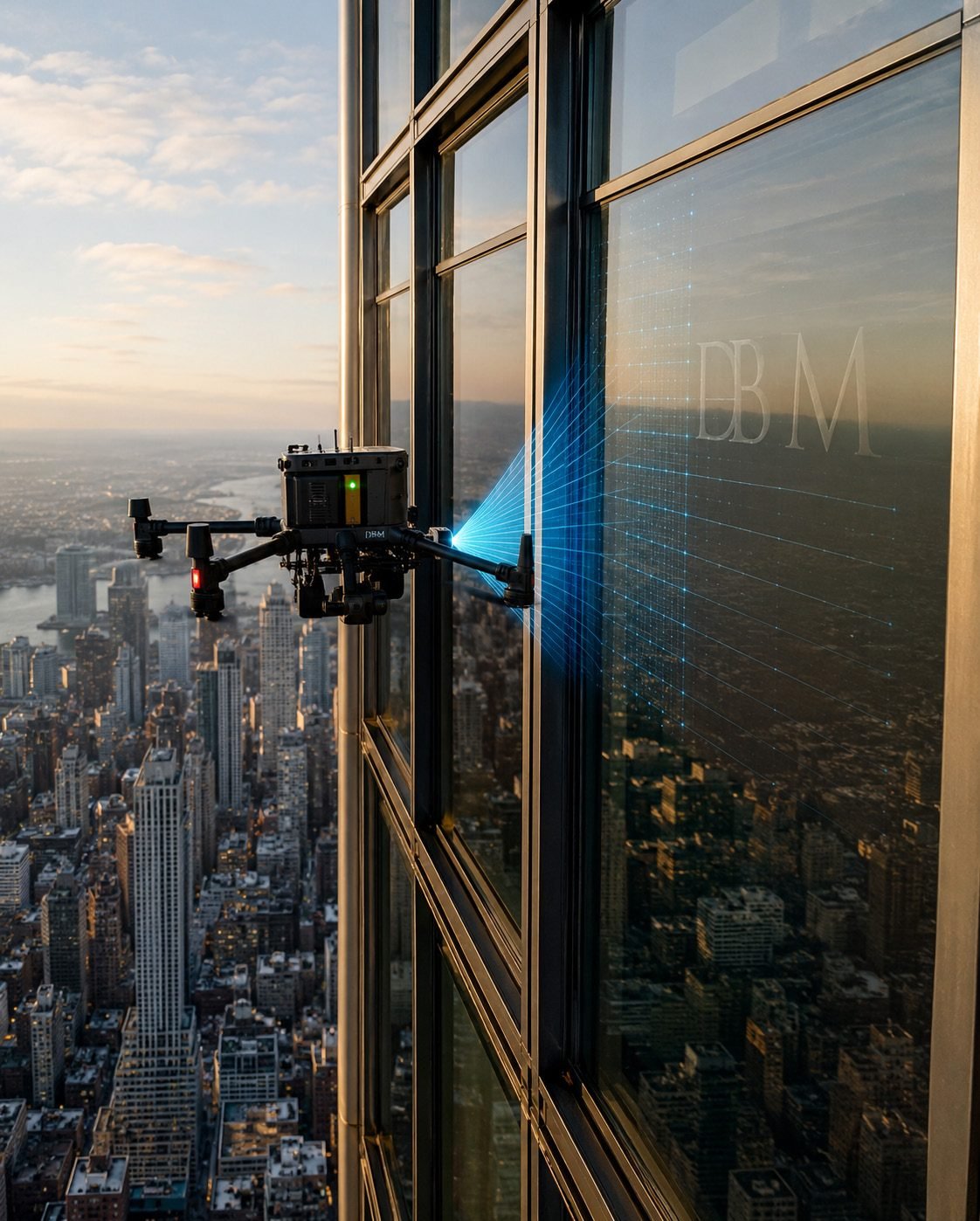
I spent nine years flying ISR missions, intelligence, surveillance, and reconnaissance, over terrain where missing a detail meant someone did not come home. When I turned those same systems toward building facades, I assumed the civilian inspection industry would be hungry for better data. What I found instead was an industry that still sends human beings dangling off skyscrapers on scaffolding that costs more than most people’s homes, squinting at concrete with the same tools their grandfathers used. The gap between what is possible and what is practiced is not measured in increments. It is measured in generations.
The technology to inspect every facade in every major city, faster, cheaper, and more accurately, exists right now. The reason buildings still fail, the reason glass panels still fall onto sidewalks, is not a technology problem. It is a regulatory and institutional inertia problem. I want to be precise about that, because the instinct is to imagine that some breakthrough is still pending, some sensor not yet invented. Nothing is pending. The sensors flew combat missions a decade ago. What has not arrived is the will to retire a method that everyone in the industry privately knows is obsolete.
The Scaffolding Tax
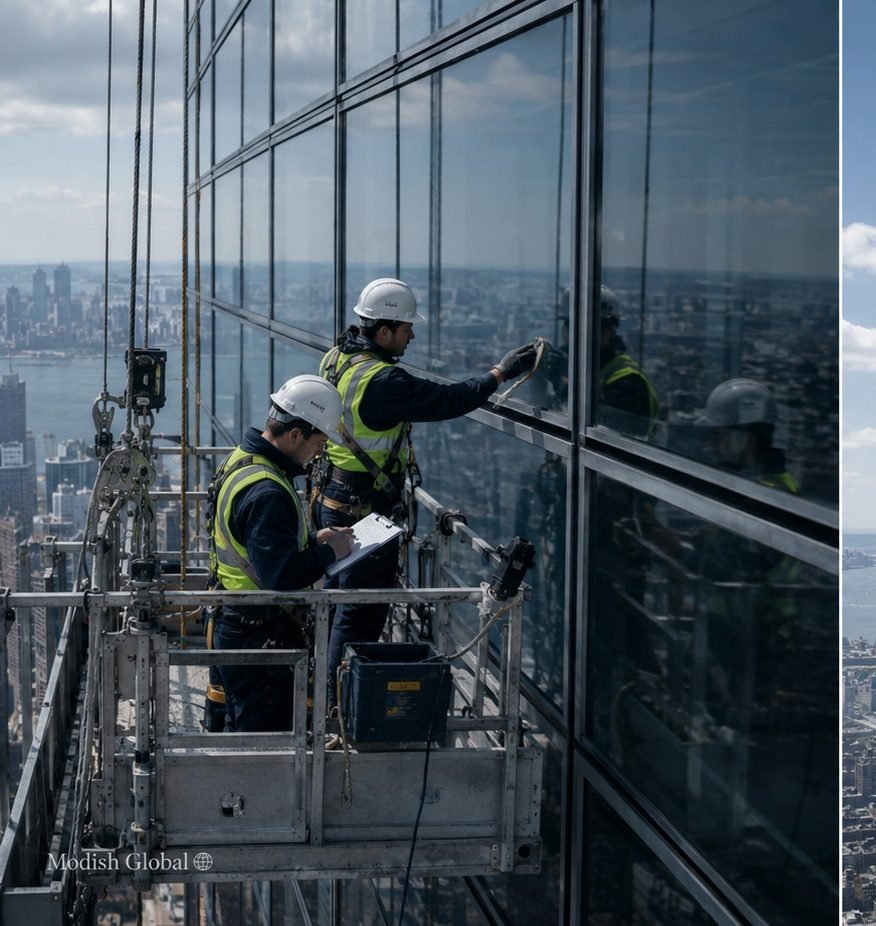
New York City’s Facade Inspection and Safety Program, known as FISP, requires periodic inspection of every building over six stories. The standard approach is to erect scaffolding costing between five hundred thousand and more than one million dollars. The inspection itself adds another two hundred to four hundred thousand. The process takes months. And the result is a PDF containing photographs and handwritten annotations that represent a single moment in time, already degrading in relevance the day it is delivered.
Multiply this across roughly 12,500 FISP buildings in New York alone and you are looking at a multi-billion-dollar recurring cost that produces, by any modern data standard, primitive results. I have reviewed these reports, three-ring binders with blurry photographs and conclusions amounting to professional hedging. Area of concern. Monitor in next cycle. These are not actionable findings. They are liability shields, written to protect the inspector rather than to inform the owner. The document exists so that someone can say an inspection occurred, not so that anyone can act on what it found.
What a Drone Sees
An autonomous drone equipped with high-resolution cameras, LiDAR, and thermal sensors can inspect an entire building envelope in a single day. Companies such as Skydio have developed platforms that navigate complex geometries autonomously, threading between setbacks and balconies without a pilot fighting the wind. The drone does not get tired. It does not lose concentration at hour six. It flies the same disciplined pattern over the last elevation that it flew over the first, and it records everything, not only the areas an inspector chose to photograph.
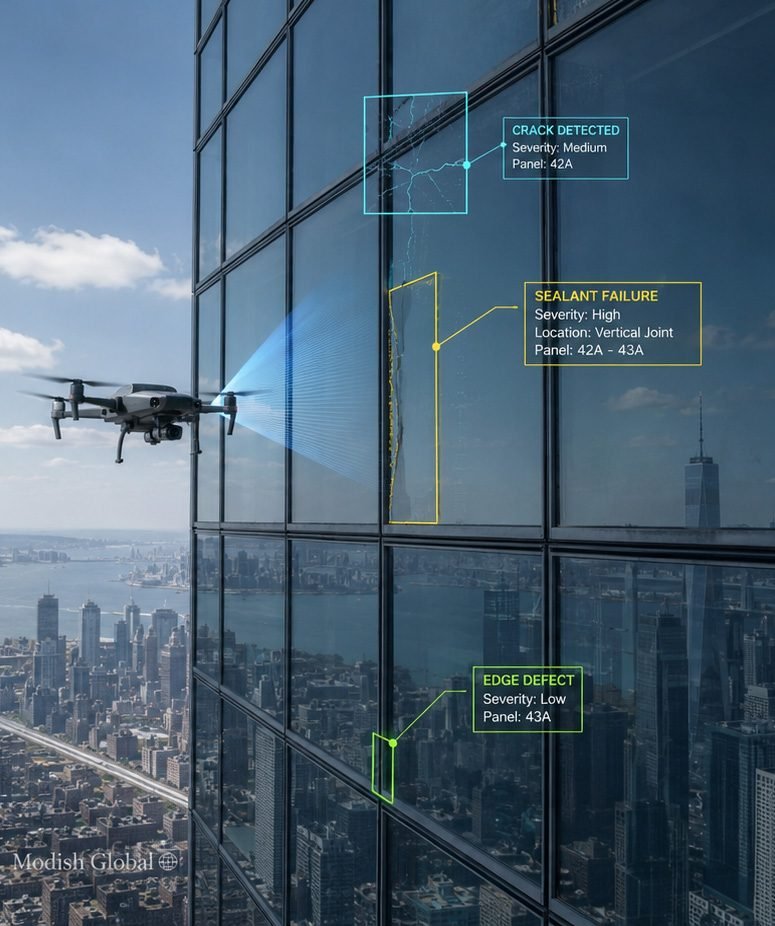
But the flight is only data collection. The revolution is what happens next. Deep learning systems, convolutional neural networks trained on hundreds of thousands of labeled facade images, detect cracks, spalling, sealant failure, glass fractures, and corroded anchors with accuracy exceeding human visual inspection. In controlled studies, the AI consistently identifies more defects with fewer false negatives. A human inspector having a bad day misses things. A neural network either works or it does not, and when it works, it works the same way every time. Consistency is not a small virtue in a discipline where the cost of a missed defect is a panel on the sidewalk.
This is not a laboratory promise. DroneDeploy processes aerial data through machine learning that flags anomalies. Pix4D stitches thousands of drone photographs into millimeter-accurate three-dimensional facade models. Gecko Robotics deploys wall-climbing robots carrying ultrasonic thickness gauges for the substrate beneath the skin. These are not prototypes. They are commercial products with thousands of completed inspections behind them, operating today on real buildings for real owners.
Dataset Versus Report
A scaffold-based inspection produces a report. A drone-plus-AI inspection produces a dataset. The distinction sounds semantic until you live inside it. A report tells you what an inspector observed on one day. A dataset tells you the condition of every square meter of facade, geo-referenced, time-stamped, and classified by defect type and severity. One is an anecdote. The other is a record.
The power of the record reveals itself over time. Fly the same mission in two years and you know the rate of change. That crack was not there last cycle. That sealant joint has degraded thirty percent. That glass panel’s thermal signature has shifted, suggesting a seal failure not yet visible to the naked eye. This is predictive maintenance, the same paradigm shift that transformed aerospace and industrial manufacturing. You stop waiting for things to fail. You inspect based on data and you intervene based on trajectory. The building tells you where it is going before it gets there, and you meet the problem while it is still cheap.
The Numbers
Let me put the comparison in the only terms that ultimately move an owner. A traditional scaffold-based FISP inspection for a forty-story tower runs between seven hundred thousand and 1.2 million dollars, on a timeline of four to eight months. The drone-plus-AI inspection for the same building runs between eighty thousand and one hundred fifty thousand dollars, on a timeline of two to four weeks, and it delivers superior output. That is not a marginal improvement. It is an order-of-magnitude reduction in cost paired with categorically better data.
I have watched this arithmetic play out on a real building. We inspected a residential glass tower where thermal imaging revealed seal failures concentrated on the northwest elevation, invisible from the ground and invisible from a swing stage. The owner replaced forty panels proactively. The estimated cost of reactive replacement, after a panel falls, after emergency scaffolding, after the litigation that inevitably follows a piece of glass striking a public sidewalk, would have been ten to twenty times higher. The cheaper method also happened to be the safer one. That is rare enough in engineering that it should command attention on its own.
What Comes Next
The paradigm the building industry is resisting has already remade the industries it borrowed from. Aerospace does not wait for an engine to fail and then investigate the wreckage. It monitors, it trends, it pulls a part before the part pulls the aircraft. Industrial manufacturing schedules maintenance against sensor data rather than against the calendar. In both cases the shift was the same. You stop treating inspection as an event that certifies the past and start treating it as a stream that forecasts the future. A facade is no different in principle from a turbine blade. It is a component under cyclic load, deteriorating along a curve, and a curve can be projected the moment you have more than one point on it.
The next integration point is already visible. Cinematic Intelligence rendering platforms represent a natural home for this diagnostic data, overlaying real-world defect mapping onto the designed-intent model to show precisely where a building’s reality has diverged from its design. The architect drew an intention. The drone recorded the outcome. Placing one atop the other turns inspection from a backward-looking chore into a living comparison between what was promised and what was built, updated every cycle.
The buildings defining the next generation of high-rise construction demand inspection that matches their complexity. You cannot inspect a thousand-foot glass curtain wall by hanging a person off the side of it. The scale defeats the methodology. As towers grow taller and their envelopes grow more intricate, the human-on-a-cable approach does not merely become expensive. It becomes physically incapable of covering the surface it is meant to certify.
Every year we delay this transition, facades deteriorate without documentation, defects progress without detection, and failures occur without prediction. In the military, we had a phrase for continuing to use inferior methods when better ones were plainly available. We called it dereliction. It was not an insult. It was a finding, entered into a record, with consequences attached. I am not certain the civilian building industry has yet earned a gentler word, and I am even less certain it should be allowed to keep choosing the older, blinder way while the better one waits, fully built, on the shelf beside it.
3D Transformative Digest — ISSN 3067-5510. Published by Modish Global Inc. © 2026 Modish Global Inc. All rights reserved. Licensed distribution only.
Leave a Reply