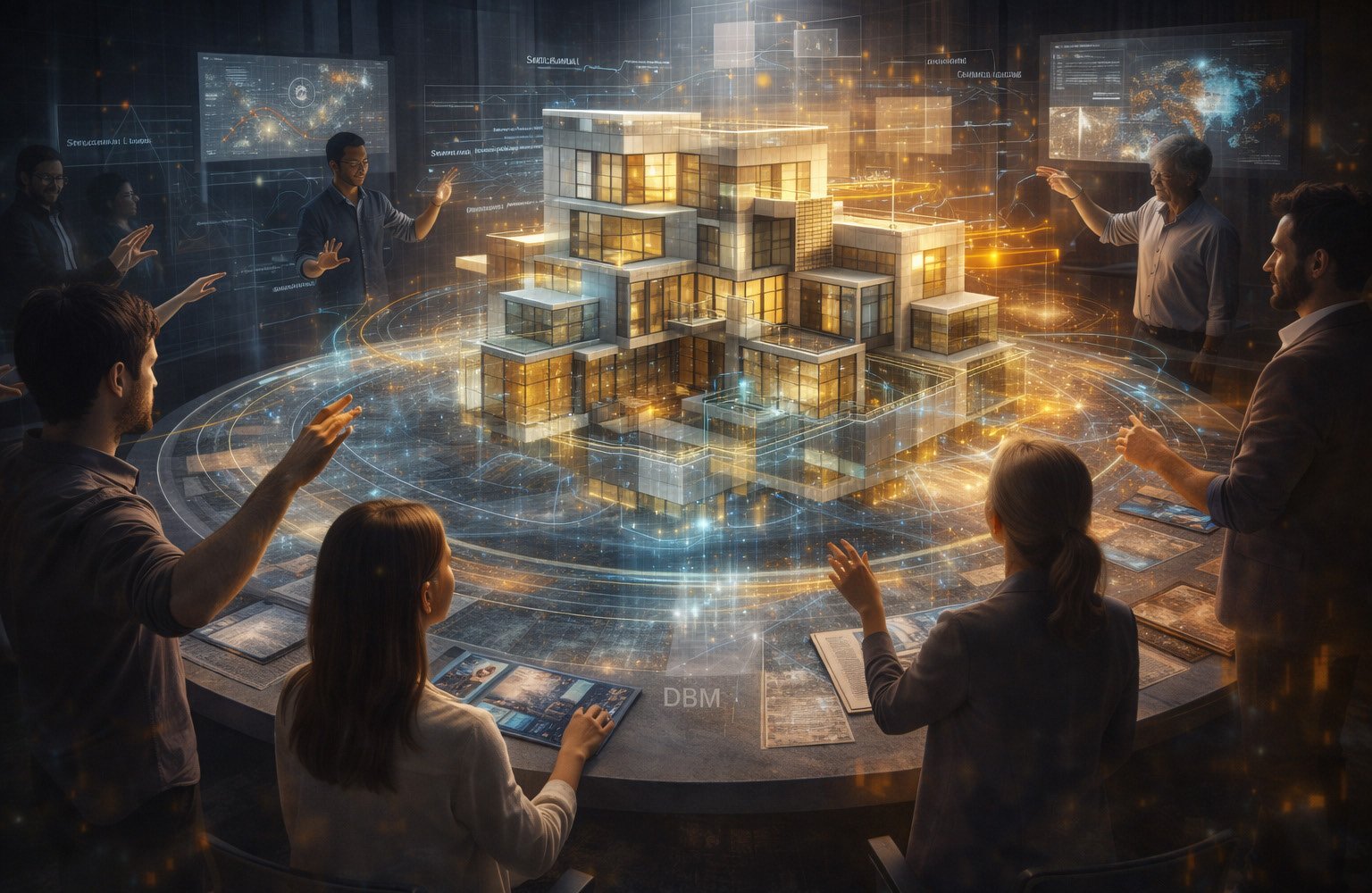
Holographic AI design collaboration: A team converges around a digital architectural model, exemplifying the distributed authorship redefining contemporary practice.
There is a provocative phrase circulating quietly within design circles, spoken not as manifesto but as observable fact: Architecture without Architects. It carries an echo from the mid-twentieth century, when theorist Bernard Rudofsky first invoked it to celebrate the vernacular traditions that built the world before credentialed practice claimed the discipline. Today, that same phrase returns—refracted through the lens of algorithmic intelligence, generative systems, and the unmistakable emergence of distributed authorship.
But here we must be precise: in 2026, “without architects” does not signify the absence of design intelligence. It signifies a fundamental reorganization of who authors form, how that authorship emerges, and what constitutes legitimate architectural creation. The gatekeepers remain, yet the gates themselves have been redrawn.
What began as an architectural exhibition celebrating indigenous wisdom has evolved into something far more consequential—a question about the nature of design agency itself in an era where artificial intelligence is not merely a tool in the architect’s hand, but increasingly a collaborator, a generator of alternatives, and in some cases, an independent voice in the creative conversation.
Rudofsky’s Provocation Finds New Currency
To understand the present moment, we must return briefly to 1964, when the Museum of Modern Art opened “Architecture Without Architects,” curated by Rudofsky. His thesis was elegant and somewhat heretical for its time: some of the world’s most sophisticated architecture emerged not from academic training or professional credential, but from accumulated vernacular knowledge—climate-responsive design, material intelligence, and community building practices refined across generations without a single “architect” present.
Rudofsky was not diminishing the value of trained designers. Rather, he was expanding the definition of authorship itself. He was asking: Where does intelligence reside? Who gets to make decisions about built form? What counts as design?
Today’s technological moment echoes that same set of questions, but with an inversion. Rather than celebrating traditions excluded from formal practice, we are now witnessing how computational systems—trained on decades of built projects, environmental data, and design logic—can generate spatial propositions with a sophistication that rivals human creativity. The question is no longer merely who designed this building, but which intelligence shaped it: human intuition, algorithmic generation, environmental constraints, or the peculiar synthesis of all three?
The Dissolution of Singular Authorship
Generative design systems operating within architectural practice today do not function as ghostwriters. They function as genuine collaborators whose outputs carry measurable intelligence. Consider what occurs in a contemporary design workflow:
A designer sketches intention. An algorithm parses that sketch, reads embedded briefs and constraints, and generates ten coherent alternatives—each responsive to climate data, structural logic, regulatory frameworks, and aesthetic parameters encoded into the system. The designer reviews, selects, refines. The algorithm learns from the selection and proposes refinements. A feedback loop emerges, neither human nor machine leading entirely, but both contributing to a solution that neither could have authored alone.
This is not delegation. This is co-authorship, and it fundamentally challenges the architectural tradition of the solitary designer as singular genius—a romantic notion that has never fully withstood historical scrutiny, but which persists nonetheless in professional mythology.

Design intelligence cascades across multiple dimensions: computational systems expand the conceivable before human judgment narrows the field.
What emerges from this distributed intelligence is architecture that operates differently. It is more responsive to site data—solar orientation, wind patterns, material availability, traffic flows. It is more anticipatory, modeling performance before construction. It is more inclusive of stakeholder feedback because the speed of iteration permits genuine participation rather than the traditional binary of accept or reject.
Is this still architecture? Absolutely. But authorship has become collective, and that collectivity is not a weakness to be transcended but a fundamental recalibration of how design intelligence operates in complex environments.
The Architect’s Metamorphosis
The profession faces a curious moment. Every major architectural publication has engaged with questions about AI’s role in practice. Industry leaders universally acknowledge that artificial intelligence cannot yet replicate the contextual judgment, ethical responsibility, and cultural intuition that human architects contribute. The most sophisticated practices in the world are not being displaced by algorithms; they are being augmented by them.
But amplification comes with transformation. The architect’s role is undergoing what might be termed a methodological evolution—from sole author to what we might call an orchestrator of intelligence systems.
Where the twentieth-century architect was primarily a designer—translator of client intent into built form—the contemporary architect increasingly functions as:
Curator of computational alternatives. Not generating every option manually, but reviewing, evaluating, and selecting from algorithmically generated possibilities based on intuitive judgment that machines have not yet mastered.
Editor of emergent outcomes. Refining solutions that arise from complex systems, understanding that design is no longer top-down but increasingly emerges from the interaction of multiple variables and intelligence sources.
Steward of meaning. Ensuring that the inevitable efficiency and optimization offered by algorithmic systems does not entirely erase the symbolic, cultural, and experiential dimensions that architecture must address—concerns that resist quantification.
Integrator of distributed expertise. Orchestrating conversations between structural engineers (human and computational), environmental systems, client aspirations, regulatory requirements, and community input in ways that converge toward coherent proposals.

The algorithmic hand guides but does not grip: human judgment and computational suggestion form a continuous loop rather than a hierarchy.
When Design Arises From Ecosystems Rather Than Individuals
The most important architectural projects emerging in 2026 share a curious characteristic: they are difficult to attribute to a single author. The residential district designed through community participation scaffolded by generative algorithms. The cultural institution shaped by environmental simulation, programmatic stacking, and multiple rounds of stakeholder feedback. The infrastructure that evolved from performance modeling, regulatory requirement, and site-specific constraint.
These projects are not less designed. They are differently authored.
This represents not a betrayal of architectural tradition but its logical evolution. Throughout history, buildings have always emerged from collaboration—master builders working with craftspeople, architects collaborating with engineers, designers responding to client constraints. The difference today is that computational systems now participate in that conversation as explicit participants rather than invisible mediators.
The result is architecture that is simultaneously more responsive and more ambitious. More responsive because real-time environmental data, performance simulation, and stakeholder feedback can inform iterations across dozens of variables. More ambitious because the speed of iteration permits exploration of solution spaces that human designers, working manually, could never traverse.
The Necessary Skepticism
Yet skepticism remains warranted. Algorithms encode the biases of those who trained them. Optimization can erase the idiosyncratic, the culturally specific, the beautifully inefficient. Distributed authorship, if poorly orchestrated, can produce designs answerable to no one’s judgment. The efficiency of computation can marginalize dimensions of architecture that cannot be quantified—memory, narrative, the weight of historical consciousness.
The challenge facing the profession is not whether to resist this shift—that resistance is moot—but how to integrate algorithmic intelligence while preserving the elements of architectural practice that cannot be automated: judgment, accountability, and the stubborn human insistence that buildings carry meaning beyond their functional performance.
Contemporary architectural practice at its best is grappling with this carefully. The most sophisticated studios are not allowing algorithms to make decisions but rather to expand the field of conceivable decisions, leaving the ultimate synthesis to human judgment informed by both computational wisdom and the irreducible complexity of context.

Multiple intelligence sources converge: the contemporary design process is decidedly non-linear, non-hierarchical, and distributed across human and computational participants.
A Redefinition Rather Than Erasure
To return to Rudofsky’s original insight: his exhibition celebrated architecture that operated outside formal credentialing, outside academic tradition, outside the professional establishment. It was not a dismissal of trained architects but an expansion of where architectural intelligence could reside.
Contemporary algorithmic design extends that expansion further. It suggests that architectural authorship can reside in generative systems, in community participation scaffolded by technology, in stakeholder feedback processed through computational interpretation, in environmental data given voice through performance simulation.
This is genuinely unsettling to a profession that has long defined itself through the authority of individual expertise. But that unsettling is productive. It forces the discipline to articulate what, precisely, architects contribute that algorithms cannot—and to defend that contribution not through credential or gatekeeping but through demonstrated value in the cultural, contextual, and experiential dimensions of the built environment.
The phrase “architecture without architects,” invoked in 2026, should not be heard as threat but as invitation. An invitation to understand authorship more generously. An invitation to recognize that intelligence is distributed across multiple forms—human intuition and algorithmic generation, professional expertise and community wisdom, individual vision and collective emergence.
The architect of the future will not be displaced but reimagined: not as sole author but as orchestrator, not as the origin point of all decisions but as the steward of meaning-making in a design process of extraordinary complexity. That is a diminishment only if we insist on measuring it against a romantic ideal of the solitary genius. Measured against the actual sophistication of the problems architecture must now address, it is an evolution toward something more adequate to the moment.
The buildings being designed today through this distributed intelligence are not lesser for lacking a singular author. Many of them are better—more responsive, more inclusive, more anticipatory of performance and impact. And that, perhaps, is Rudofsky’s true legacy: the understanding that architecture emerges not from the credential of the architect, but from the intelligence that brings it into being, wherever that intelligence resides.
Leave a Reply