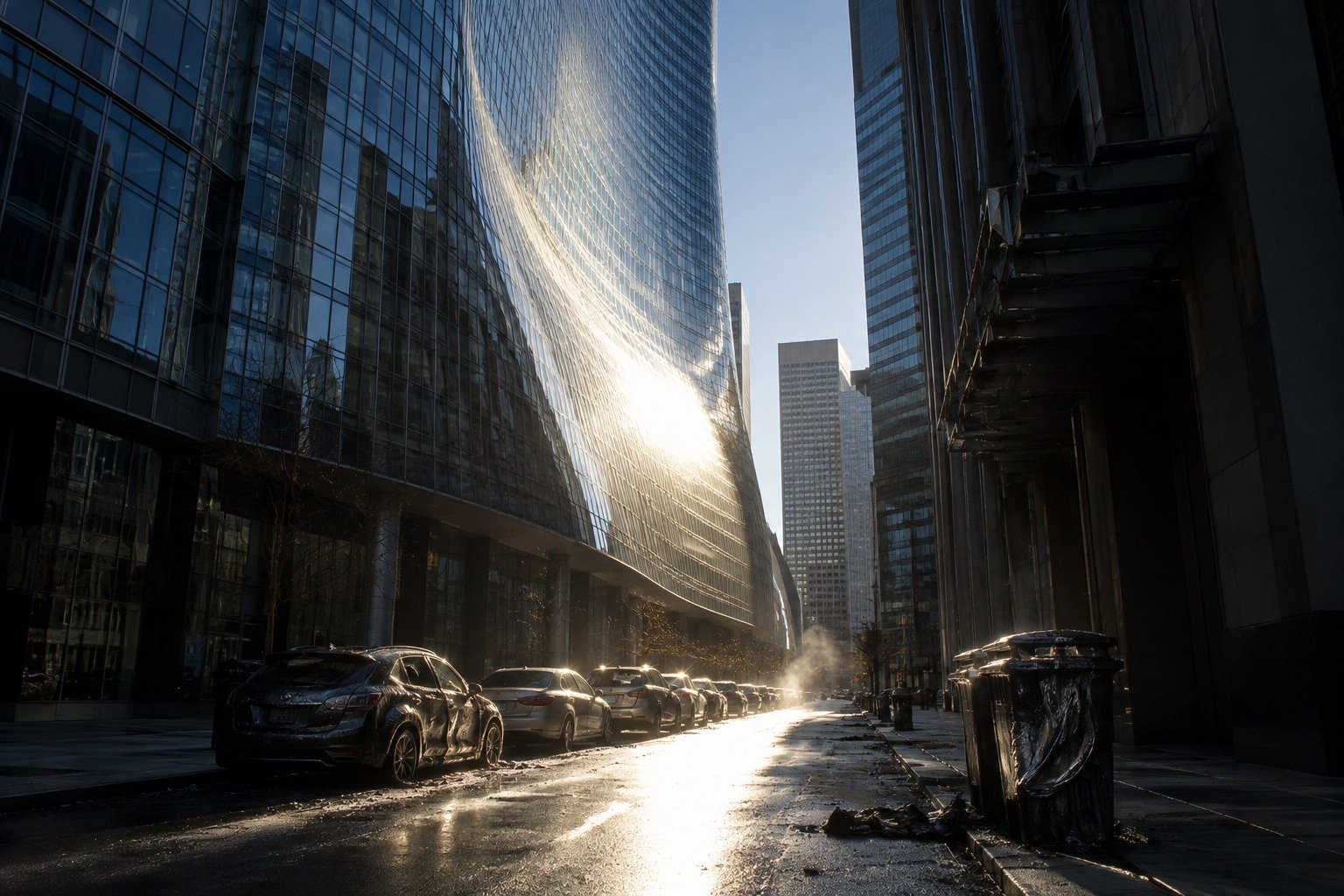
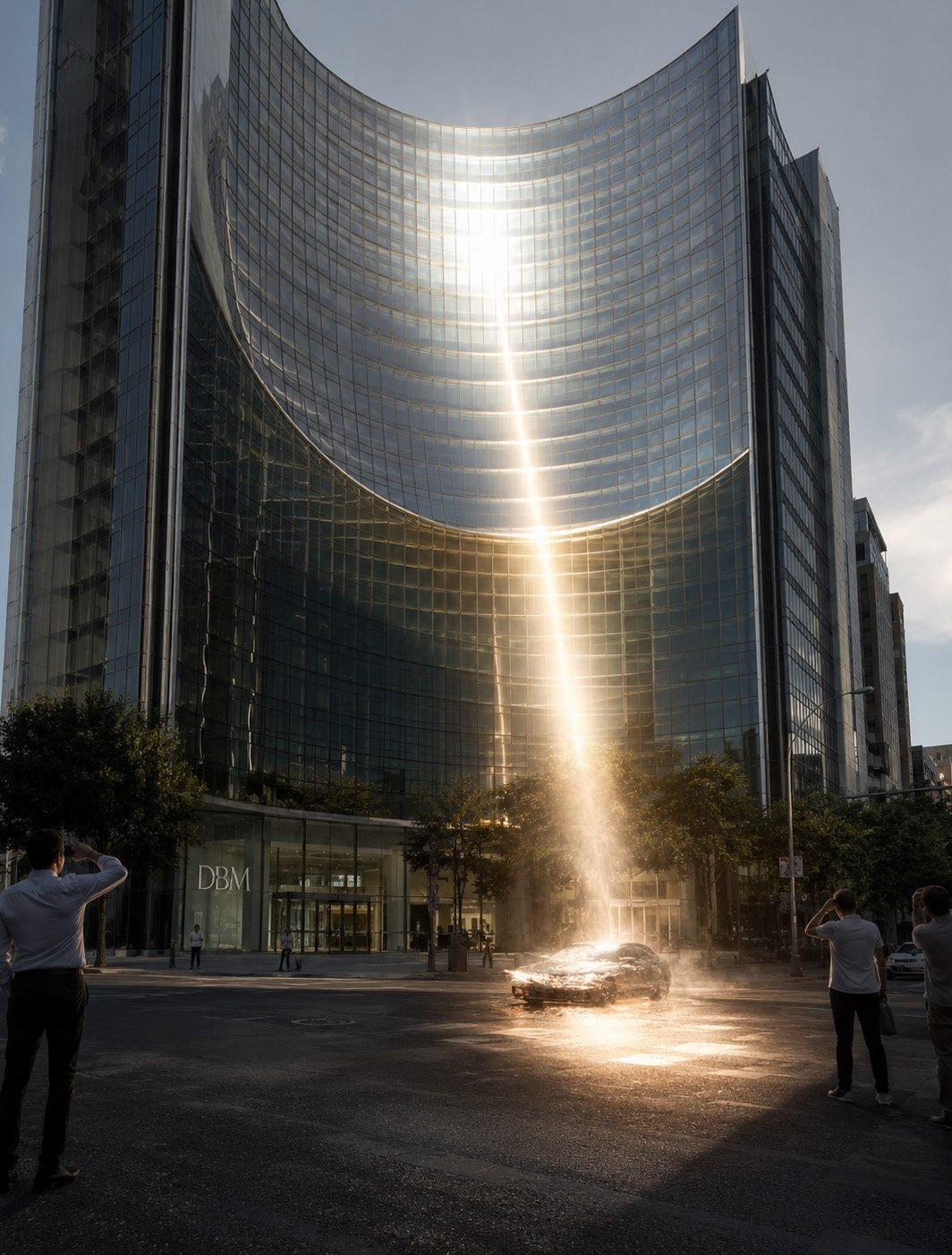
On a Tuesday in September 2013, a Jaguar XJ parked on Eastcheap Street in London began to melt. The vinyl trim warped. The bonnet badge deformed. Surface temperatures exceeded 117 degrees Celsius. The source was not the sun alone. Three hundred meters away and thirty-seven stories above, the concave facade of 20 Fenchurch Street, the building London had already nicknamed the Walkie Talkie, was acting as a parabolic reflector. The building’s geometry concentrated reflected solar radiation into a focal zone at street level exceeding six times ambient irradiance. It was not reflected sunlight in the ordinary sense. It was focused sunlight, with the properties of a solar furnace.
The developer’s initial response was to erect a screen in the lobby and station an attendant on the street, a remedy so modest against a phenomenon so violent that it reads, in retrospect, as denial rendered in signage. The permanent fix, a brise-soleil to scatter the beam, cost ten million pounds. The architect, Rafael Vinoly, observed that the solar concentration effect had been underestimated. I have spent my career studying the interaction between glass architecture and the urban microclimate, and I can tell you that underestimated is the wrong word. The physics were not underestimated. They were simply never modeled at all.
The Vdara Precedent
Four years earlier, guests at the Vdara Hotel in Las Vegas, another Vinoly design, reported what they called a death ray. The hotel’s concave facade concentrated sunlight onto the pool deck, melting plastic drink cups and inflicting first-degree burns on the skin of people who had come only to lie in the sun. Management responded by deploying larger umbrellas. The physics of the two incidents were identical. A concave reflective surface gathers parallel rays of sunlight and bends them toward a focus, exactly as a magnifying glass does, and where that focus lands on the ground it deposits a concentration of energy no ordinary surface was built to receive.
The designers of the Walkie Talkie did not consult the Vdara incident record. This pattern, known physics, documented precedent, repeated failure, is the central tragedy of architectural solar glare. It is not that the discipline lacks the knowledge. The knowledge was published, litigated, and photographed. It is that the knowledge sits in one silo while the design decision is made in another, and the two are never introduced. A profession that would never guess at a wind load or a floor load continues to guess at the behavior of reflected light, as though sunlight were a matter of taste rather than of geometry.
Two Mechanisms of Harm
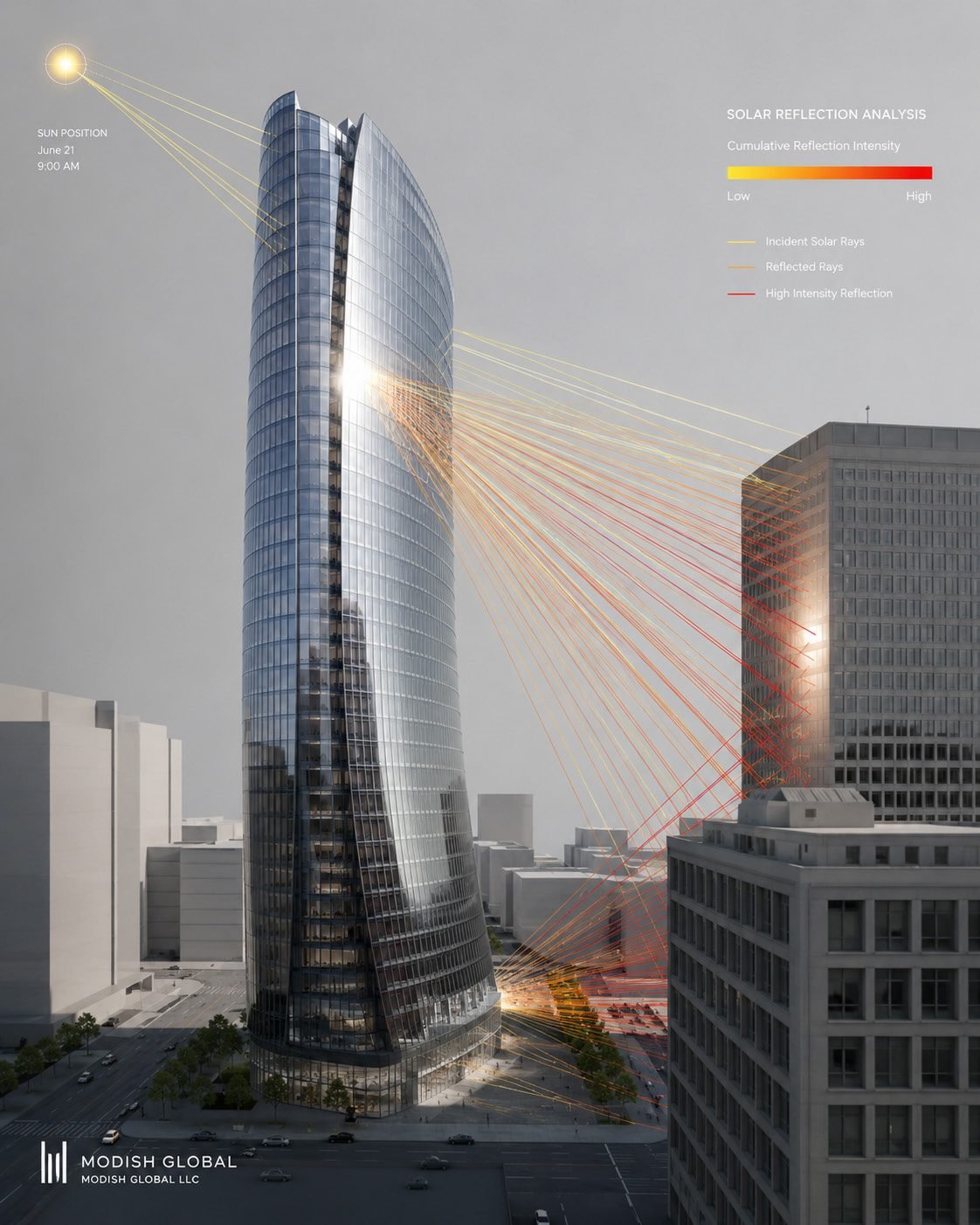
There are two distinct mechanisms by which a glass building harms the ground around it, and it is worth separating them cleanly. Specular reflection from flat glass is mirror-like. The angle of incidence equals the angle of reflection. It creates glare but does not concentrate energy. Convergent reflection from concave surfaces is a different animal entirely. The reflected rays converge toward a focal zone where energy density exceeds the incident irradiance by an order of magnitude. This is what melted the Jaguar. The curved building did not merely bounce the sun. It gathered the sun and aimed it.
But the flat facade is not innocent. Specular reflection from flat surfaces produces its own widespread harm. Directed beams cause disability glare, the optical condition that renders pedestrians and traffic signals invisible to drivers. Studies published in Solar Energy and in Building and Environment document glass facades producing reflected irradiance that exceeds disability glare thresholds at distances up to three hundred meters. The concave tower burns. The flat tower blinds. Between them they cover nearly every geometry the contemporary skyline offers, and neither harm appears anywhere in the calculations that permitted the building.
The Urban Heat Multiplier
Reflected solar radiation heats every surface it strikes. In dense glass canyon environments, reflected energy bounces between facades in what we call inter-building reflection, depositing energy into the urban heat island with each bounce. My research at MIT documented temperature differentials of four to seven degrees Celsius between streets flanked by glass curtain walls and streets flanked by masonry facades of equivalent height. The glass tower is not a neutral occupant of the city. It is an active contributor to the heat island, collecting solar energy on one surface and depositing it, concentrated, onto every adjacent surface.
I testified before the Sao Paulo municipal council showing that a single sixty-story glass tower on Avenida Faria Lima raised adjacent pavement temperatures by nine degrees Celsius during peak exposure. Combined with ambient temperatures near forty degrees, this produced pavement-level conditions exceeding the threshold for sustained pedestrian heat stress. The council commissioned a study. The study confirmed the data. The regulations that followed were modest. This is the pattern, repeated on three continents. The evidence arrives, it is verified, and the response falls short of the physics it was meant to address.
The Regulatory Void
No provision in the International Building Code requires solar reflection analysis. A developer can construct a fully compliant glass tower that produces disability glare on a highway and burns pedestrians on a neighboring sidewalk without a single code violation. This is worth stating plainly, because it defies the intuition of anyone who assumes that a harm this vivid must already be regulated. It is not. The beam is legal.
Some jurisdictions have acted. London now requires convergent analysis for curved facades, a direct inheritance of the Walkie Talkie. Singapore limits reflectivity. Sydney addresses reflected radiation in its planning framework. But these are exceptions carved out after visible failure, not a settled standard. Shadow studies are required virtually everywhere. Wind studies are required in most jurisdictions. But reflected solar radiation, which can melt cars, burn skin, and blind drivers, remains in most regulatory frameworks entirely invisible. We require a building to prove it will not cast an inconvenient shadow, and we ask nothing at all about whether it will cast a beam.
Tools That Already Exist
The absence of regulation cannot be blamed on the absence of tools. Autodesk, IES Virtual Environment, and the open-source Ladybug Tools can all model solar reflection paths with sub-meter precision. These are production tools, in daily use by the minority of firms that choose to perform reflection analysis and ignored by the majority, because no code requires it and no client demands it. The capability is sitting in the same software these firms already own to model daylight and shadow. Only the will to point it at the street is missing.
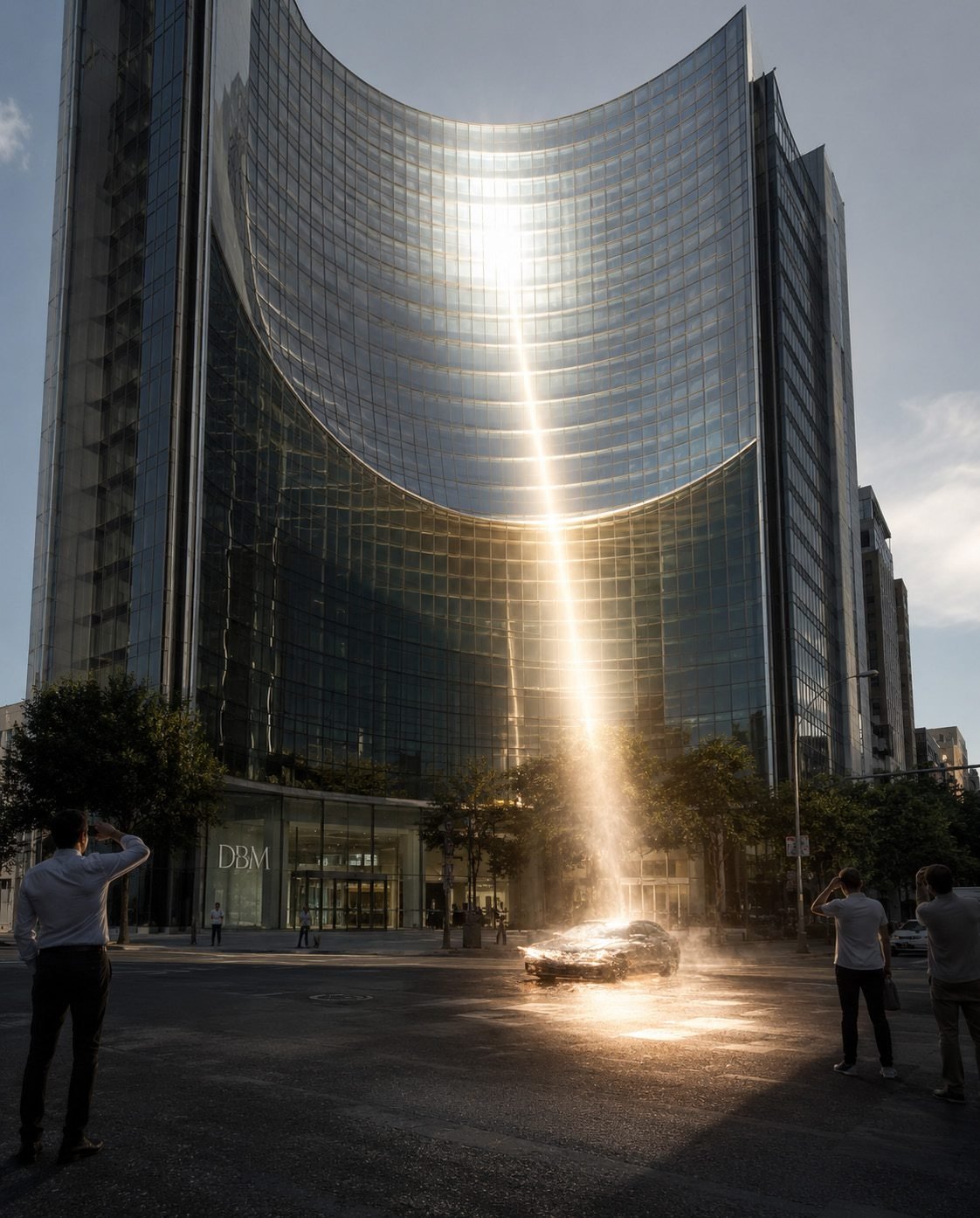
Cinematic architectural visualization, calibrated to physical light transport models, can go further still, simulating reflected behavior across seasonal cycles and producing photorealistic renderings of the actual conditions at street level. This matters more than engineers sometimes appreciate, because of how institutions respond. City councils do not act on irradiance tables. They act on images. Show a council a spreadsheet of watts per square meter and they will file it. Show them a photorealistic rendering of a melting car and a blinded driver, and they will convene a hearing. The image is the instrument of persuasion that the report has never managed to be.
The Honest Conclusion
Glass towers are beautiful. I do not dispute this, and I have never wanted to. What is not legitimate is the refusal to examine where beauty’s externalities land. Every reflective surface has two sides. The occupant sees the view. The street receives the beam. The architect designs for the occupant, and the pedestrian inherits what the architect did not model. This is not a failure of talent. It is a failure of accounting, a decision about whose experience counts as part of the design and whose does not.
The sun rises. The glass reflects. The beam lands where physics dictates, indifferent to intention and unmoved by acclaim. Beauty is not a defense. It is simply the reason no one looked down. Until we require a building to answer for the light it throws as rigorously as we require it to answer for the shadow it casts, we will keep discovering our failures the way London discovered its, on an ordinary afternoon, in the warping trim of a parked car that no one thought to model.
3D Transformative Digest — ISSN 3067-5510. Published by Modish Global Inc. © 2026 Modish Global Inc. All rights reserved. Licensed distribution only.
Leave a Reply